





Real Estate Development in UAE: Mastering Project Success from Feasibility to Handover
30 Mar 2026 • 13 min read

Umme Aimon Shabbir
Editor at First Bit


Real estate development in the UAE has become a high-stakes business process, not just a construction activity. One weak feasibility assumption, one missed approval, or one poorly managed handover can turn a profitable project into a long-term liability.
Dubai’s market is fast-moving but also heavily regulated. Escrow rules, project registration, licensing, and buyer protection measures shape how real estate development in Dubai projects are planned, sold, and delivered.
This guide breaks down the full lifecycle of property development in the UAE from feasibility to handover with a focus on what actually drives project success. It is written for professionals working in Dubai development real estate who want stronger control over cost, time, compliance, and delivery outcomes.
Regulatory and Legal Framework for Real Estate Development
Real estate development in the UAE operates within a structured legal environment designed to protect buyers, regulate developers, and enforce market transparency. In Dubai, this framework plays a direct role in how projects are registered, marketed, sold, and handed over.
In 2025, Dubai recorded AED 686.8 billion in total property sales across more than 215,000 transactions, reflecting the scale of activity where regulatory compliance becomes commercially critical[?].
For developers and contractors, the regulatory framework is not only a legal requirement. It directly affects licensing eligibility, project launch timelines, escrow access, and buyer confidence in real estate development Dubai projects. This is why compliance planning must begin before feasibility is finalized, not after construction starts.
Key Governing Authorities
Real estate development in Dubai is primarily regulated by the Dubai Land Department (DLD). The DLD oversees land registration, ownership documentation, project approvals, and compliance requirements for developers operating within the emirate. It acts as the central authority ensuring that real estate development Dubai projects meet legal and administrative standards.
The Real Estate Regulatory Agency (RERA) operates under the DLD and focuses on market transparency, licensing, and regulatory enforcement. RERA sets rules for developer registration, escrow compliance, broker licensing, and sales governance in property development activities.
Together, DLD and RERA shape how Dubai development real estate projects are launched, marketed, and delivered. Developers must align feasibility, registration, and sales strategies with these authorities to avoid delays, penalties, or project suspension.
Real Estate Licensing Requirements
Licensing is a mandatory first step in real estate development in Dubai. Developers must obtain the appropriate real estate activity license before launching or marketing any project. These licenses cover development, sales, brokerage, consulting, leasing, and other regulated activities.
The licensing process requires developers to establish a legal entity, register with relevant authorities, and meet compliance standards set by DLD and RERA. Financial capacity, documentation accuracy, and adherence to regulatory criteria are reviewed before approval.
Without proper licensing, developers cannot legally market units, register projects, or initiate off-plan sales. For real estate development Dubai projects, licensing is not a procedural formality; it is a foundational compliance requirement that directly affects project timelines and investor trust.
Pre-development Phase of Real Estate Development
The pre-development phase determines whether a project should proceed at all. In real estate development, decisions made during feasibility directly affect funding structure, licensing timelines, and long-term profitability.
For developers involved in Dubai development real estate, early-stage planning must account for demand cycles, regulatory approvals, infrastructure availability, and buyer preferences. Weak feasibility assumptions at this stage often lead to delays or capital strain later.
This phase connects financial modeling, legal checks, and land evaluation into one structured assessment before significant capital is deployed.
According to research from JLL, around 34,000 residential units were scheduled for delivery in Dubai in 2024, contributing to a broader housing supply of 42,000 units across Dubai and Abu Dhabi[?].
Land acquisition must also consider zoning regulations, permitted land use, infrastructure access, and master plan compatibility. Purchasing land without confirming planning compliance can delay approvals and increase holding costs in property development projects.
Project Registration & Escrow Setup
Project registration is mandatory before launching off-plan sales in real estate development Dubai. Developers must register their project through the DLD’s Oqood portal, submit the required documents, and obtain approval before marketing units.
Registration links each development to verified land ownership, approved plans, and compliance status. This step strengthens transparency and ensures that sales activity is tied to officially recognized projects.
For off-plan property development, developers must open a regulated escrow account. Buyer funds are deposited into this account and released based on certified construction progress, creating financial discipline within real estate development projects.
Build a successful business in the UAE
Launch your projects effortlessly with FirstBit ERP
Request a demo
Development Phase of Property Development

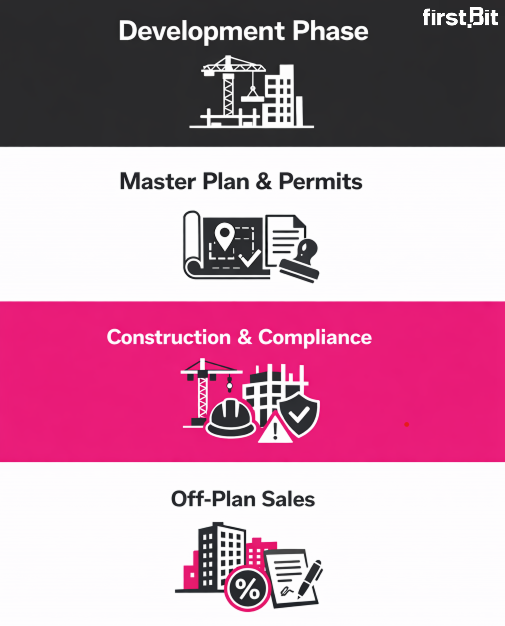
Development phase of property development
The development phase translates approved feasibility into physical execution. In real estate development, this stage involves detailed approvals, contractor mobilization, regulatory inspections, and ongoing financial oversight. It is where planning assumptions are tested against operational realities.
For projects in real estate development in Dubai, compliance remains continuous rather than one-time. Authorities monitor construction progress, escrow withdrawals, and adherence to approved plans throughout execution. Regulatory oversight continues until final certification is issued.
Execution discipline during this phase determines whether the project reaches handover on schedule and within budget. Weak coordination between planning, finance, and site management often results in cost overruns or approval delays.
Master Plan & Permits
Before construction begins, developers must secure approval of the project master plan from relevant authorities. The master plan confirms land use, layout, infrastructure integration, and compliance with planning standards.
Building permits are required before site mobilization can begin. Coordination with utility providers, civil defense, and infrastructure authorities is part of this process in property development projects. These approvals ensure safety, environmental, and zoning compliance.
Delays at the permit stage can disrupt financing schedules and contractor mobilization. In Dubai development real estate, structured approval tracking reduces administrative risk and supports smoother project execution.
Construction & Compliance
Construction is the most capital-intensive stage of real estate development. It requires strict coordination between contractors, consultants, suppliers, and regulatory authorities to maintain schedule, cost, and quality standards.
In real estate development Dubai, construction progress must align with approved master plans and escrow release conditions. Authorities monitor structural stages, safety compliance, and adherence to building regulations throughout execution.
Legal compliance during this phase includes honoring contractual obligations, maintaining transparent financial reporting, and meeting RERA and DLD requirements. In property development, failure to comply can result in penalties, work stoppages, or restrictions on future project launches.
Off-Plan Sales
Off-plan sales are a common financing mechanism in real estate development in Dubai. Developers may market and sell units before completion, but only after project registration and escrow requirements are in place.
In 2025, off-plan transactions accounted for 72.9% of total sales activity in Dubai, underscoring the market's reliance on forward pipeline delivery[?].
Pre-completion sales must follow regulated disclosure and documentation standards. Sales and Purchase Agreements define payment plans, timelines, and unit specifications, which makes contract discipline essential for property development delivery.
For developers, off-plan revenue improves cash flow but increases delivery accountability. Delays, design changes, or weak quality control can damage buyer confidence and future Dubai development real estate performance.
Post-development Phase of Real Estate Development Dubai
The post-development phase determines how smoothly a project transitions from construction to occupancy. In real estate development, this stage focuses on certification, legal transfer, financial settlement, and operational readiness. It is the final checkpoint before revenue realization is fully secured.
For projects in real estate development Dubai, compliance does not end at structural completion. Authorities verify that the project aligns with approved plans, safety codes, and infrastructure standards. Regulatory confirmation is required before formal handover can proceed.
A disciplined close-out process protects the developer's reputation and investor confidence. Weak documentation or delayed approvals at this stage can undermine the commercial success of even well-executed property development projects.
Project Completion & Handover
Before units can be occupied, developers must obtain completion certificates and final approvals from relevant authorities. These confirm that construction complies with approved plans, structural safety requirements, and municipal regulations. Formal certification marks the transition from development to occupancy readiness.
Unit registration and issuance of title deeds follow once compliance is verified. Ownership is formally recorded with the land department, completing the legal transfer process in Dubai development real estate transactions. Accurate documentation ensures smooth ownership transition and reduces post-handover disputes.
Structured handover procedures, including snagging inspections and final quality checks, are essential. Coordinated inspections between contractors, consultants, and authorities reduce warranty claims and strengthen buyer satisfaction in real estate development Dubai projects.
Escrow Closure & Financial Settlement
Escrow closure marks the financial completion of a project in real estate development Dubai. Once construction obligations are fulfilled and all buyer payments are reconciled, developers may initiate the formal process of closing the project escrow account.
Funds can only be released after compliance verification and confirmation that all contractual milestones have been achieved. This controlled mechanism protects buyers and ensures financial discipline within property development projects.
Final financial settlement also includes contractor payments, retention release, and reconciliation of variation accounts. Accurate financial documentation at this stage reduces audit exposure and supports credibility in future Dubai development real estate ventures.
Property & Facility Management
The lifecycle of real estate development does not end at handover. Post-completion management plays a critical role in maintaining asset value, operational efficiency, and investor returns.
In real estate development Dubai, developers must coordinate with owners’ associations, facility managers, and service providers to ensure maintenance standards are upheld. This includes infrastructure upkeep, utility management, and compliance with community regulations.
Strong post-handover management strengthens brand reputation and long-term buyer confidence. For large-scale property development projects, effective facility management supports sustained occupancy rates and stable asset performance.
Launch your business the smart way
Request a demo
FirstBit ERP for Real Estate Development: Streamlining Project Planning to Delivery
As real estate development projects move from feasibility to handover, financial coordination becomes increasingly complex. Multiple contractors, staged payments, escrow controls, and regulatory reporting create layers of administrative pressure. Structured financial systems help developers maintain oversight across each phase of delivery.
FirstBit ERP is an accounting and business management system used in the UAE that supports financial tracking and operational control. In the context of property development, it can assist with structured monitoring of budgets, commitments, and payments throughout the project lifecycle.
- Centralized financial management. Financial data such as project budgets, supplier invoices, and payment records can be maintained within one system. This reduces fragmentation and supports clearer financial oversight across real estate development Dubai projects.
- Budget vs. actual cost monitoring. Project costs can be tracked against approved budgets. This allows developers to identify variances early and take corrective action before overruns escalate.
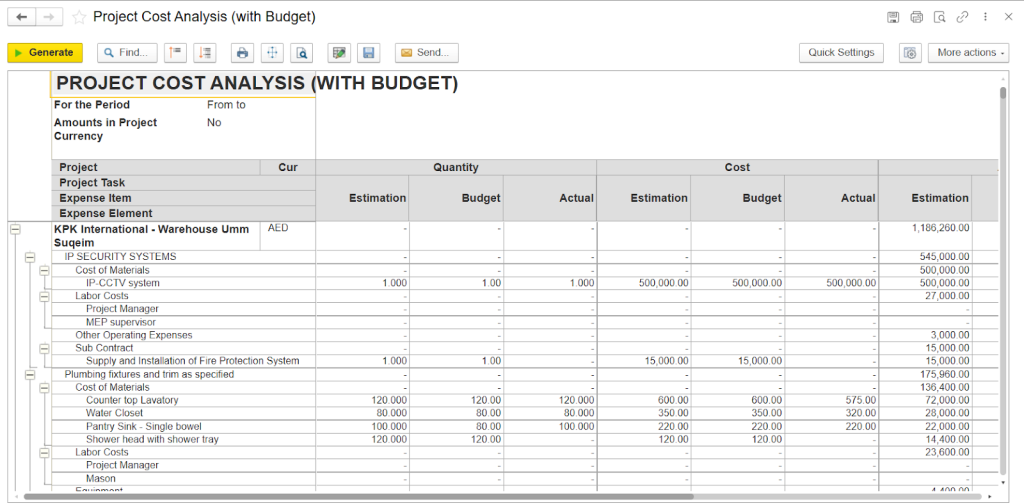
Project cost analysis in FirstBit ERP
- Procurement and vendor payment tracking. Purchase orders, supplier invoices, and payment schedules can be recorded systematically. This supports better control over commitments and improves transparency in contractor settlements.
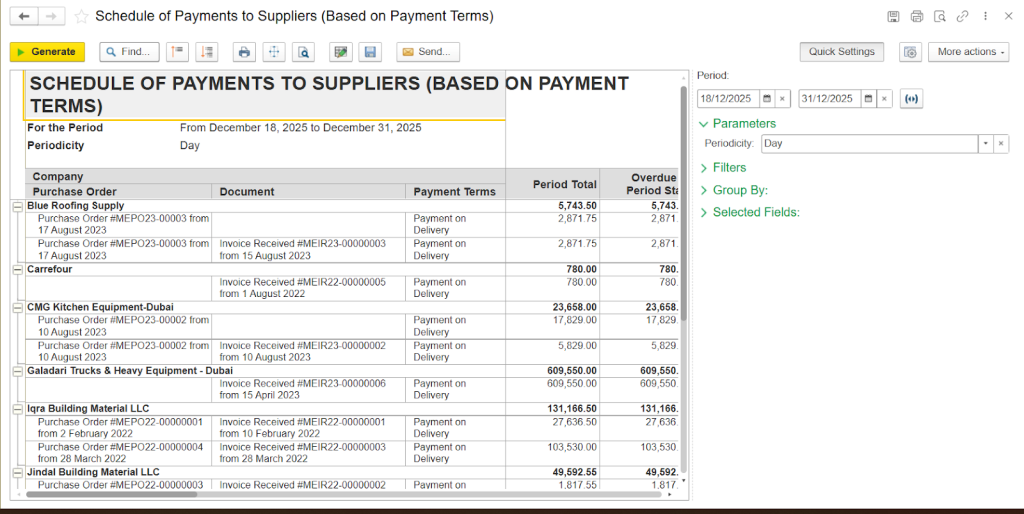
Payment schedule report in FirstBit ERP
- Escrow-linked financial visibility. Where projects involve escrow mechanisms, structured financial records help align certified progress with payment releases. This supports compliance in regulated Dubai development real estate environments.
- Project-level financial reporting. Reports can be generated at the project level to monitor cost, revenue, and margin performance. These insights support management review and strategic decision-making.
By supporting structured financial controls rather than altering contractual terms, ERP systems help reduce administrative risk in real estate development projects. For developers managing multiple projects simultaneously, consistent financial visibility strengthens operational discipline from planning through delivery.
Conclusion
The UAE’s regulatory structure and market scale have reshaped how real estate development is executed. Projects today operate within a tightly supervised environment where financial discipline, regulatory alignment, and delivery credibility matter as much as architectural design.
In real estate development Dubai, success increasingly depends on integration. Feasibility must align with licensing timelines, escrow controls must align with construction progress, and handover planning must begin long before completion. Fragmented execution is often the hidden cause of cost pressure and delivery delays.
Developers who approach property development as a connected lifecycle rather than isolated stages position themselves for stronger investor confidence and sustainable growth. In a competitive Dubai development real estate market, structured planning and disciplined execution remain the most reliable drivers of long-term project success.
Scale your business in the UAE
Optimize all your workflows with a single ERP system
Request a demo
FAQ
Who is the biggest real estate developer in Dubai?
What are the new developing areas in Dubai?
What is the 2% rule for property?
Who are the big four in real estate?

Umme Aimon Shabbir
Editor at First Bit
Share this article
'%3e%3cg%20clip-path='url(%23clip1_6548_6055)'%3e%3cpath%20d='M13.974%2015.6195C14.2724%2016.0185%2014.6532%2016.3487%2015.0905%2016.5876C15.5278%2016.8265%2016.0114%2016.9686%2016.5084%2017.0042C17.0055%2017.0398%2017.5043%2016.9681%2017.9712%2016.7939C18.4381%2016.6198%2018.8621%2016.3472%2019.2143%2015.9948L21.2994%2013.9098C21.9324%2013.2544%2022.2827%2012.3766%2022.2747%2011.4654C22.2668%2010.5543%2021.9014%209.68269%2021.257%209.03839C20.6127%208.39408%2019.7412%208.02862%2018.83%208.0207C17.9189%208.01278%2017.0411%208.36305%2016.3857%208.99606L15.1902%2010.1845M16.754%2014.2295C16.4555%2013.8305%2016.0747%2013.5003%2015.6374%2013.2614C15.2002%2013.0225%2014.7166%2012.8804%2014.2196%2012.8448C13.7225%2012.8092%2013.2237%2012.8809%2012.7568%2013.0551C12.2899%2013.2292%2011.8659%2013.5018%2011.5136%2013.8542L9.42861%2015.9392C8.7956%2016.5946%208.44534%2017.4724%208.45326%2018.3836C8.46117%2019.2947%208.82664%2020.1663%209.47094%2020.8106C10.1152%2021.4549%2010.9868%2021.8204%2011.898%2021.8283C12.8091%2021.8362%2013.6869%2021.4859%2014.3423%2020.8529L15.5308%2019.6645'%20stroke='%235F7896'%20stroke-width='1.39002'%20stroke-linecap='round'%20stroke-linejoin='round'/%3e%3c/g%3e%3c/g%3e%3crect%20x='0.438953'%20y='0.438953'%20width='28.9709'%20height='28.9709'%20rx='14.4855'%20stroke='%235F7896'%20stroke-width='0.877907'/%3e%3cdefs%3e%3cclipPath%20id='clip0_6548_6055'%3e%3crect%20width='29.8488'%20height='29.8488'%20rx='14.9244'%20fill='white'/%3e%3c/clipPath%3e%3cclipPath%20id='clip1_6548_6055'%3e%3crect%20width='16.6802'%20height='16.6802'%20fill='white'%20transform='translate(7.02344%206.58435)'/%3e%3c/clipPath%3e%3c/defs%3e%3c/svg%3e)


Related articles


See all








See FirstBit ERP solutions in action
Discover how our system solves the unique challenges of contractors in a personalized demo.
After the demo you will get a quotation for your company.
After the demo you will get a quotation for your company.