





AWP in Construction: The Complete Guide to Advanced Work Packaging
Publication date 13 Apr 2026 •
Updated 21 Jun 2026 •
12 min read

Umme Aimon Shabbir
Editor at First Bit


On most construction sites, delays don’t start with major failures; they begin with small interruptions. A crew arrives ready to work, but the drawings are incomplete, materials haven’t been delivered, or another team hasn’t finished their part. What should have been a productive day turns into waiting, rescheduling, and rework.
These issues are rarely caused by poor execution on-site. In most cases, the problem lies in how work is planned and handed over to the field. When tasks reach the site without being fully ready, even the most experienced teams struggle to maintain progress and efficiency.
This is where AWP in construction offers a different approach. Instead of pushing partially prepared work to execution, it focuses on ensuring that every construction work package is complete, sequenced, and ready before work begins. By aligning teams early, AWP construction helps turn unpredictable site conditions into controlled, reliable project outcomes.
AWP Construction Meaning
At its core, the AWP meaning is about planning construction work in a way that aligns directly with how it will be executed on site. Instead of treating engineering, procurement, and construction as separate phases, AWP construction connects them into one continuous workflow. This ensures that work moves forward without interruptions caused by missing inputs or poor coordination.
In practical terms, the AWP construction meaning is the process of breaking a project into structured and manageable scopes called work packages. Each construction work package is clearly defined, sequenced, and prepared with all required inputs before it reaches the field. This shifts the focus from reacting to issues on-site to preventing them during planning.
Unlike traditional approaches, where planning is often disconnected from execution, AWP construction is driven by the Path of Construction. This means work is planned based on how it will actually be built, ensuring better coordination between teams and fewer delays during execution.
Research based on Construction Industry Institute (CII) case studies shows that AWP has been reported to improve productivity by up to 25% and reduce total installed cost by up to 10%[?].
AWP Work Package Hierarchy

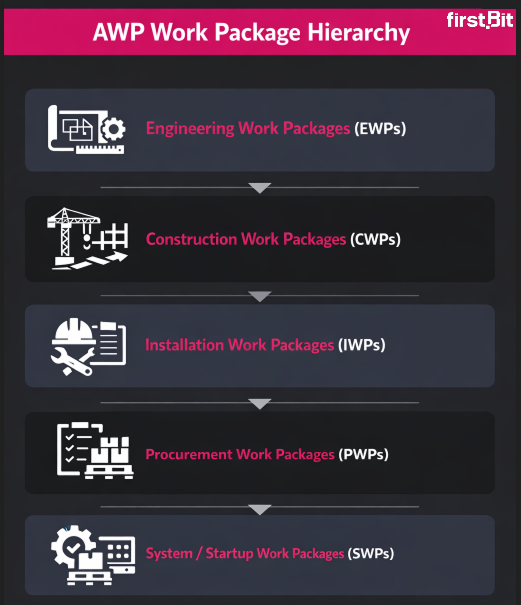
AWP work package hierarchy
A key part of AWP construction is its structured hierarchy of work packages that connects design, procurement, and execution. Instead of managing the project as one large scope, the work is divided into clearly defined levels that align with how construction will actually progress. This ensures that every construction work package is created with execution in mind.
The hierarchy in AWP construction meaning is not just about breaking work into smaller pieces. It ensures that each level feeds the next with complete and accurate information, reducing miscommunication between teams. This structured flow helps prevent delays caused by missing inputs or unclear scope during execution.
At a high level, the AWP hierarchy includes Engineering Work Packages (EWPs), Construction Work Packages (CWPs), Installation Work Packages (IWPs), and supporting packages such as PWPs and SWPs. Each plays a specific role in translating planning into executable work on site.
Engineering Work Packages (EWPs)
Engineering Work Packages define the design scope required for construction. They organize drawings, specifications, and technical details into structured deliverables that support downstream planning. In AWP construction, EWPs ensure that engineering outputs are aligned with how the project will actually be built.
These packages act as the starting point for creating accurate construction work packages. If engineering deliverables are incomplete or misaligned, it directly impacts execution on site. This is why EWPs must be developed with construction sequencing in mind.
Construction Work Packages (CWPs)
A construction work package defines a logical and manageable scope of work aligned with the Path of Construction. CWPs are structured based on execution priorities, ensuring that work is sequenced correctly and dependencies are clearly identified.
In AWP construction, CWPs act as the bridge between planning and execution. They group tasks into workable sections, allowing teams to plan labor, materials, and timelines more effectively. This improves coordination and reduces disruptions during construction.
Installation Work Packages (IWPs)
Installation Work Packages provide the final level of detail required for field execution. They include all necessary inputs such as drawings, materials, tools, and permits required by crews. In AWP construction, IWPs ensure that work can begin without constraints.
Each IWP is released only when all prerequisites are met. This means crews are not waiting for information or materials once work starts. As a result, productivity improves and site-level inefficiencies are reduced.
Other Work Packages (PWPs, SWPs)
Procurement Work Packages (PWPs) ensure that materials are sourced and delivered in alignment with each construction work package. This prevents delays caused by late or mismatched deliveries and keeps execution on track.
System/Startup Work Packages (SWPs) support commissioning and handover activities. They ensure that systems are tested and completed in a structured manner. Together, these packages connect procurement and commissioning with the overall AWP framework.
The Construction Industry Institute (CII) highlights that AWP improves project predictability by ensuring that work packages are constraint-free before execution, reducing delays caused by missing information or materials[?].
This is why the hierarchy of AWP construction meaning is essential. By structuring work into clearly defined levels, AWP ensures that every construction work package is complete, coordinated, and ready for execution. This approach improves workflow reliability and supports consistent project performance.
Achieve peak productivity on site
Manage teams, equipment, and materials in FirstBit ERP
Request a demo
AWP Construction Implementation Roadmap
Implementing AWP in construction is not a one-time step but a structured approach that starts early and continues throughout the project lifecycle. It focuses on preparing work before it reaches the site, ensuring that every construction work package is fully defined, sequenced, and ready for execution. This reduces uncertainty and improves coordination across teams.
A strong implementation roadmap aligns engineering, procurement, and construction around a single execution strategy. Instead of working in silos, teams follow a shared plan driven by how the project will actually be built. This is what makes AWP construction meaning practical and effective in real-world projects.
Early Project Setup
The foundation of AWP construction is established during the early planning phase. This includes defining the Path of Construction, identifying work areas, and aligning project scope with execution strategy. Early decisions shape how efficiently the project will be delivered, often supported by ERP systems that help centralize planning data and coordinate stakeholders.
If AWP is introduced late, teams often struggle to realign plans with execution needs. Starting early ensures that engineering and procurement are guided by construction priorities, reducing delays and rework during later stages. This approach further is strengthened by adopting the best ERP solutions in the UAE to enable better integration, visibility, and control across the project lifecycle.
According to Project Management Institute (PMI) research, engineering decisions can determine up to 80% of total project cost, highlighting the importance of early planning and alignment[?].
Organizational Alignment and Roles
Successful AWP construction depends on strong organizational alignment and clearly defined roles. Leadership must support the approach and ensure that all teams follow the same execution strategy. Without this, even well-defined work packages can fail during implementation.
Planners, engineers, procurement teams, and site managers must work collaboratively. Each role contributes to ensuring that every construction work package is complete and constraint-free before execution begins. Clear communication is essential to maintain consistency.
Planning and Sequencing of Work Packages
Sequencing is central to AWP construction, meaning that work must be planned based on actual site execution rather than design convenience. This ensures that dependencies are resolved before work begins, reducing bottlenecks during construction.
Aligning EWPs, CWPs, and IWPs with the Path of Construction creates a smooth workflow. It allows teams to move from one activity to the next without unnecessary delays, improving overall schedule reliability and productivity.
Data and Technology Integration
AWP relies on accurate and real-time data to function effectively. Integrated digital platforms help manage work packages, track progress, and identify constraints before they impact execution. This improves visibility across all stages of the project.
Cloud-based systems ensure that all stakeholders are working with the latest information. In AWP construction, this reduces miscommunication and supports better decision-making, especially when managing multiple construction work packages across teams.
This roadmap shows that AWP construction is not just about planning but about creating a system where work is always ready before execution. By aligning early decisions, team roles, and data systems, projects become more predictable and easier to manage.
Best Practices for Effective Use of the Construction Work Package
Successfully applying AWP construction requires more than just defining work packages. It depends on how consistently teams follow structured planning, coordination, and execution practices throughout the project lifecycle. When done correctly, each construction work package becomes a reliable unit of work that can be executed without delays.
These best practices ensure that AWP construction meaning is translated into real on-site results. They help teams stay aligned, improve visibility, and maintain control over execution. Without these practices, even well-structured work packages can fail to deliver expected outcomes.
Start Early and Integrate from Planning
One of the most important principles in AWP construction is starting early. Integrating AWP during the planning phase ensures that engineering, procurement, and construction teams are aligned from the beginning. This reduces disconnects that typically appear later in execution.
Early integration allows teams to identify constraints before they impact the schedule. It ensures that every construction work package is complete and ready before reaching the field. This improves execution reliability and minimizes disruptions on-site.
Use Integrated Digital Tools
Digital tools play a critical role in supporting AWP construction meaning by providing real-time visibility into project data. They allow teams to track each construction work package, monitor progress, and identify issues early. This helps maintain alignment across all project stakeholders.
Integrated systems ensure that teams are working with consistent and updated information. In AWP construction, this reduces errors caused by miscommunication and improves overall coordination between planning and execution.
Continuous Improvement
AWP should be treated as a continuous process rather than a one-time setup. Teams must regularly review performance and refine their approach based on actual project outcomes. This ensures that planning methods evolve and improve over time.
By analyzing completed work packages, teams can identify gaps and apply lessons learned to future activities. This continuous improvement approach strengthens the effectiveness of AWP construction and supports more predictable project delivery.
Ensure timely and profitable project completion with FirstBit ERP
Request a demo
FirstBit ERP in AWP Construction: Real-Time Control for Predictable Project Outcomes
While AWP construction provides the framework for planning and execution, its effectiveness depends on how well project data is managed across teams. Without clear visibility into costs, resources, and progress, even well-defined work packages can face delays or misalignment. This is where FirstBit ERP supports the practical implementation of AWP construction meaning.
planning and execution by centralizing financial and operational data. It enables teams to manage each construction work package with better control, ensuring that planning decisions are supported by real-time insights. This improves coordination and strengthens overall project performance.
Key capabilities of FirstBit ERP in AWP construction:
- Centralized project data management. Brings financial, procurement, and operational data into one system, ensuring all teams work with consistent and updated information.
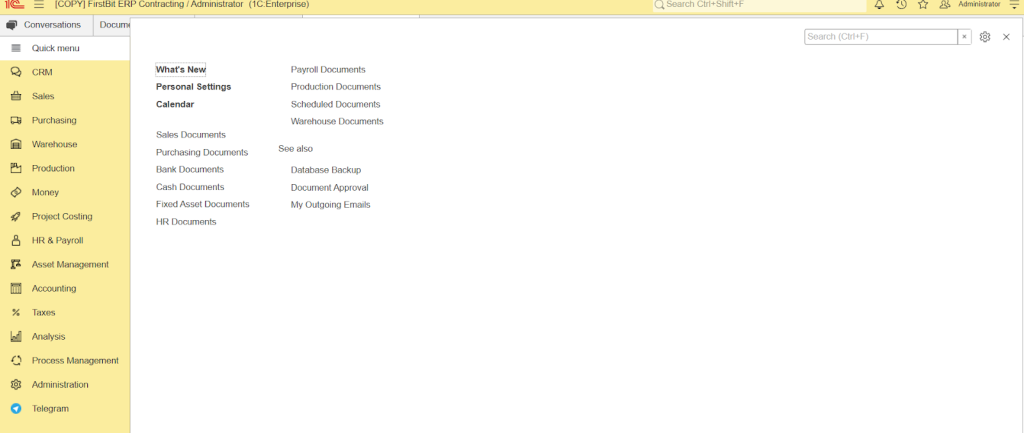
Manager Dashboard in FirstBit ERP
- Real-time cost tracking. Allows teams to monitor project costs as work progresses, helping maintain alignment between budget and execution.
- Budget control and variance analysis. Supports tracking planned vs actual costs, enabling early identification of deviations within each construction work package.
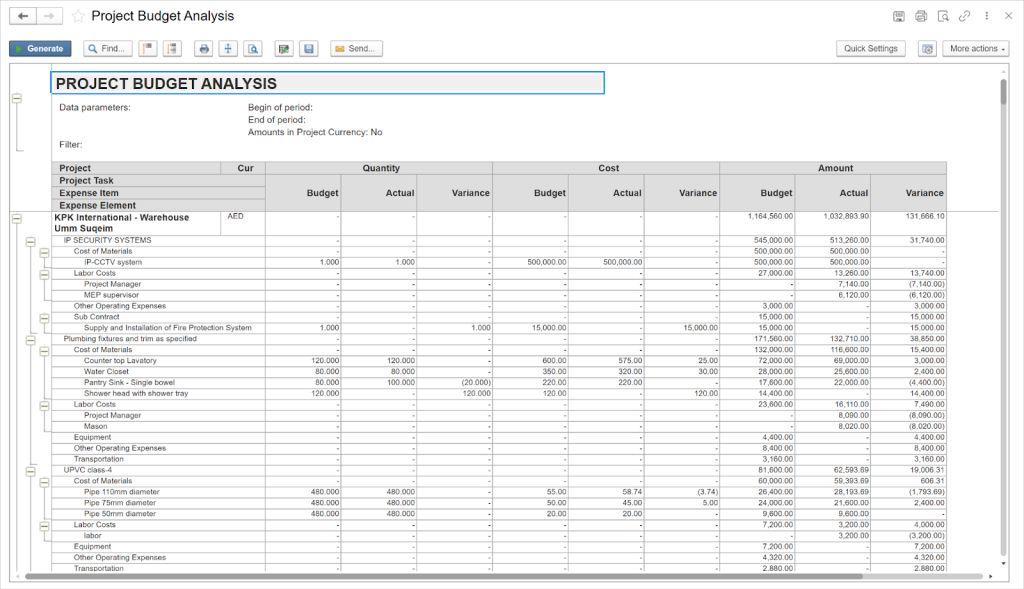
Project budget analysis in FirstBit ERP
- Procurement and material visibility. Helps track material availability and procurement status, reducing delays caused by missing or late deliveries.
- Integration with project workflows. Aligns financial data with project activities, supporting better coordination between planning and on-site execution.
- Reporting and performance insights. Provides structured reports that help teams evaluate progress, identify risks, and make informed decisions.
These capabilities support the core objective of AWP construction, which is to ensure that work is fully prepared before execution. By improving visibility and control, FirstBit ERP helps teams manage each construction work package more effectively.
In practice, FirstBit ERP does not replace AWP processes but enhances them by strengthening data accuracy and coordination. This allows organizations to implement AWP construction meaning more effectively and achieve more predictable and controlled project outcomes.
Conclusion
AWP brings a level of structure to construction projects that is often missing in traditional approaches. It encourages teams to think beyond immediate tasks and focus on how work should flow from planning to execution. This shift helps create a more disciplined and organized project environment.
What makes AWP construction effective is not just the breakdown into work packages, but the clarity it brings to decision-making. When teams understand what needs to be done, when it should be done, and what is required to complete it, execution becomes more controlled and less reactive. This clarity is what supports consistent project performance.
At the same time, the success of AWP construction meaning depends on how well it is applied in practice. Tools, processes, and team alignment all play a role in ensuring that each construction work package delivers the intended value. Without this consistency, even the best frameworks can fall short.
Build a successful business in the UAE
Launch your projects effortlessly with FirstBit ERP
Request a demo
FAQ
What is AWP in construction in simple terms?
What are the core goals and key benefits of implementing AWP?
What Key Performance Indicators (KPIs) are used to measure AWP success?

Umme Aimon Shabbir
Editor at First Bit
Share this article
'%3e%3cg%20clip-path='url(%23clip1_6548_6055)'%3e%3cpath%20d='M13.974%2015.6195C14.2724%2016.0185%2014.6532%2016.3487%2015.0905%2016.5876C15.5278%2016.8265%2016.0114%2016.9686%2016.5084%2017.0042C17.0055%2017.0398%2017.5043%2016.9681%2017.9712%2016.7939C18.4381%2016.6198%2018.8621%2016.3472%2019.2143%2015.9948L21.2994%2013.9098C21.9324%2013.2544%2022.2827%2012.3766%2022.2747%2011.4654C22.2668%2010.5543%2021.9014%209.68269%2021.257%209.03839C20.6127%208.39408%2019.7412%208.02862%2018.83%208.0207C17.9189%208.01278%2017.0411%208.36305%2016.3857%208.99606L15.1902%2010.1845M16.754%2014.2295C16.4555%2013.8305%2016.0747%2013.5003%2015.6374%2013.2614C15.2002%2013.0225%2014.7166%2012.8804%2014.2196%2012.8448C13.7225%2012.8092%2013.2237%2012.8809%2012.7568%2013.0551C12.2899%2013.2292%2011.8659%2013.5018%2011.5136%2013.8542L9.42861%2015.9392C8.7956%2016.5946%208.44534%2017.4724%208.45326%2018.3836C8.46117%2019.2947%208.82664%2020.1663%209.47094%2020.8106C10.1152%2021.4549%2010.9868%2021.8204%2011.898%2021.8283C12.8091%2021.8362%2013.6869%2021.4859%2014.3423%2020.8529L15.5308%2019.6645'%20stroke='%235F7896'%20stroke-width='1.39002'%20stroke-linecap='round'%20stroke-linejoin='round'/%3e%3c/g%3e%3c/g%3e%3crect%20x='0.438953'%20y='0.438953'%20width='28.9709'%20height='28.9709'%20rx='14.4855'%20stroke='%235F7896'%20stroke-width='0.877907'/%3e%3cdefs%3e%3cclipPath%20id='clip0_6548_6055'%3e%3crect%20width='29.8488'%20height='29.8488'%20rx='14.9244'%20fill='white'/%3e%3c/clipPath%3e%3cclipPath%20id='clip1_6548_6055'%3e%3crect%20width='16.6802'%20height='16.6802'%20fill='white'%20transform='translate(7.02344%206.58435)'/%3e%3c/clipPath%3e%3c/defs%3e%3c/svg%3e)


Related articles


See all








See FirstBit ERP solutions in action
Discover how our system solves the unique challenges of contractors in a personalized demo.
After the demo you will get a quotation for your company.
After the demo you will get a quotation for your company.