As construction companies in the UAE digitize operations, they’re collecting more personal data than ever from employee records and subcontractor details to client communications. This makes compliance with the UAE Data Protection Law (PDPL) and General Data Protection Regulation (GDPR) essential to ensure that information is managed securely and transparently.
According to the UAE Digital Government, the PDPL (Federal Decree-Law No. 45 of 2021) is the country’s first comprehensive federal data protection law, designed to align with international standards like the GDPR[?].
For construction firms, data protection law in the UAE and GDPR compliance in the UAE extend beyond avoiding penalties; they safeguard sensitive project data, maintain client trust, and ensure the ethical handling of information across all business processes.
This guide breaks down PDPL and GDPR obligations for UAE construction businesses, explaining key principles, compliance steps, and how
FirstBit ERP supports secure, automated data management to simplify adherence.
Importance of Data Protection Law
Construction companies manage extensive personal and operational data from employee information and payroll details to supplier contracts and project documentation. The UAE Data Protection Law (PDPL) and General Data Protection Regulation (GDPR) establish the standards that govern how this information must be processed, stored, and shared.
The UAE Cybersecurity Council reported that it intercepts over 200,000 cyberattacks daily targeting national sectors, reinforcing the urgency for businesses to strengthen data protection and compliance measures[?].
For construction firms, compliance with the data protection law in UAE is both a legal and operational safeguard. Projects involve multiple subcontractors and vendors exchanging personal and contractual data daily, making them particularly vulnerable to unauthorized access and misuse.
The PDPL mandates strict controls over who accesses this data, how long it’s retained, and how securely it’s stored. At the same time, GDPR compliance in the UAE ensures that companies working with European partners or clients maintain international privacy standards.
Together, these regulations help firms minimize legal exposure, prevent data misuse, and maintain client trust, which is essential in an industry where reputation and accountability drive long-term success.
Legal Foundations and Applicability
Data protection laws define how organizations collect, process, and share personal data, and in the UAE, two primary frameworks govern this space: the UAE Data Protection Law (PDPL) and the General Data Protection Regulation (GDPR).
While both share similar principles, their applicability depends on where data subjects are located and how the information is processed.
For UAE construction firms, understanding these foundations is essential. Companies routinely handle sensitive personal data belonging to employees, subcontractors, consultants, and international clients. Knowing which law applies and when helps prevent compliance errors that could lead to penalties or loss of trust.
Lawful bases for PDPL and GDPR
| Lawful basis | Under PDPL | Under GDPR UAE |
| Consent | Explicit permission from individuals (e.g., sharing contact or ID details with a subcontractor) | Required for optional processing (e.g., marketing, tracking, or voluntary data sharing). |
| Contractual Necessity / Contract | Processing necessary to fulfill an employment or service contract (e.g., payroll, attendance tracking). | Applies to employee management, supplier dealings, and project contracts. |
| Legal obligation | Required for compliance with UAE laws (e.g., labor, tax, or safety regulations). | Required for compliance with EU or UAE laws (e.g., record-keeping, reporting). |
| Public interest | For activities serving public safety or emergency response (e.g., incident management). | Not explicitly separate under GDPR, but may fall under “Legal Obligation” or “Legitimate Interests” depending on context. |
| Legitimate interests | For limited business purposes where data use does not override individual rights (e.g., access control or security). | For internal auditing, fraud prevention, or dispute resolution, provided privacy rights are respected. |
ERP tailored to UAE legislation
Navigate UAE construction laws effortlessly
Request a demo
UAE Data Protection Law (PDPL) — Key Concepts
The UAE Data Protection Law (PDPL), issued under Federal Decree-Law No. 45 of 2021, serves as the country’s first comprehensive privacy framework
[?]. It standardizes how personal data is collected, stored, and transferred, ensuring consistency across all sectors, including construction.
Scope and Applicability
The PDPL applies to data controllers and processors operating within the UAE, as well as entities located outside the country that process the personal data of UAE residents
[?]. This means even international construction consultants or project offices managing UAE project data are subject to compliance.
However, the law exempts specific entities and activities, including:
Government bodies, public entities, and judicial or security authorities.
Organizations within the UAE free zones that have their own data protection regimes, such as DIFC and ADGM.
Data processed for national security, defense, or law enforcement purposes.
Core Principles of PDPL
The PDPL is built on several key principles that mirror global privacy frameworks like the GDPR:
Lawfulness and fairness. Data must be collected and used for legitimate, transparent purposes.
Purpose limitation. Information should only be used for the specific purpose it was collected (e.g., worker attendance tracking, payroll).
Data minimization. Collect only what is necessary for operations.
Integrity and confidentiality. Personal data must be safeguarded against unauthorized access or misuse.
Storage limitation. Data should be retained only as long as needed for business or legal reasons.
Relevance for Construction Firms
For construction companies, PDPL compliance affects both administrative and on-site operations. Worker registration, biometric access systems, CCTV footage, and safety records all fall within the law’s scope. Firms must:
Notify individuals about how their data will be used.
Securely store HR and subcontractor data with encryption or restricted access.
Maintain detailed records of who accesses data and for what purpose.
By aligning with the PDPL, construction businesses not only fulfill regulatory obligations but also demonstrate accountability, strengthening client confidence and reducing risks tied to data misuse.
General Data Protection Regulation GDPR UAE — Key Concepts
While the UAE Data Protection Law (PDPL) governs domestic data use, the
General Data Protection Regulation (GDPR) applies when UAE-based companies handle the personal data of individuals located in the European Union. For many construction firms, this occurs when collaborating with EU consultants, investors, or technology vendors.
Scope and Applicability
The GDPR has extraterritorial reach, meaning it applies to any organization, even outside the EU, that processes EU residents’ data or offers them goods or services.
In a UAE construction context, this could include:
HR departments processing personal data of EU staff or consultants,
Project management teams sharing site data with EU-based engineering firms, or marketing teams communicating with EU clients and suppliers.
Core Principles of GDPR
The GDPR’s foundation is built on seven principles, which overlap closely with the PDPL but with stricter accountability requirements:
Lawfulness, fairness & transparency. Personal data must be processed openly and for legitimate purposes
[?].
Purpose limitation. Data collected for one reason (e.g., recruitment) cannot be used for another without consent
[?].
Data minimization. Only necessary personal data should be collected
[?].
Accuracy. Information must be kept up to date.
Storage limitation. Data should not be retained indefinitely.
Integrity & confidentiality. Data must be secured against unauthorized access or loss.
Accountability. Companies must be able to demonstrate compliance through documented processes and audits.
Relevance for Construction Firms
Construction companies in the UAE often engage in international projects that involve cross-border communication and data exchange. Under GDPR compliance in the UAE, even project documentation or subcontractor data shared with an EU partner qualifies as “processing.”
To comply, firms must:
Obtain explicit consent when collecting data from EU residents.
Maintain processing records detailing what data is stored and why.
Use secure transfer mechanisms when sharing information outside the UAE.
Respond promptly to data subject requests such as access, correction, or deletion.
These requirements ensure that construction businesses operating internationally maintain transparency, avoid penalties, and build trust with EU-based partners and clients.
Stay fully compliant with the latest UAE laws and regulations
Request a demo
Data Subject Rights and Processing Obligations for GDPR and PDPL
Both the UAE Data Protection Law (PDPL) and the General Data Protection Regulation (GDPR) give individuals control over how their personal data is used. For construction companies, this means employees, subcontractors, and clients have defined legal rights over the data collected about them from attendance records and payroll files to CCTV footage and project documentation.
The UAE Personal Data Protection Law (PDPL) establishes key rights for individuals, including access, correction, erasure, and objection, ensuring alignment with international privacy frameworks such as the GDPR[?].
Meeting these obligations requires construction firms to design clear processes for handling data requests, verifying consent, and ensuring secure data retention. These systems must also log requests and responses to demonstrate compliance during audits or investigations.
Rights under PDPL
The PDPL outlines several rights that companies must uphold whenever they process personal information:
Access. Individuals can request copies of their personal data (e.g., HR records, site access logs)
[?].
Correction. Inaccurate or outdated data must be updated promptly.
Erasure. Data must be deleted once it’s no longer required for contractual or legal reasons.
Objection. Individuals can object to non-essential processing activities such as marketing or profiling.
Portability. Employees and contractors can request that their personal data be transferred securely to another entity.
In a construction context, these rights apply to:
Employee data is stored in payroll or attendance systems.
Worker records captured through biometric or access-control devices.
Subcontractor and client details shared across project management platforms.
To comply, firms should maintain data request logs, define response timelines, and train HR and administrative staff on handling these requests appropriately.
Rights under GDPR UAE
Under GDPR compliance in the UAE, individuals in the EU have a comparable but broader set of rights, including:
Right to erasure (“Right to Be Forgotten”). Data must be deleted upon request unless legally required for record-keeping
[?].
Data portability. Firms must provide personal data in a readable format when a transfer request is made.
Restriction and objection. Data subjects can limit or object to processing based on legitimate interest or marketing activities.
Profiling and automated decisions. Companies using AI-based analytics, automated payroll, or risk assessment tools must ensure human review before making impactful decisions.
Non-compliance with these obligations can lead to complaints or fines from EU supervisory authorities, even for UAE-based organizations. Construction companies working with European clients or partners must ensure internal workflows are capable of responding to such requests within one month, as required by GDPR.
Cross-Border Data Transfers
In construction, projects often involve global collaboration. Design consultants in Europe, engineering teams in Asia, and contractors in the GCC regularly exchange digital drawings, HR information, and financial data. When this data includes personal details such as employee IDs, site photos, or client information, companies must comply with strict cross-border data transfer rules under both PDPL and GDPR.
These regulations ensure that personal data leaving the UAE or the EU remains protected to the same standard as if it never left the country. Non-compliance can lead to penalties, data loss, and reputational damage, especially when managing high-value government or infrastructure contracts.
PDPL Rules for Data Transfers Outside the UAE
The UAE Data Protection Law (PDPL) allows international data transfers only when the recipient country or organization offers adequate protection equivalent to the UAE’s legal framework.
Transfers are permitted when:
The UAE Data Office confirms that the destination country has adequate safeguards.
The data subject has provided explicit consent.
The transfer is necessary to fulfill a contract with the data subject (for example, paying an overseas employee or consultant).
The transfer is required for public interest or legal claims.
For construction companies, this often applies when:
Sending payroll or HR data to international head offices.
Sharing project drawings with offshore design or tender teams.
Backing up data to global cloud providers.
Before initiating such transfers, companies should conduct transfer impact assessments (TIAs) and include data protection clauses in contracts with third-party vendors or consultants. These measures provide documented proof that personal data remains secure once it leaves the UAE.
GDPR Mechanisms for International Data Transfers
The GDPR sets equally rigorous requirements for data leaving the EU. It permits transfers only when:
The recipient country benefits from an EU adequacy decision (confirming its privacy laws offer adequate protection).
Standard Contractual Clauses (SCCs) or Binding Corporate Rules (BCRs) are in place.
The data subject gives explicit consent after being informed of potential risks.
For UAE-based construction firms partnering with EU clients or consultants, this means that data shared for tenders, joint projects, or design coordination must include an approved transfer mechanism. Many firms rely on
cloud platforms that host data in multiple regions, so verifying whether these providers comply with GDPR UAE standards is crucial.
To ensure compliance, companies should:
Verify their cloud or ERP vendor’s transfer safeguards.
Maintain signed copies of SCCs or contractual addenda.
Review transfer arrangements annually as regulations evolve.
When applied correctly, these mechanisms help UAE construction businesses operate seamlessly across borders without violating either PDPL or GDPR compliance requirements.
Protect your rights under UAE law
Manage contracts efficiently with FirstBit
Request a demo
What Is PDPL Compliance?
For construction firms, this law applies to every stage of information management from worker registration and payroll to client communication and vendor coordination. Because these operations often involve multiple third parties, maintaining control over data flow and ensuring secure storage is critical.
Core Obligations Under PDPL
To comply with the UAE’s data protection law, organizations must implement both legal and technical measures, including:
Obtain lawful consent before collecting or processing personal data, unless another legal basis applies (e.g., contract or public interest)
[?].
Notify individuals (data subjects) about how their information will be used, with whom it will be shared, and for how long it will be stored.
Maintain records of processing activities (data type, purpose, recipients, storage location, and retention period).
Implement security measures such as encryption, access controls, and secure backups to prevent unauthorized use or breaches.
Allow individuals to exercise their rights, including access, correction, deletion, and objection to data processing.
Appoint a Data Protection Officer (DPO) if the company handles high-risk or large-scale data (e.g., biometric site access, surveillance systems).
Report data breaches immediately to the UAE Data Office, detailing the impact, affected individuals, and corrective actions taken.
Ensure lawful cross-border transfers by verifying adequate protection in the recipient country or obtaining explicit consent.
In simple terms, PDPL compliance is about accountability and prevention, ensuring that every personal data point is collected for a legitimate reason, processed transparently, and protected through appropriate safeguards.
For UAE construction companies, these obligations translate into real-world actions: defining data-handling procedures for site workers, controlling subcontractor access to employee information, and ensuring that all digital project records are stored securely and lawfully.
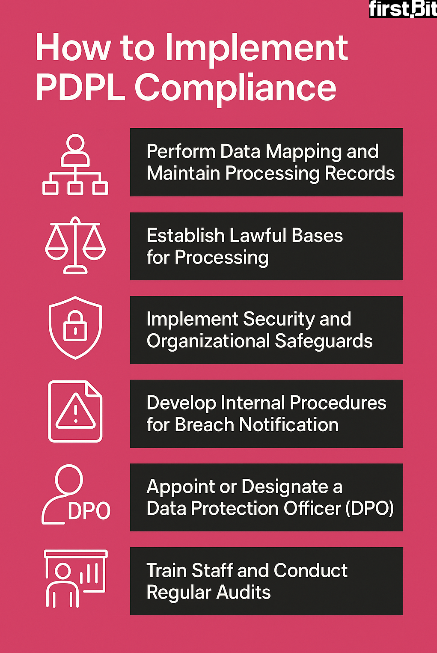
How to Implement PDPL Compliance
Steps to implement PDPL compliance
Achieving compliance with the UAE Personal Data Protection Law (PDPL) requires a structured approach. Construction firms handle large volumes of personal data from employee IDs and payroll details to subcontractor agreements and CCTV footage, making it essential to apply privacy principles systematically across all operations.
Below is a step-by-step roadmap adapted for the UAE construction sector.
1. Perform Data Mapping and Maintain Processing Records
The first step in implementing PDPL compliance is identifying what personal data your company collects, where it is stored, and how it is shared.
Creating a Register of Processing Activities (RoPA) provides this visibility. It should document:
The data categories (e.g., worker details, client contact info, project site logs)
The purpose of processing
Data recipients (subcontractors, consultants, vendors)
Storage location and retention period
This mapping not only supports compliance audits but also helps reduce unnecessary data retention, a common issue in construction firms managing multiple software systems.
Pro Tip: Use a centralized ERP or project management platform to integrate data mapping with your existing workflows. It minimizes duplication and ensures updates occur automatically when records change.
2. Establish Lawful Bases for Processing
Every instance of personal data use must have a valid justification under PDPL. Typical lawful bases in construction include:
Contractual necessity. Managing employee records, issuing payments, or handling site access.
Legal obligations. Compliance with UAE
labor, safety, or tax laws.
Consent. Required when collecting optional data (e.g., health surveys or marketing communications).
By clearly linking each data activity to its legal basis, firms demonstrate accountability and minimize the risk of unlawful processing.
Pro Tip: Create a quick-reference chart linking each data category (e.g., CCTV footage, payroll info, visitor logs) with its lawful basis and retention period. This simplifies audits and staff training.
3. Implement Security and Organizational Safeguards
PDPL compliance depends heavily on protecting data integrity. Construction companies should establish both technical and procedural controls, such as:
Encryption of personal records and cloud backups.
Role-based access control to limit exposure of sensitive information.
Regular security audits of ERP, HR, and document management systems.
Vendor due diligence to ensure subcontractors follow the same security standards.
Pro Tip: Review user-access permissions quarterly. Many breaches occur simply because former employees or temporary contractors still have active credentials.
4. Develop Internal Procedures for Breach Notification
Under PDPL, breaches must be reported immediately to the UAE Data Office once discovered. To prepare, firms should define:
Who investigates and reports a breach.
How are affected individuals notified?
What corrective actions are taken to limit damage?
Having predefined escalation paths ensures consistent responses even across multiple project sites.
Pro Tip: Run a breach-response simulation at least once a year. It helps teams understand timelines, responsibilities, and documentation requirements before a real incident occurs.
5. Appoint or Designate a Data Protection Officer (DPO)
If your construction business handles large-scale personal data or high-risk processing (e.g., surveillance, biometric systems, or IoT-based site monitoring), appointing a DPO is mandatory.
The DPO oversees privacy compliance, performs risk assessments, and acts as the liaison with the UAE Data Office. Even if not legally required, appointing a privacy lead ensures better coordination across departments.
Pro Tip: Choose a DPO familiar with both legal and technical aspects of data handling. In construction firms, this could be someone from the IT or compliance department with additional privacy training.
6. Train Staff and Conduct Regular Audits
PDPL compliance is an ongoing process that requires continuous awareness. Regular training helps employees, from site supervisors to HR staff, recognize data privacy risks and follow best practices.
Internal audits validate whether policies are being applied correctly and uncover areas needing improvement.
Pro Tip: Incorporate short privacy refreshers into safety meetings or monthly team briefings. This keeps staff informed without disrupting daily operations.
Implementing these steps ensures full compliance with the UAE data protection law, reducing regulatory risks while strengthening transparency and trust. For construction businesses, it also enhances operational efficiency, protecting sensitive data with the same diligence used to safeguard physical worksites.
Meet all of the UAE legal requirements with FirstBit ERP
Request a demo
What Is GDPR Compliance?
For construction companies in the UAE, this typically includes situations such as:
Collaborating on joint projects with EU-based contractors or consultants.
Processing data of EU employees, engineers, or clients working temporarily in the UAE.
- Hosting data on cloud systems that store or process information in EU regions.
Complying with the General Data Protection Regulation GDPR UAE ensures that individuals’ personal data is processed lawfully, fairly, and transparently, regardless of where the company operates.
Core Obligations Under GDPR
GDPR places greater emphasis on documentation, accountability, and proactive risk management than most regional laws. The main obligations for construction firms include:
Identify lawful processing bases (consent, contract, legal obligation, legitimate interest, etc.) for every data activity.
Maintain detailed data processing records (Article 30) showing how, where, and why data is processed.
Provide clear privacy notices explaining data use to employees, clients, and partners.
Respect data subject rights, including access, rectification, erasure (“right to be forgotten”), and data portability.
Secure personal data through encryption, access control, and pseudonymization.
Conduct Data Protection Impact Assessments (DPIAs) for high-risk operations such as biometric site access, CCTV, or IoT-based worker tracking.
Appoint a Data Protection Officer (DPO) if large-scale or sensitive data processing occurs.
Notify supervisory authorities and affected individuals of any data breach within 72 hours.
Why GDPR Matters for UAE Construction Firms
For UAE-based construction businesses, GDPR UAE compliance is not just a legal safeguard; it’s a competitive differentiator. Many EU-based partners require documented compliance before engaging in international contracts.
In practical terms, this means:
Maintaining GDPR-aligned clauses in subcontractor agreements.
Using compliant cloud storage and email platforms.
Implementing consent and retention policies that align with EU expectations.
Following GDPR also demonstrates professionalism and builds client confidence, showing that your firm values data integrity and privacy accountability as much as project quality and safety.
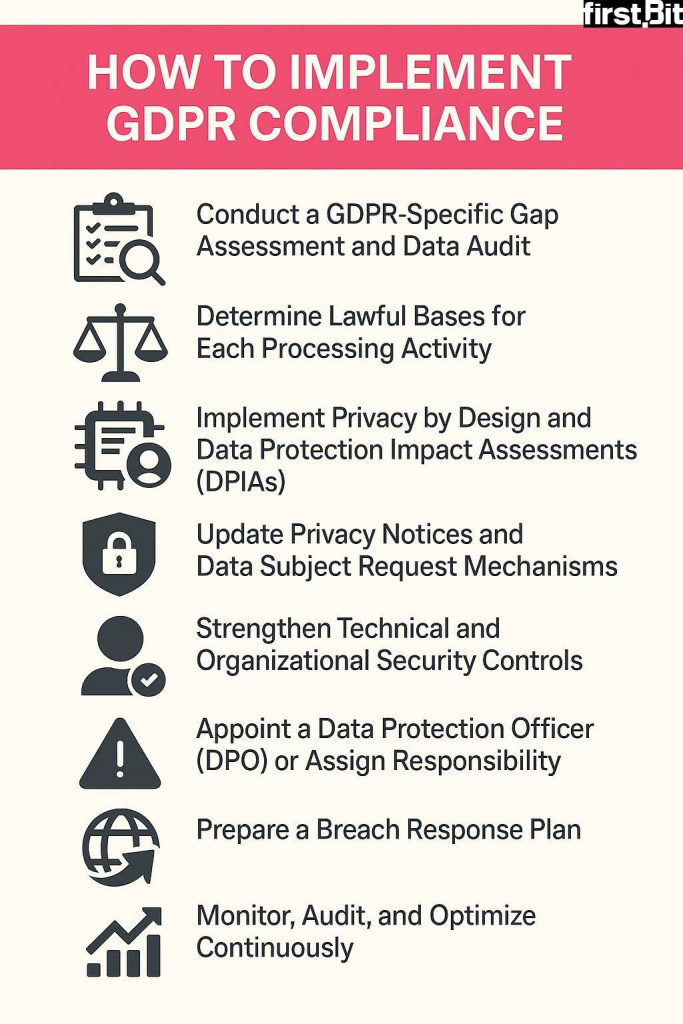
How to Implement GDPR Compliance
Steps to implement GDPR compliance
Achieving GDPR UAE compliance involves aligning your data-handling practices with the EU’s General Data Protection Regulation (Regulation (EU) 2016/679). For construction companies, compliance is especially relevant when working with EU-based clients, consultants, or employees whose data is processed through UAE offices or shared platforms.
Here’s a structured roadmap that construction businesses can follow to meet GDPR UAE standards efficiently.
1. Conduct a GDPR-Specific Gap Assessment and Data Audit
The first step is to identify what personal data your organization handles and where it flows. This includes:
Employee and contractor records (passports, payroll, attendance logs)
Client or consultant details stored in ERP and CRM systems (to determine the level of CRM GDPR compliance)
Access logs from on-site surveillance, biometrics, and
IoT sensors
A gap assessment compares your current practices with GDPR requirements, helping you discover missing privacy notices, unclear lawful bases, or unprotected data storage systems.
Pro Tip: Use your ERP or HR system to auto-tag personal data fields. This helps you maintain a live inventory of sensitive information instead of relying on manual audits.
2. Determine Lawful Bases for Each Processing Activity
To achieve compliance with the GDPR, every instance of personal data use must have a lawful basis. Construction firms commonly rely on:
Contractual necessity. When processing worker or vendor data to fulfill employment or project contracts.
Legal obligation. When data is used to comply with UAE or EU tax, labor, or safety regulations.
Legitimate interest. For site security, access control, or internal audits.
Consent. Only for voluntary data collection, such as training feedback or marketing updates.
This mapping helps prevent accidental misuse of data (e.g., sharing HR data with third parties without a valid reason).
Pro Tip: Maintain a “Lawful Basis Register.” It’s a one-page summary showing what legal grounds apply to each data type, perfect for audits and vendor reviews.
3. Implement Privacy by Design and Data Protection Impact Assessments (DPIAs)
Before launching new digital tools like cloud-based project dashboards or biometric access systems, perform a Data Protection Impact Assessment (DPIA). It evaluates how data is collected, stored, and shared, and whether it exposes individuals to risk.
For example, a construction company introducing site cameras or worker tracking via RFID should:
Identify potential privacy risks (constant monitoring, third-party access)
Limit data collection to what’s necessary (e.g., video of entry points only)
Establish clear retention rules (e.g., delete footage after 30 days)
Pro Tip: Add DPIA approval as a required checkpoint before deploying any new technology. It avoids late-stage rework and ensures privacy compliance is built in from day one.
4. Update Privacy Notices and Data Subject Request Mechanisms
Every employee, client, and partner should know how their personal data is handled. GDPR requires transparent privacy notices that are written in plain language.
For construction firms, this applies to:
Employment contracts and onboarding forms
Vendor registration portals
Client project communication channels
Each notice should explain:
What data is collected and why
Who it’s shared with (e.g., payroll providers, consultants)
How long has it been stored?
How individuals can exercise their rights (e.g., access, correction, or erasure)
Pro Tip: Include a privacy contact email in every company document or website footer. It shows transparency and makes data subject requests easier to manage.
5. Strengthen Technical and Organizational Security Controls
Security is the backbone of GDPR compliance. In construction, vulnerabilities often appear when multiple subcontractors use shared systems or Wi-Fi networks. To address this, firms should implement:
Data encryption for stored and transmitted files.
Multi-factor authentication (MFA) for ERP and project management platforms.
Access segmentation limits site-level data to relevant managers.
Vendor compliance checks for all cloud or payroll providers.
Pro Tip: Create a quarterly “Access Audit.” Review user permissions and immediately revoke access for departed employees or expired contractor accounts.
6. Appoint a Data Protection Officer (DPO) or Assign Responsibility
If your company processes EU residents’ data at scale, a DPO must be appointed. This role ensures continuous GDPR oversight, conducts audits, and liaises with EU regulators if required.
Construction firms often assign this responsibility to a compliance or IT manager trained in data protection.
Pro Tip: The DPO should sit outside the operational hierarchy, ideally reporting to the CEO or board, to avoid conflicts of interest during investigations.
7. Prepare a Breach Response Plan
GDPR mandates notifying the relevant EU authority within 72 hours of discovering a breach. To meet this deadline, firms need a clearly defined incident-response process, which includes:
Identifying who investigates the breach (IT + legal).
Classifying the incident’s severity.
Preparing draft notifications for authorities and affected individuals.
Pro Tip: Maintain an encrypted breach logbook. Even if an incident doesn’t require reporting, GDPR requires documentation showing how it was evaluated and resolved.
8. Ensure Cross-Border Data Transfer Compliance
Many UAE firms store data in global cloud servers. Under GDPR, personal data can only be transferred outside the EU using approved safeguards such as:
Standard Contractual Clauses (SCCs)
Binding Corporate Rules (BCRs)
Adequacy decisions (countries with EU-recognized protection)
Pro Tip: Maintain a register of all data transfer agreements. During audits, this record demonstrates due diligence and ensures accountability.
9. Monitor, Audit, and Optimize Continuously
GDPR compliance must evolve alongside your operations. Construction firms should:
Review privacy policies every six months.
Log all access requests and breach events.
Conduct annual third-party security assessments.
Pro Tip: Use internal dashboards to track compliance metrics (e.g., number of training sessions, DPIAs completed, and breaches prevented). It visualizes progress and strengthens management reporting.
By following these steps, UAE construction companies can maintain GDPR compliance UAE, reduce exposure to international penalties, and position themselves as trustworthy partners in global projects. Embedding privacy into every system and workflow ensures long-term operational resilience and regulatory peace of mind.
ERP tailored to UAE legislation
Navigate UAE construction laws effortlessly
Request a demo
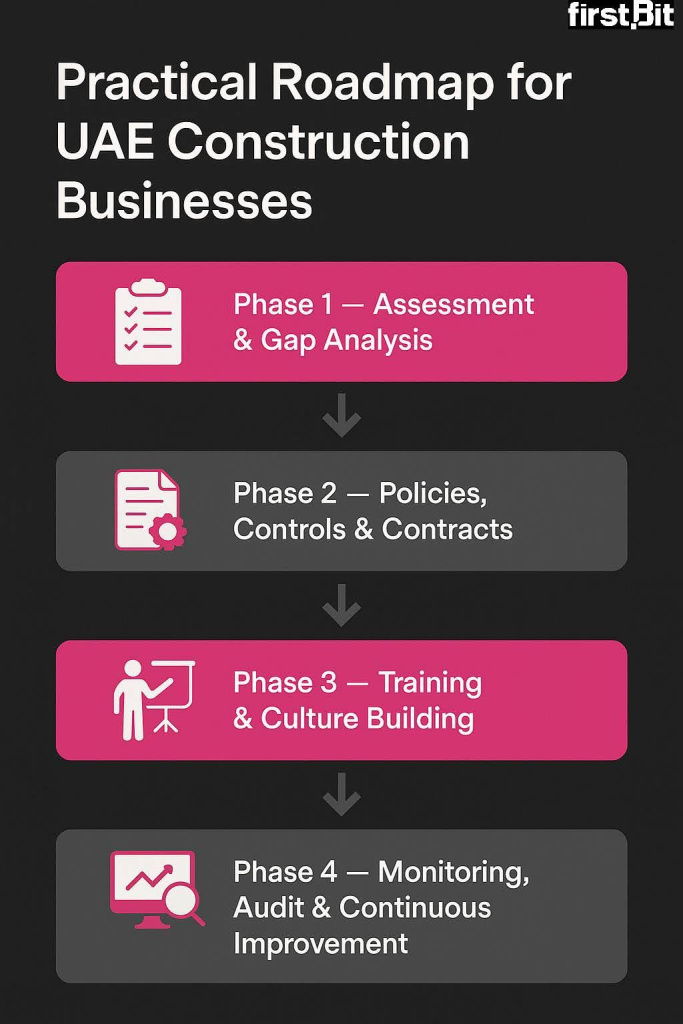
Practical Roadmap for UAE Construction Businesses
Phases of construction businesses
Building compliance with both PDPL and GDPR UAE isn’t a one-time checklist; it’s a structured, ongoing process. For construction companies managing hundreds of workers, subcontractors, and suppliers, implementing privacy controls systematically helps minimize disruption while ensuring full legal alignment.
Below is a four-phase roadmap designed specifically for the construction sector.
Phase 1 — Assessment & Gap Analysis
The first step is understanding your current data landscape. Conduct a comprehensive data inventory to identify what personal information your business collects, where it is stored, and how it is shared.
Key tasks in this phase:
Map data across HR, project,
procurement, and finance systems.
Identify all data types: employee records, site access logs, CCTV footage, vendor information.
Review existing privacy documentation, consent forms, and security controls.
Conduct a gap analysis comparing your practices with PDPL and GDPR requirements.
This phase establishes your starting point and highlights areas of high risk, such as unsecured file storage, outdated policies, or missing consent mechanisms.
Pro Tip: Involve IT, HR, and project management teams from the start. Each department handles unique data streams that often overlap, and early collaboration prevents blind spots.
Phase 2 — Policies, Controls & Contracts
Once the gaps are clear, formalize your data protection framework through updated documentation and internal policies.
Tasks include:
Draft internal privacy policies for employees and external privacy notices for clients and vendors.
Implement technical safeguards such as encryption, secure backups, and access control.
Update or sign Data Processing Agreements (DPAs) with subcontractors and technology vendors.
Define data retention rules and establish procedures for lawful cross-border data transfers.
In construction projects where multiple subcontractors use shared systems, strong contractual terms are essential. DPAs ensure that third parties uphold the same privacy and security standards as your organization.
Pro Tip: Maintain a single repository (physical or digital) of all privacy-related documents. It simplifies audits and demonstrates compliance during inspections or client reviews.
Phase 3 — Training & Culture Building
Policies only work if employees understand and follow them. In the construction sector, where many workers operate off-site, building a privacy-first culture is crucial.
Conduct mandatory onboarding and refresher training sessions on data privacy and cybersecurity. Use real-life examples (like unauthorized sharing of site photos or accidental data loss) to show practical impact. Create an easy escalation channel for employees to report suspected breaches or policy violations.
Pro Tip: Integrate privacy reminders into existing safety meetings or toolbox talks. It saves time and reinforces that data protection is as essential as physical safety.
Phase 4 — Monitoring, Audit & Continuous Improvement
Once policies are live, regular monitoring ensures compliance doesn’t erode over time.
Ongoing activities:
Conduct mandatory onboarding and refresher training sessions on data privacy and cybersecurity.
Use real-life examples (like unauthorized sharing of site photos or accidental data loss) to show practical impact.
Create an easy escalation channel for employees to report suspected breaches or policy violations.
Appoint privacy champions within departments (HR, IT, projects) to reinforce awareness.
This continuous review cycle enables construction firms to evolve their compliance framework in tandem with regulatory and operational changes.
Pro Tip: Track privacy KPIs such as the number of training sessions completed, incidents reported, or DPIAs conducted in a live dashboard. It creates measurable proof of compliance progress and can be integrated into your ERP system for executive reporting.
By following these four phases, UAE construction businesses can build a sustainable compliance ecosystem that meets both PDPL and GDPR UAE obligations. Beyond avoiding penalties, it enhances governance, client confidence, and the overall efficiency of data handling across all projects.
FirstBit ERP: Simplifying PDPL & GDPR Compliance UAE for Construction Firms
Ensuring compliance with both the UAE data protection law (PDPL) and GDPR UAE can be challenging for construction firms that handle large volumes of personal and project-related data. While ERP software alone cannot guarantee compliance,
FirstBit ERP supports these obligations by embedding structure, security, and accountability into everyday operations.
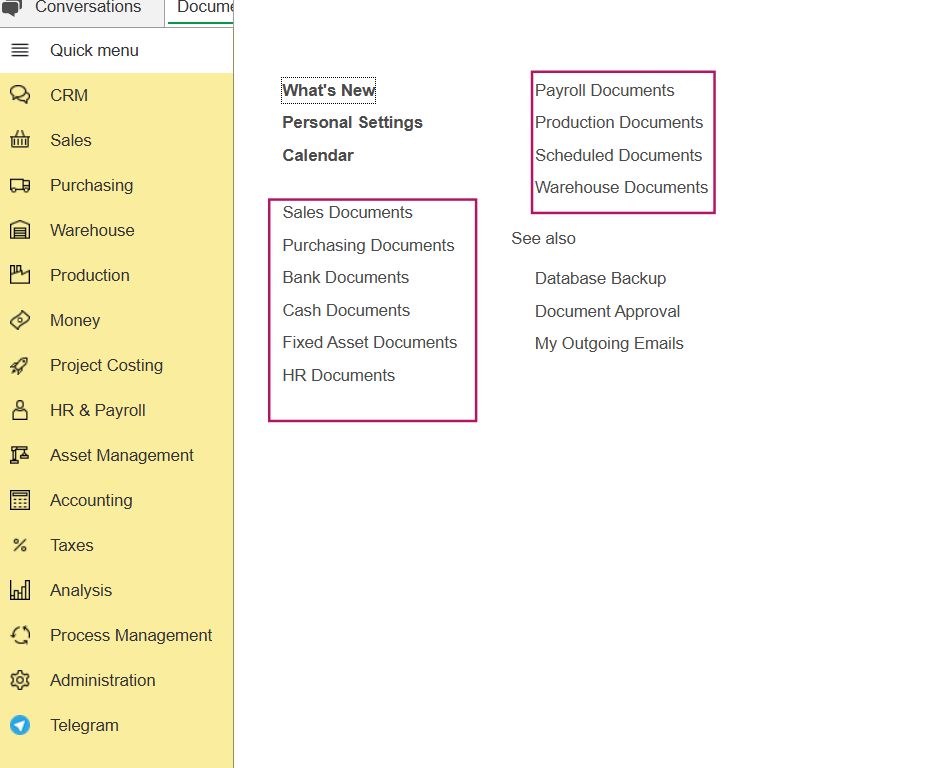
Centralized Data Management
Construction projects generate data from multiple departments such as HR, finance, procurement, and
project management, often stored across disconnected systems.
FirstBit ERP unifies all this information in a single, secure platform, helping teams maintain accurate data inventories, eliminate duplication, and control access to sensitive records. This centralized approach aligns with the PDPL and GDPR principles of integrity and accountability.
Different kinds of data documents in FirsBit ERP
Role-Based Access and Authorization
Both PDPL and GDPR emphasize limiting access to personal data only to those who need it.
FirstBit ERP enables role-based access control, allowing permissions to be assigned based on job function. HR teams, for example, can manage employee data, while project managers access subcontractor or vendor information without overlap.
This structure minimizes internal risk and supports the “least privilege” principle required under both laws.
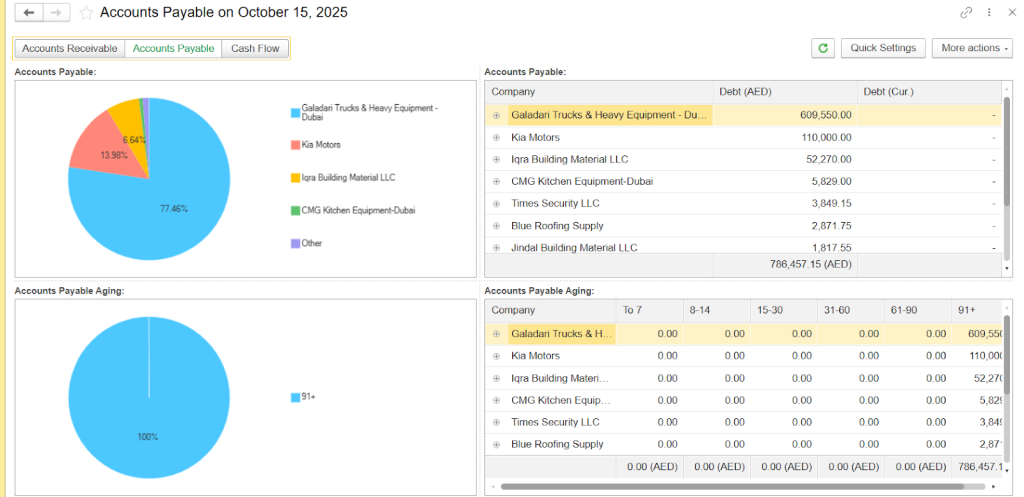
Manager dashboard in FirstBit ERP
Secure Data Processing and Storage
Data confidentiality and integrity are essential to both frameworks.
FirstBit ERP provides secure data storage with encryption and automated backups, ensuring information remains protected from loss or unauthorized access. The system’s flexible deployment options, cloud or on-premise, give companies greater control over where and how data is stored, supporting compliance with cross-border transfer policies.
Transparent Record-Keeping and Audit Trails
Compliance requires proof of accountability.
FirstBit ERP automatically tracks data changes, user activity, and document histories across accounting, HR, and project modules. These built-in audit trails simplify internal reviews, help demonstrate compliance during inspections, and support faster responses to data access or deletion requests.
Real-Time Reporting and Monitoring
Real-time visibility is vital for proactive compliance management.
FirstBit ERP offers real-time dashboards and analytics that allow compliance and operations teams to monitor updates, approvals, and changes across multiple sites.
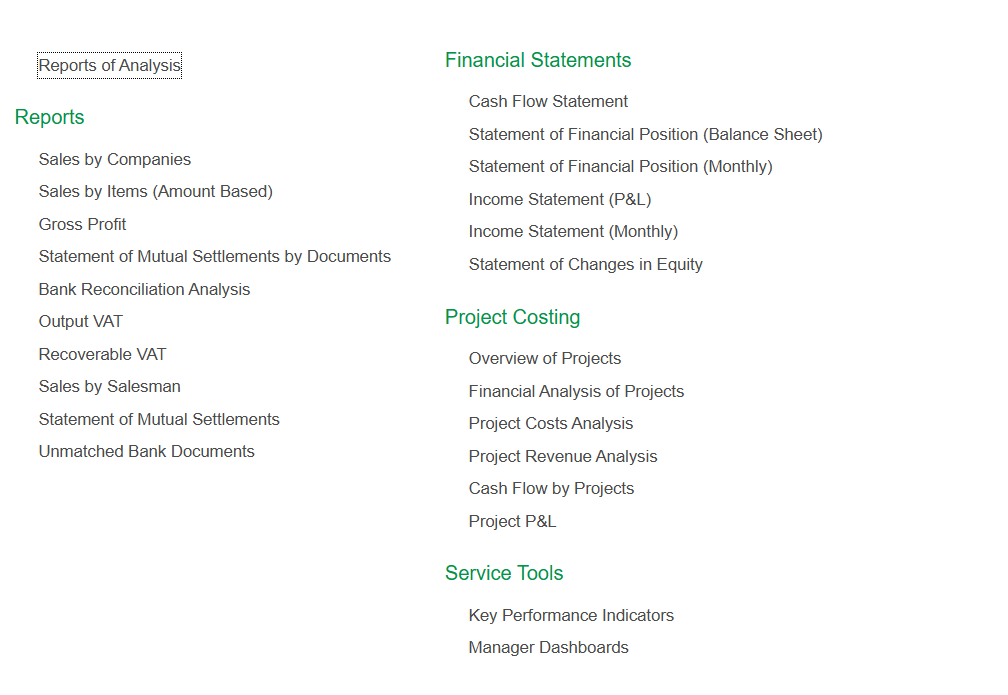
Analysis reports in FirstBit ERP
This continuous oversight supports GDPR’s accountability principle by ensuring the timely detection and correction of irregular data activities.
Vendor and Contract Management
Third-party relationships present some of the highest compliance risks in construction.
FirstBit ERP helps manage this by consolidating vendor and subcontractor contracts, including Data Processing Agreements (DPAs) and other compliance-related documentation, within the system.
Having all agreements centrally stored improves transparency, simplifies renewal tracking, and ensures that each vendor relationship meets PDPL and GDPR expectations.
By integrating these functions into daily operations, FirstBit ERP helps UAE construction companies maintain stronger control over data handling, improve transparency, and support compliance efforts with minimal administrative burden.
Rather than treating PDPL and GDPR as additional layers of bureaucracy, firms using
FirstBit ERP can embed privacy and accountability directly into their operational workflow, reducing risks while strengthening client and partner trust.
Stay fully compliant with the latest UAE laws and regulations
Request a demo
Conclusion
For UAE construction companies, compliance with PDPL and GDPR UAE goes far beyond meeting legal requirements; it’s about strengthening the foundation of how information is managed, shared, and protected across projects.
By embedding privacy principles into workflows, firms ensure that sensitive data from employees, subcontractors, and clients is handled with the same precision and accountability as project execution itself.
A well-implemented compliance framework reduces risk exposure, supports transparent communication, and builds long-term trust with both local and international partners.
When coupled with systems like
FirstBit ERP, businesses gain the tools to manage data securely, maintain visibility across operations, and document compliance without slowing productivity.
In an industry built on reliability and detail, data protection is now part of that same standard. Construction firms that act early and implement structured compliance measures position themselves not only for regulatory peace of mind but for stronger business credibility, smoother operations, and a competitive edge in a market where trust and transparency matter more than ever.
FAQ
Do I need to comply with PDPL if my construction company is based in the UAE?
Yes. The UAE Personal Data Protection Law (PDPL) applies to any organization that processes personal data within the UAE, regardless of size or sector.
This includes construction companies that handle employee records, subcontractor data, site surveillance footage, or client information.
Even if you operate in a free zone like DIFC or ADGM, you must comply with those jurisdictions’ separate data protection frameworks, which closely mirror PDPL principles.
What types of data are protected under PDPL and GDPR?
Both PDPL and GDPR protect any information that can directly or indirectly identify a person.
In the construction sector, this often includes: employee and subcontractor details (passport numbers, contact information, payroll data); biometric data (site access or time-tracking systems); health and safety records; client or project stakeholder information.
These laws require organizations to collect, store, and use such data lawfully, transparently, and securely.
Why would a UAE construction firm need to comply with GDPR?
Even if your company is based in the UAE, you must comply with the GDPR in two situations.
First: if you process or store the personal data of EU citizens (e.g., European consultants or project partners).
Second: if you offer goods or services to clients or organizations within the EU.
For example, a UAE construction firm working with an EU engineering consultant or storing EU employee data on a shared system would fall under GDPR UAE compliance requirements.
Meeting these standards not only prevents regulatory penalties but also enhances credibility when dealing with international partners.
What is a Data Protection Impact Assessment (DPIA), and when do I need one?
A Data Protection Impact Assessment (DPIA) is a structured process used to identify and minimize privacy risks before starting any high-risk data processing activity.
Construction companies typically need a DPIA when implementing: CCTV or surveillance systems on sites; Biometric access or attendance tracking; IoT sensors that collect worker or site data; and Cloud platforms are used for managing personal data.
Conducting DPIAs helps ensure compliance with both PDPL and GDPR, demonstrating that the company has assessed and mitigated potential risks to individuals’ privacy before launching new systems.
Protect your rights under UAE law
Manage contracts efficiently with FirstBit
Request a demo
Umme Aimon Shabbir
Editor at First Bit
Aimon brings a deep understanding of the modern construction business to her articles by providing practical content.












'%3e%3cg%20clip-path='url(%23clip1_6548_6055)'%3e%3cpath%20d='M13.974%2015.6195C14.2724%2016.0185%2014.6532%2016.3487%2015.0905%2016.5876C15.5278%2016.8265%2016.0114%2016.9686%2016.5084%2017.0042C17.0055%2017.0398%2017.5043%2016.9681%2017.9712%2016.7939C18.4381%2016.6198%2018.8621%2016.3472%2019.2143%2015.9948L21.2994%2013.9098C21.9324%2013.2544%2022.2827%2012.3766%2022.2747%2011.4654C22.2668%2010.5543%2021.9014%209.68269%2021.257%209.03839C20.6127%208.39408%2019.7412%208.02862%2018.83%208.0207C17.9189%208.01278%2017.0411%208.36305%2016.3857%208.99606L15.1902%2010.1845M16.754%2014.2295C16.4555%2013.8305%2016.0747%2013.5003%2015.6374%2013.2614C15.2002%2013.0225%2014.7166%2012.8804%2014.2196%2012.8448C13.7225%2012.8092%2013.2237%2012.8809%2012.7568%2013.0551C12.2899%2013.2292%2011.8659%2013.5018%2011.5136%2013.8542L9.42861%2015.9392C8.7956%2016.5946%208.44534%2017.4724%208.45326%2018.3836C8.46117%2019.2947%208.82664%2020.1663%209.47094%2020.8106C10.1152%2021.4549%2010.9868%2021.8204%2011.898%2021.8283C12.8091%2021.8362%2013.6869%2021.4859%2014.3423%2020.8529L15.5308%2019.6645'%20stroke='%235F7896'%20stroke-width='1.39002'%20stroke-linecap='round'%20stroke-linejoin='round'/%3e%3c/g%3e%3c/g%3e%3crect%20x='0.438953'%20y='0.438953'%20width='28.9709'%20height='28.9709'%20rx='14.4855'%20stroke='%235F7896'%20stroke-width='0.877907'/%3e%3cdefs%3e%3cclipPath%20id='clip0_6548_6055'%3e%3crect%20width='29.8488'%20height='29.8488'%20rx='14.9244'%20fill='white'/%3e%3c/clipPath%3e%3cclipPath%20id='clip1_6548_6055'%3e%3crect%20width='16.6802'%20height='16.6802'%20fill='white'%20transform='translate(7.02344%206.58435)'/%3e%3c/clipPath%3e%3c/defs%3e%3c/svg%3e)