





How to Deal with Delays in Construction Projects: Tips for Project Managers
Publication date 11 Aug 2025 •
Updated 18 Jul 2026 •
13 min read

Christa Tintelnot
Contributing Author


Delays in construction projects are inevitable — but their impact isn’t. In the UAE, where 50% of projects miss deadlines, understanding the types of delays, their root causes, and contractual consequences is critical to protecting your margins and reputation.
This guide breaks down excusable vs. inexcusable delays, critical vs. non-critical paths, and provides a practical framework for delay analysis in construction contracts — so you can respond fast, claim entitlements, and keep projects on track.
Consequences of Delay in Construction Projects
Did you know that 50% of construction projects in the UAE don't finish on time?[?]
Construction delays in the UAE are a systemic challenge that impacts the national economy, where construction accounts for roughly 11 % of GDP[?]. They affect even mega projects like the Zayed National Museum in Abu Dhabi[?], whose opening has been postponed by nearly 15 years. Now it’s scheduled for December 2025.
If government-funded projects face setbacks like this, what about others? Let’s explore the consequences of delay in construction projects.
If government-funded projects face setbacks like this, what about others? Let’s explore the consequences of delay in construction projects.
Financial:
-
Labour costs increase due to overtime and turnover, often pushing the payroll-to-revenue ratio above sustainable levels
-
Higher rental costs for equipment, despite downtime
-
Liquidated damages might be enforced up to 10% of contract value[?]
Operational:
-
Tight schedules lead to mistakes, safety risks, and reduced quality
-
Employee burnout negatively affects efficiency
-
Rescheduled deliveries disrupt the supply chain
Stakeholder and reputational:
-
Lack of trust between clients, contractors, and investors
-
Reputation can suffer long-term
-
Difficulties with securing future contracts
Types of Delays in Construction Projects: Critical, Excusable, Compensable
Delays in construction projects are typically categorized based on their causes, impact on the schedule, and eligibility for compensation. This approach makes it easier to determine who is responsible, manage contractual obligations, and plan what to do next.
| Type of delay | Definition | Who bears responsibility | Reimbursable | Example |
| Critical | A delay that affects the project's critical path and extends the completion date. | Depends on the cause of the delay. | Only if the delay is both excusable and compensable. | Late approval of a building permit delaying construction. |
| Excusable | A delay caused by events beyond the contractor's control, entitling the contractor to a time extension. | No party is at fault (e.g., force majeure) or as defined by the contract. | Usually no (time extension only). | Extreme heat in Dubai (>45°C), severe storms, government restrictions (like Midday Work Ban). |
| Compensable | An excusable delay caused by the owner/client, entitling the contractor to both additional time and monetary compensation. | Client/Owner. | Yes. | Client requests an additional floor after construction has begun. |
Critical vs. Non-Critical Delays
Critical delay is a delay in the task that postpones the project completion or a key milestone by the same duration.
Examples: late building permit approval, unresolved design issue on structural system, extended delay in critical equipment delivery.
Non‑critical delay is a delay affecting tasks off the critical path that have float. These do not delay the project’s end date as long as they remain within their float buffer.
Examples: delay in exterior landscaping, postponement of non-essential fixtures, minor supply chain hold-ups for decor elements.
Excusable vs. Inexcusable Delays
Excusable delay is caused by events beyond the contractor’s control and not due to their negligence or planning.
Examples:
-
Extreme weather, pandemics, natural disasters
-
Delayed inspections or permits, or late scope/design changes
-
Employer-caused delays: withheld approvals, blocked access to the site
-
Third-party disruptions, e.g., civil unrest, supply‑chain collapse
Inexcusable delays result from the contractor's actions, omissions, or foreseeable risks.
Examples:
-
Poor planning or scheduling
-
Inadequate labor or equipment
-
Late procurement or site mobilization
-
Failure to follow a Notice To Proceed (NTP)
Compensable vs. Non-Compensable Delays
Compensable delay is a subtype of excusable delay caused by the project owner or other contractor parties (e.g., design revisions, withheld approvals).
Delay must affect a critical task to qualify; non-critical ones don’t get compensated.
A contractor is typically entitled to both an Extension of Time (EOT) and reimbursement of direct/indirect costs (e.g., labor rates, equipment, overhead).
Examples:
-
Requested changes during construction
-
Delays by the owner in approving shop drawings
-
Change orders issued late by the client
-
Employer-caused suspension of work
Pro tip: Gather all required documentation to support the cost claim. Include proof that delay affects critical path work, owner causation, and timely notice.
Non-compensable delay is also an excusable delay caused by forces outside both contractor and owner (e.g., extreme weather, labor strikes), not attributable to the owner.
The contractor usually receives an EOT only, but no financial reimbursement—each party bears its costs.
Examples:
-
Unusually severe storms that are not typical for the season
-
Independent labor strike
-
Natural disasters or force majeure events
Stay ahead of delays
Monitor project progress with FirstBit ERP
Request a demo
Root Causes of Delay in Construction Projects
Delays in construction projects often stem from a mix of predictable risks and unexpected disruptions. They may result from contractor, owner, consultant, or external factors, including poor planning, design changes, resource shortages, financial issues, adverse weather, and regulatory or approval delays.
Understanding types of causes of delay in construction projects is critical for managers who aim to plan ahead and respond effectively when setbacks occur.
Understanding types of causes of delay in construction projects is critical for managers who aim to plan ahead and respond effectively when setbacks occur.
Expected Causes
These causes of delays can be managed with better planning and oversight.
-
Late payments. When planned funding fails to arrive on time, due to delays in bank transfers or slow client payments, work stalls. Cash flow gets disrupted.
-
Cost overruns. Budgets that are unrealistic or too tight can quickly drain cash reserves. This leads to procurement delays, halted operations, and re-scoping.
-
Poor crew management. Ineffective scheduling, weak supervision, and inefficient task assignments can result in idle labor, reduced productivity, or even cascading delays.
-
Ineffective communication. Disjointed communication channels, combined with unclear protocols, often result in misunderstandings, duplicated work, and costly rework.
-
Inadequate planning. Lack of buffers, bad task sequencing, and incomplete risk assessments lead to bottlenecks that cause unmanageable timelines.
-
Scope and design changes. Every change requires contract updates and rescheduling. This disrupts the overall project flow.
-
Contractor and subcontractor performance. Frequent crew absences, low quality of work, and missed deadlines from third parties significantly delay project delivery.
-
Client approval delays. Slow approvals of design submittals and change order requests frequently become critical path issues that halt work.
Unexpected Causes
These are more difficult to predict and may be out of the project team's control.
Examples:
-
Adverse weather and environmental conditions
-
Equipment failures and supply chain disruptions
-
Vandalism, theft, or site accidents
-
Political factors or legal obstacles
-
Pandemics
How to Conduct Delay Analysis in Construction Contracts
Construction delay analysis helps determine the causes and impact of project delays, establish responsibility, and support entitlement to extensions of time and related claims under the contract.
Follow these steps to conduct an effective delay analysis in construction contracts and prepare a well-supported Extension of Time (EOT) claim:
- Review the construction contract thoroughly. Examine the contract to understand the provisions governing project delays, extensions of time (EOT), notice requirements, liquidated damages, and risk allocation.
- Collect all relevant project records. Gather key documents such as the baseline schedule, updated schedules, delay event log, daily reports, correspondence, change orders, weather records, inspection reports, and progress photographs.
- Establish the baseline schedule. Identify the approved baseline schedule, which is typically developed using the Critical Path Method (CPM) for construction projects. It should reflect the original plan for completing the work, including the planned activities, durations, logic, and key milestones.
- Identify and classify delay events. Determine every event that affected project progress and classify each delay as excusable, non-excusable, compensable, or concurrent based on the contract. Proper classification helps establish responsibility and determines whether the contractor may be entitled to additional time or compensation.
- Determine the impact on the critical path. Evaluate whether each delay affected activities on the project's critical path, as only delays that extend the critical path generally delay the project's completion.
- Select an appropriate delay analysis method. Choose a methodology that suits the project's records, timing, and contractual circumstances. Common methods include Time Impact Analysis, Window Analysis, As-Planned vs. As-Built Analysis, and Collapsed As-Built Analysis.
- Assess the effect of each delay on project completion. Compare planned progress with actual performance to determine how each delay event influenced the project's completion date. This step quantifies the duration and significance of individual delays while distinguishing critical delays from minor disruptions.
- Evaluate concurrent delays. Analyze situations where delays caused by different parties occur during the same period. Understanding each concurrent delay is essential because it can significantly affect entitlement to extensions of time and financial compensation under the contract.
- Quantify the time and cost consequences. Calculate the contractual effects of proven delays, including extensions of time, prolongation costs, disruption costs, and any applicable liquidated damages. All calculations should be supported by project records and consistent with the contract terms.
- Prepare a comprehensive delay analysis report. Summarize the methodology, evidence, findings, critical path impacts, responsibility for delays, and resulting time and cost entitlements in a clear and well-supported report.
- Submit the Extension of Time (EOT) claim in accordance with the contract. Prepare a formal EOT claim that clearly presents the delay events, supporting evidence, including delay analysis, updated schedules, and any other documents required by the contract. Ensure that all contractual notices are issued and the claim is submitted within the specified notification period.
Your 5-Step Delay Analysis Checklist
Construction delays are inevitable on many projects, but not every delay justifies an Extension of Time (EOT) or additional compensation. A structured delay analysis helps project teams establish the facts, assess the impact on the project programme, determine contractual responsibility, and prepare well-supported EOT and delay claims.
Use the following five-step checklist to analyse delay events consistently and ensure that all key contractual and scheduling considerations are addressed before submitting a claim:
- Document the delay event. Record the date, describe the event, identify the affected activities, and gather supporting evidence such as site diaries, photographs, RFIs, emails, instructions, weather records, and meeting minutes.
- Identify critical vs. non-critical path impact. Determine whether the delay affects the project's critical path or only consumes available float by comparing the baseline schedule with the updated programme.
- Determine responsibility. Establish whether the delay was caused by the contractor, client, third party, or a force majeure event, and assess any concurrent delays in accordance with the contract.
- Calculate time and cost impact. Compare baseline versus actual progress to quantify the delay duration and evaluate its effect on project completion, labour, equipment, overheads, disruption, and additional costs.
- Submit the EOT and claim within the contractual deadline. Prepare the Extension of Time (EOT) submission, include the delay analysis and supporting evidence, issue any required contractual notices, and submit the claim within the notification period specified in the contract.
Managing Project Delays After the Analysis
Once the delay analysis has identified the causes, impacts, and contractual entitlement, the next step is to minimize the effects of the disruption and keep the project moving forward.
Follow these best practices to manage project delays in construction after completing the delay analysis:
- Communicate clearly and quickly. Notify everyone leading the project immediately. Transparent communication helps manage expectations and maintain trust. Share what caused the delay, how it affects the timeline, and what steps are being taken to fix the problem.
- Replan the schedule. Revise your project timeline to reflect the delay. Use project management tools to adjust task order and durations. Look for opportunities to compress or fast-track work to recover lost time.
- Adjust the budget and contracts. Look at the financial impact of the delay. Change the budgets and, if necessary, revise contracts or issue change orders.
- Monitor and adapt in real time. Use enhanced monitoring to stay ahead of any further issues or delays. Use dashboards or reporting tools to track progress and make rapid adjustments as more information becomes available.
- Follow contractual delay notification procedures. Many construction contracts require a timely notice of delay to preserve entitlement to an Extension of Time or compensation. Always comply with the notice periods specified in your contract. (Instead of stating "30 days," it is more accurate to refer to the specific contract, as notice periods vary by contract form and jurisdiction.)
- Conduct a post-delay review. When everything has been resolved, review what caused the delay, evaluate how effectively it was managed, and identify lessons learned to reduce the risk of similar delays on future projects.
Ensure timely and profitable project completion with FirstBit ERP
Request a demo
Proven Strategies to Manage Delays in Construction
You may not be able to avoid every delay in construction, but you can minimize its impact by taking proactive measures. The strategies below can help project managers reduce the likelihood of delays and manage them effectively when they occur. They consist of step-by-step plans tailored to address specific causes of delays in construction projects.
Delays Caused by Financial Challenges: Solution
When you’ve already sent an invoice, but planned funding falls short or arrives late, your progress often halts. Whether it happened due to bank delays or slow client payments, here’s how to recover from this delay in construction:
- Act immediately: claim your contractual entitlements. Put the employer (or their bank) on formal notice that lack of funding has stalled the schedule. Concurrently submit an Extension of Time (EOT) claim plus a separate financing and/or disruption claim, backed with evidence (bank correspondence, payroll reports, etc.).
- Bridge the gap: use short‑term liquidity tools. Arrange for invoice factoring or commercial bridging loans—these can often be fast‑tracked in under a week.
- Restructure cash flow. Agree upon a milestone‑based billing: key achievements (site mobilization, key milestones) should trigger payment quickly. Shift to electronic invoicing by using invoicing software such as FirstBit ERP for finance management, which includes automatic reminders for late payments.
- Develop a recovery schedule. Prioritize activities that can proceed without full funding or that require minimal upfront materials or labor costs.
If a construction delay was caused by cost overruns, you can find more tips in our comprehensive guide to managing project cost overrun.
Delays Caused by Poor Crew Performance: Solution
Poor crew performance often coincides with inadequate crew management. That’s why you need a complex set of measures to address both issues effectively.
- Measure crew performance. Use time cards to track when contractors clock in and clock out. Record how many hours each crew spends on each major task. Note the number of reworks needed afterward. Ask the site supervisor to report on situations when the crew is experiencing idle time (e.g., before material delivery).
- Introduce weekly meetings. During these times, superintendents, foremen, as well as subcontractors, need to review real-time sequencing, confirm readiness, and reassign crews as necessary. They can also break down weekly plans into daily goals.
- Foster strong supervision. Define the site hierarchy: for every 10-15 crew members, there should be a foreman with clearly defined authority.
- Teach them problem-solving skills. Train them to monitor productivity, safety, quality, and crew morale. This way, foremen can deal with recurring issues before they cause delays.
- Implement ERP software. Construction payroll software can help you allocate labor where it’s needed the most to avoid shortages or overstuffing. You can also use it to monitor attendance and analyze performance data.
Delays Caused by Ineffective Communication: Solution
Here is how to create strong communication systems to get the construction project back on track:
- Stop miscommunication. Compile a list of all active RFIs, change orders, and email threads. Identify which contain the misinformation/errors in data that lead to project delay. Tag those needing immediate follow‑up.
- Rebuild the system. Create and distribute a Communication Management Plan (CMP). Then you need to notify everyone. Send a memo stating: “As of this morning, all formal communication must go through [1-2 chosen channels]. No exceptions” and attach a file with CMP.
The CMP defines:
-
Who talks to whom (for each type of team member, specify who is responsible for answering their questions)
-
What must be communicated: RFIs, design changes, daily safety report, project delays, etc.
-
Through which channel (email, software, messaging app)
-
When (immediately, daily, weekly)
-
Format and naming rules (e.g., “RFI‑123_Yellow column”)
Delays Caused by Inadequate Planning: Solution
When lack of effective planning is the cause of a construction delay, a structured schedule recovery is the remedy.
- Run a time impact analysis (TIA)[?]. Compare the original baseline with the actual data (both as-built and as-planned) to quantify the schedule delay, so you can identify the tasks affected by it.
- Check the schedule for problems. You need to look for a negative float (when an activity's available time buffer is below zero) or illogical dependencies (when task relationships are established incorrectly).
- Identify the critical path. Use the Critical Path Method (CPM) to identify the most critical tasks that must be completed to successfully finish the project.
- Add time buffers. Insert buffers before critical milestones, handoffs, or permitting to protect your timeline against future unknown disruptions.
Delays Caused by Scope and Design Changes: Solution
Here is what you can do to adjust the schedule after the scope or design change and resume the work.
Sort out changes
Create a central log of all upcoming changes and group them by:
-
Source: Owner request, design error, etc.
-
Status: “Estimated Time Impact Analysis” | “In negotiation” | “Signed by contracting officer's representative”
-
Critical path impact: No / Near‑critical / Critical
Control COR Process
Establish a Change Control Board (CCB). This central group (project manager, designer representative, contract administrator) adjudicates change requests based on priority, cost, schedule, and contract terms. You also need to pre‑establish approval thresholds (e.g.,> two working days).
Suggest a standardized Change Order Form (COR) for everyone to follow. Each request can include:
-
Description of change
-
Reason – e.g., owner-initiated, unseen condition
-
Separate time/cost estimate
-
Contract clause reference
-
Effects on milestones
-
Attachments – design drawing, markups, photos
-
Review deadline (e.g., 72 hours).
Execution
Sort CORs by how critical they are to complete. Start with critical changes; until you finish them, delay non-essential ones. Update your schedule by creating a new Critical Path Method (CPM) analysis that incorporates the latest changes and phase durations.
How FirstBit ERP Can Help Manage Delay in Construction Contracts
FirstBit ERP provides clear visibility into project progress, finance management, and labor allocation. Each feature is designed to help you identify warning signs early and address issues before they escalate into costly delays.
-
Project performance dashboard. Track vital KPIs in real time—such as schedule performance and task progress. So you can quickly notice when you are at risk of falling behind schedule and take early corrective action before delays become critical.

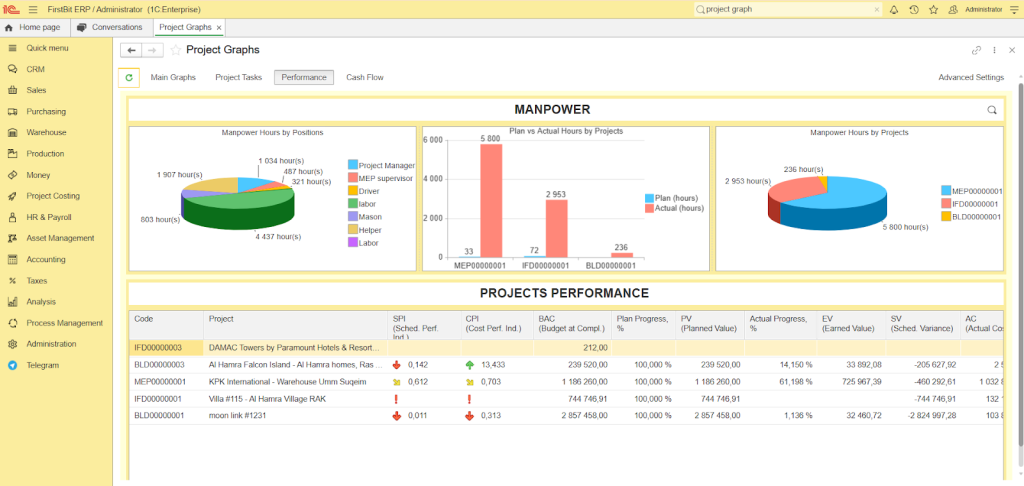
Project performance graphs in FirstBit ERP
-
Project tracking with a Gantt chart. Use a visual timeline to analyze task dependencies. When one task is delayed, you can quickly identify the other tasks that will be affected and take appropriate measures to address the impact.
-
Project progress report. Get an update for each BOQ line to verify that the actual completed work aligns with the official project schedule.
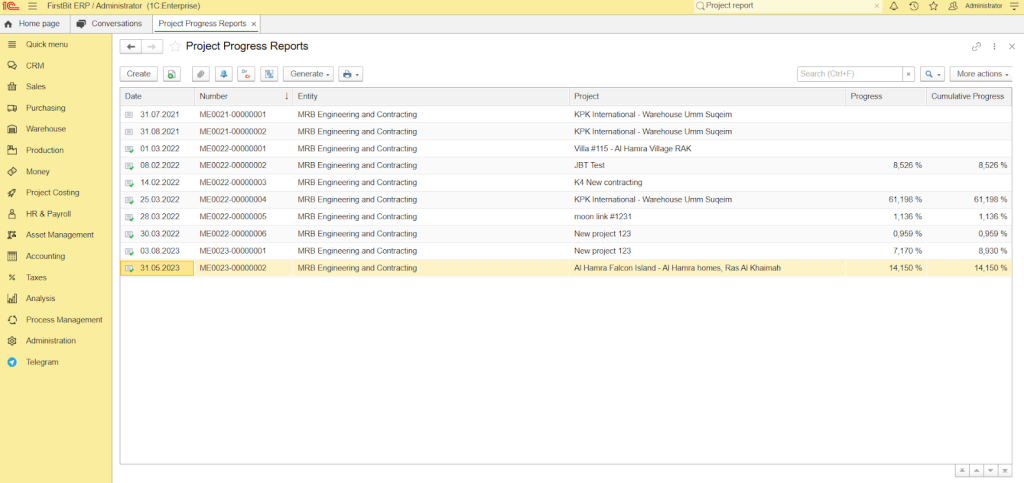
Project progress reports by FirstBit ERP
-
Time cards. Keep precise records of labor hours to monitor and prevent regular absences that can cause labor shortages or even reduce productivity.
-
Cash flow by project. Track cash inflows and outflows, so you can spot potential budget overruns before they cause delays.
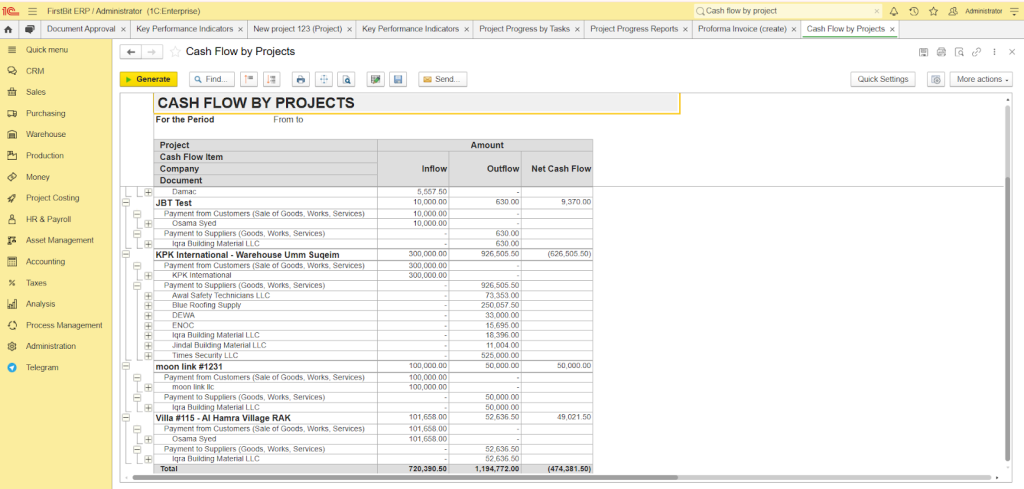
Cash flow by project in FirstBit ERP
Achieve flawless teamwork
Coordinate roles and schedules through FirstBit ERP
Request a demo
Conclusion
Construction delays are unavoidable—but with the right tools and strategies, their impact can be significantly reduced. Proactive planning, clear communication, and real-time performance tracking are essential in preventing minor setbacks from becoming major disruptions.
Beyond reactive measures, construction firms must invest in systems that support continuous improvement and data-driven decision-making. FirstBit’s ERP software plays a key role here. It helps you track project progress, monitor finance, and manage resources. This strategic advantage can help you protect your profits, reputation, and long-term success against any delays.
FAQ
What are the main types of delays in construction projects?
How do you perform delay analysis in construction contracts?
What are the consequences of delay in construction projects?
What’s the difference between concurrent delay and critical delay, and how does it affect my entitlement to time extensions?
How soon after a delay event must I notify the client to preserve my contractual rights in Dubai?
Stay ahead of schedule
Request a demo

Christa Tintelnot
Contributing Author
Share this article
'%3e%3cg%20clip-path='url(%23clip1_6548_6055)'%3e%3cpath%20d='M13.974%2015.6195C14.2724%2016.0185%2014.6532%2016.3487%2015.0905%2016.5876C15.5278%2016.8265%2016.0114%2016.9686%2016.5084%2017.0042C17.0055%2017.0398%2017.5043%2016.9681%2017.9712%2016.7939C18.4381%2016.6198%2018.8621%2016.3472%2019.2143%2015.9948L21.2994%2013.9098C21.9324%2013.2544%2022.2827%2012.3766%2022.2747%2011.4654C22.2668%2010.5543%2021.9014%209.68269%2021.257%209.03839C20.6127%208.39408%2019.7412%208.02862%2018.83%208.0207C17.9189%208.01278%2017.0411%208.36305%2016.3857%208.99606L15.1902%2010.1845M16.754%2014.2295C16.4555%2013.8305%2016.0747%2013.5003%2015.6374%2013.2614C15.2002%2013.0225%2014.7166%2012.8804%2014.2196%2012.8448C13.7225%2012.8092%2013.2237%2012.8809%2012.7568%2013.0551C12.2899%2013.2292%2011.8659%2013.5018%2011.5136%2013.8542L9.42861%2015.9392C8.7956%2016.5946%208.44534%2017.4724%208.45326%2018.3836C8.46117%2019.2947%208.82664%2020.1663%209.47094%2020.8106C10.1152%2021.4549%2010.9868%2021.8204%2011.898%2021.8283C12.8091%2021.8362%2013.6869%2021.4859%2014.3423%2020.8529L15.5308%2019.6645'%20stroke='%235F7896'%20stroke-width='1.39002'%20stroke-linecap='round'%20stroke-linejoin='round'/%3e%3c/g%3e%3c/g%3e%3crect%20x='0.438953'%20y='0.438953'%20width='28.9709'%20height='28.9709'%20rx='14.4855'%20stroke='%235F7896'%20stroke-width='0.877907'/%3e%3cdefs%3e%3cclipPath%20id='clip0_6548_6055'%3e%3crect%20width='29.8488'%20height='29.8488'%20rx='14.9244'%20fill='white'/%3e%3c/clipPath%3e%3cclipPath%20id='clip1_6548_6055'%3e%3crect%20width='16.6802'%20height='16.6802'%20fill='white'%20transform='translate(7.02344%206.58435)'/%3e%3c/clipPath%3e%3c/defs%3e%3c/svg%3e)


Related articles


See all








See FirstBit ERP solutions in action
Discover how our system solves the unique challenges of contractors in a personalized demo.
After the demo you will get a quotation for your company.
After the demo you will get a quotation for your company.