Construction projects in the UAE operate on tight schedules, where every hour of machine availability is crucial. Understanding equipment downtime meaning is the first step toward protecting productivity and project profitability. A single breakdown can delay multiple crews, disrupt workflows, and cause costly ripple effects that impact deadlines.
In this guide, you will learn the primary causes of equipment downtime, its financial impact, the formula for calculating cost of downtime, and practical strategies to reduce downtime to improve equipment reliability.
What Is the Equipment Downtime Meaning in Construction?
The equipment downtime in construction refers to any period when machinery or heavy equipment is unavailable for work due to breakdowns, repairs, inspections, scheduled maintenance, or other operational issues. Whether planned or unplanned, downtime prevents equipment from performing its intended function, reducing productivity and delaying timelines.
In construction projects, equipment downtime can affect excavators, cranes, loaders, bulldozers, and other critical machines that keep work moving. Even a short period of inactivity can lead to missed deadlines, increased labor costs, idle crews, and higher project expenses.
Monitoring downtime with
equipment tracking software, identifying its root causes, and implementing preventive maintenance strategies help contractors improve equipment reliability, maximize uptime, and keep projects on schedule.
Equipment non-productivity is one of the top ten causes of construction project delays in Abu Dhabi. Poor equipment utilization, idle machinery, and inefficient operations directly extend project duration and increase costs. (Source: Dissertation by Ghias Rehman, General Manager & Project Director, submitted to The British University in Dubai).
Types of Equipment Downtime: Planned vs. Unplanned
Equipment downtime is categorized as either planned or unplanned based on whether the stoppage is scheduled in advance or occurs unexpectedly. Understanding the differences between these two types of downtime helps organizations improve maintenance planning and increase overall equipment effectiveness (OEE).
Key difference:
Planned downtime is intentional, scheduled, and controlled to improve long-term equipment reliability.
Unplanned downtime is unexpected, reactive, and disruptive, typically resulting in higher operational costs and lost productivity.
| Aspect | Planned equipment downtime | Unplanned equipment downtime |
| Cause | Preventive maintenance, scheduled inspections, cleaning, calibration, product changeovers, and equipment upgrades. | Equipment breakdowns, power failures, operator errors, material shortages, quality issues, and unexpected mechanical or electrical failures. |
| Cost of downtime | Generally lower because labor, parts, and resources are planned in advance. | Usually higher due to emergency labor, expedited parts, overtime, and lost production. |
| Effect on equipment reliability | Improves equipment reliability and extends asset life. | Indicates reliability issues and may lead to additional failures if recurring. |
| Maintenance strategy | Preventive and predictive maintenance. | Corrective or reactive maintenance. |
| Typical objective | Prevent failures and optimize asset performance. | Restore equipment operation as quickly as possible after an unexpected failure. |
Extend equipment lifecycle
Schedule maintenance and avoid downtime with FirstBit ERP
Request a demo
Common Causes of Unplanned Equipment Downtime in the UAE
Industrial equipment in the UAE operates under demanding environmental and operational conditions. Understanding the most common causes of downtime helps businesses reduce unexpected failures, improve maintenance planning, and maintain consistent productivity.
The following are some of the most common causes of equipment failures and production interruptions:
Reactive maintenance practices. Delaying maintenance until equipment fails often results in longer repair times, higher maintenance costs, and unplanned production stoppages.
Improper equipment operation. Incorrect operating procedures, equipment overloading, and insufficient operator training can accelerate wear, damage critical components, and increase the risk of unexpected failures.
Extreme heat and high temperatures. Prolonged exposure to intense heat can cause equipment to overheat, reduce the lifespan of critical components, and place additional strain on cooling systems.
Dust and sand ingress. Fine desert dust and sand can clog filters, contaminate lubricants, damage moving parts, and reduce the efficiency of both mechanical and electrical equipment.
Mechanical wear and component fatigue. Continuous operation, heavy workloads, and insufficient lubrication accelerate wear on bearings, belts, gears, seals, and other critical components.
Electrical and hydraulic failures. Loose electrical connections, hydraulic leaks, fluid contamination, and damaged seals can lead to sudden equipment shutdowns and reduced operational performance.
Limited spare parts availability. Long lead times for imported replacement parts can significantly extend repair times and increase overall equipment downtime.
Implementing a proactive preventive maintenance strategy helps reduce these common causes of downtime. Regular inspections, condition monitoring, and timely replacement of worn components improve equipment reliability and extend asset life.
7 Strategies to Reduce Construction Equipment Downtime
Construction equipment downtime is often caused by preventable issues such as poor maintenance, operator error, delayed repairs, inadequate planning, and unexpected component failures.
Below, you will find strategies tailored to the specific causes of downtime, designed to prevent them or reduce their frequency.
1. Prevent Breakdowns with Preventive Maintenance
Cause of downtime: Missed or delayed maintenance causes gradual wear that eventually leads to mechanical failure.
Solution: Preventive maintenance is the most effective way to avoid unexpected equipment failures. Instead of repairing machines after they break down, schedule routine servicing to identify worn components early and keep equipment operating at peak performance.
How to do it:
Follow the manufacturer's recommended maintenance schedule.
Change engine oil, hydraulic fluid, coolant, and filters on time.
Lubricate moving components regularly to reduce friction and wear.
Replace worn belts, hoses, seals, and bearings before they fail.
Inspect brakes, electrical systems, batteries, and hydraulic lines during scheduled service.
Keep detailed maintenance records to ensure no service intervals are overlooked.
2. Detect Problems Early Through Daily Inspections
Cause of downtime: Small mechanical issues often go unnoticed until they cause complete equipment failure.
Solution: Never skip daily equipment inspections, even when projects are behind schedule. A quick walk-around before each shift helps identify leaks, loose components, damaged hoses, or warning lights before they develop into costly mechanical failures. Small issues caught early are usually faster and less expensive to repair.
The best way to do it is to create a standardized daily inspection checklist that includes:
Engine oil and coolant levels
Hydraulic fluid condition
Tire or track wear
Battery terminals and electrical connections
Belts, hoses, and fittings
Fuel system leaks
Warning lights and fault codes
Safety guards and controls
Visible cracks, loose bolts, or structural damage
3. Reduce Operator-Related Equipment Damage
Cause of downtime: Improper machine operation accelerates wear and increases the risk of equipment damage.
Solutions: Invest in regular operator training to ensure every machine is used correctly. Proper operating techniques reduce unnecessary wear on engines and drivetrain components. It also helps operators recognize early signs of mechanical problems before a breakdown occurs.
How to do it:
Provide comprehensive operator training for every machine type.
Conduct refresher training when introducing new equipment or technologies.
Teach operators proper startup, shutdown, and loading procedures.
Encourage operators to report unusual noises, vibrations, overheating, or warning indicators immediately.
Establish clear operating guidelines to prevent overloading or misuse.
4. Use Equipment Monitoring and Telematics
Cause of downtime: Hidden mechanical problems remain undetected until equipment suddenly stops working.
Solutions: Take advantage of telematics and condition monitoring to detect problems that aren't visible during routine inspections. Real-time equipment data allows maintenance teams to schedule repairs before failures occur, reducing unplanned downtime and improving fleet availability.
Modern telematics and condition-monitoring systems continuously collect equipment data. When integrated with
AI for site monitoring, this data can be analyzed automatically to detect anomalies, predict failures, and improve maintenance planning.
Integrating telematics with
ERP software for contractors further enhances these capabilities by connecting equipment data with maintenance schedules, work orders, equipment tracking, inventory management, procurement, project costs, and resource planning.
5. Keep Critical Spare Parts Available
Cause of downtime: Repair work is delayed because replacement parts are unavailable.
Solution: Review your maintenance history to identify the parts that fail most often and keep them in stock. Having critical spare parts readily available eliminates unnecessary waiting time and allows repairs to begin immediately, minimizing project delays.
Maintain inventory for commonly replaced components such as:
Filters
Belts
Hydraulic hoses
Batteries
Seals
Bearings
Sensors
Fuses
Fluids and lubricants
6. Analyze Every Equipment Failure
Cause of downtime: The same failures continue because only the symptoms — not the underlying causes — are repaired.
Solution: Treat every major breakdown as an opportunity to improve your maintenance program. Instead of replacing the failed component and moving on, investigate why the failure occurred and update maintenance procedures to prevent the same issue from happening again.
After every major breakdown:
- Identify the failed component.
- Determine the root cause of the failure.
- Document the repair and maintenance history.
- Review whether maintenance schedules need adjustment.
- Update operating procedures if operator error contributed to the failure.
- Share findings with maintenance personnel and equipment operators.
7. Plan Maintenance Before Equipment Fails
Cause of downtime: Reactive maintenance begins only after equipment has already broken down.
Solution: Don't wait for equipment to stop working before scheduling repairs. Build a maintenance plan and keep construction projects on schedule. Planned maintenance is almost always less disruptive and less expensive than reactive maintenance.
Develop maintenance schedules using:
Engine operating hours
Equipment utilization rates
Manufacturer recommendations
Previous repair history
Equipment age and condition
Sensor and telematics data
Keep your equipment running smoothly
Request a demo
How to Calculate the True Cost of Equipment Downtime in Construction
Calculating the true cost of equipment downtime involves more than adding up repair invoices. While direct maintenance expenses are easy to measure, the largest financial losses often come from halted production, idle employees, wasted materials, and delayed customer deliveries.
A complete calculation gives maintenance and operations teams the data needed to justify investments in preventive maintenance, predictive maintenance, and equipment upgrades.
Equipment downtime formula:
Equipment Downtime Cost = (Equipment Hourly Cost + Idle Crew Cost + Site Overhead per Hour + Equipment Replacement Cost per Hour) × Downtime Hours + Repair Costs + Delay Costs
The total cost of downtime combines several categories of expenses:
Equipment hourly cost. Use the machine's internal ownership or rental rate, including depreciation, financing, insurance, and operating costs.
Idle crew cost. Include operators, laborers, supervisors, and subcontractors who cannot continue work because the equipment is unavailable.
Site overhead. Account for ongoing project expenses such as site offices, security, utilities, temporary facilities, and project management salaries.
Replacement equipment. Include rental charges, transportation, mobilization, and operator costs if a substitute machine is required.
Repair expenses. Add replacement parts, technician labor, emergency service call-outs, towing, and expedited shipping.
Schedule delay costs. Consider extended project duration, overtime needed to recover lost time, subcontractor standby charges, and liquidated damages if contractual deadlines are affected.
Companies using
ERP software in Dubai can automate much of this calculation by utilizing maintenance records, labor costs, worked hours, equipment tracking, and financial data stored within a single system before applying the equipment downtime formula.
Example of Calculation
A contractor is using an excavator for site excavation when the machine experiences an unexpected hydraulic failure. Repairs take 6 hours, preventing excavation work from continuing.
Assume the following costs:
Equipment hourly cost: $180/hour
Idle crew cost (operator + four laborers + supervisor): $420/hour
Site overhead (site office, supervision, utilities, security): $150/hour
Replacement excavator rental: $210/hour
Repair costs (parts and technician): $2,100
Schedule recovery (overtime to stay on schedule): $900
Calculation:
- Hourly downtime cost (Equipment hourly cost + idle crew cost + site overhead + Replacement rental): $180 + $420 + $150 + $210 = $960/hour
- Downtime cost (Hourly downtime cost x downtime hours): $960 × 6 = $5,760
- Add repair costs (Downtime cost + repair cost): $5,760 + $2,100 = $7,860
- Add schedule recovery costs (Cost of overtime to stay on schedule): $7,860 + $900 = $8,760
Total Equipment Downtime Cost = $8,760
Although the repair itself costs only $2,100, the actual financial impact is more than four timeshigher once idle labor, equipment costs, project overhead, replacement equipment, and schedule recovery are included.
This illustrates why contractors should evaluate the total cost of downtime, rather than focusing solely on maintenance expenses.
Can you use a downtime calculator for construction?
A downtime calculator can be a useful tool, but most online downtime calculators (for example, a calculator by TVH) are designed for manufacturing environments, where costs are calculated using production output, factory labor, and plant overhead.
They often don't account for construction-specific cost drivers such as idle crews, equipment ownership costs, project delays, replacement equipment rentals, and extended site overhead.
Cost Impact of Equipment Downtime for UAE Contractors
Research by the Construction Industry Institute estimates that equipment-related cost of downtime can range from $2,000 to $10,000 per day (7,345 AED to 36,725 AED), making downtime one of the highest hidden expenses in project execution.
The cost of downtime is a major financial concern for construction contractors in the UAE, where equipment reliability directly affects project performance, profitability, and client satisfaction.
The table below summarises the key cost impacts of equipment downtime for UAE contractors and highlights supporting evidence from relevant industry and academic sources.
| Cost impact of equipment downtime | Description for UAE contractors | Key supporting sources with links |
| Increased maintenance and repair costs | Equipment breakdowns require expensive corrective maintenance, emergency repairs, replacement spare parts, and specialized labour. This significantly increases maintenance expenditure. | Strategic approach to breakdown maintenance on construction plant – UAE perspective |
| Project cost overruns | Downtime disrupts construction activities, increases site overheads, extends equipment ownership costs, and contributes to overall project cost overruns. | Time and cost overruns in the UAE construction industry: a critical analysis |
| Idle labour costs | Operators, technicians, and crews to remain on the payroll while productive work halts. Wages, allowances, and employee benefits continue regardless of equipment availability. | The cost of foreign labor in the United Arab Emirates |
| Schedule delay costs | Equipment failures interrupt critical-path activities, extending project duration and increasing indirect costs such as supervision, administration, and site management. | Causes of Delay in Construction Projects In Abu Dhabi |
| Contractual penalties and claims | Delays caused by equipment downtime may expose contractors to liquidated damages, contractual penalties, and client claims for late project delivery. | Strategic approach to breakdown maintenance on construction plant – UAE perspective |
Keep equipment in the best condition
Monitor equipment warranties and certifications
Request a demo
How FirstBit ERP Helps Construction Companies Reduce Equipment Downtime?
Construction equipment downtime can delay projects, increase operating costs, and reduce overall productivity.
FirstBit ERP helps construction companies keep equipment available and perform efficiently by combining asset management, maintenance planning, real-time tracking, and cost control within a single platform.
This enables project managers and equipment teams to identify potential issues early, improve resource allocation, and reduce unexpected breakdowns.
With the help of FirstBit ERP you can:
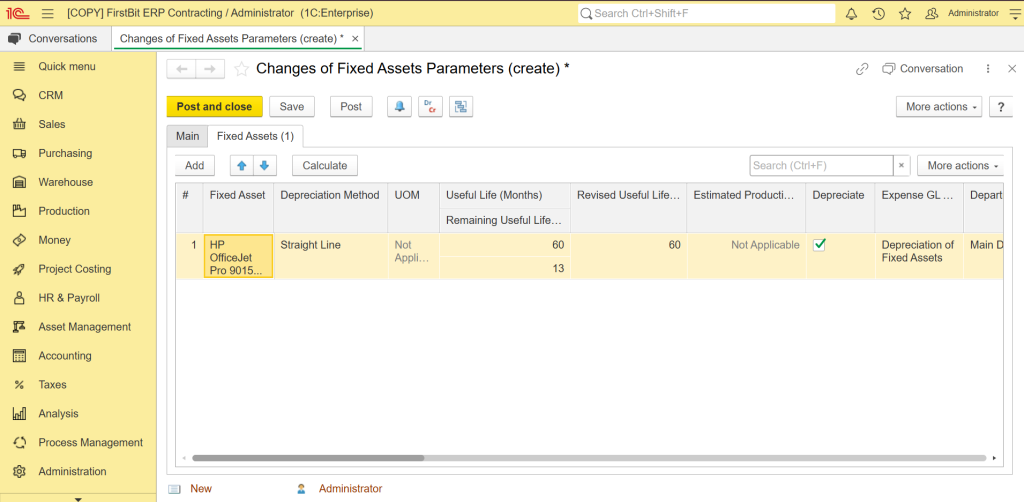
Schedule preventive maintenance. Automate maintenance schedules based on service intervals and equipment usage to reduce the risk of unexpected failures and extend equipment life.
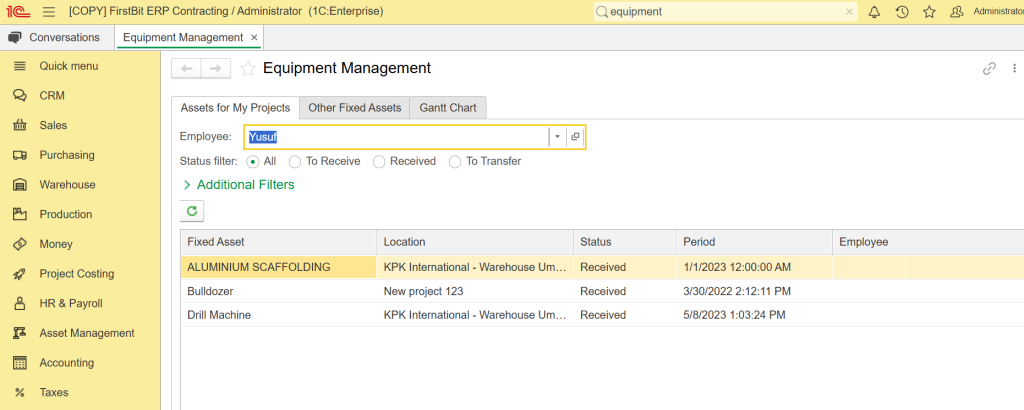
Track equipment in real time. Monitor the location, availability, and status of machinery across multiple construction sites to prevent delays caused by misplaced or unavailable assets.
Calculate equipment hourly cost. Use the machine's internal ownership or rental rate, including depreciation, financing, insurance, and operating costs.
Fixed asset depreciation in FirstBit ERP Contracting
Optimize equipment allocation. Use a centralized resource calendar to assign equipment where it is needed most, minimizing idle time and preventing scheduling conflicts.
Monitor maintenance history. Store service records, warranties, manuals, and inspection documents for every asset, allowing maintenance teams to access critical information quickly.
Track operating costs. Record expenses such as repairs, fuel consumption, depreciation, and rentals to identify high-cost equipment and improve maintenance decisions.
Analyze equipment utilization. Review usage hours and performance data to identify underused or overworked assets, helping companies improve fleet efficiency and make better purchasing or rental decisions.
Equipment management in FirstBit ERP Contracting
By improving visibility, maintenance planning, and equipment utilization, FirstBit ERP helps construction companies reduce downtime and keep projects on schedule. Better equipment management also lowers operating costs and supports higher productivity across every project.
Changes of fixed asset parameters in FirstBit ERP Contracting
Conclusion
Construction companies that understand equipment downtime meaning can make better maintenance decisions, improve equipment availability, and keep projects moving efficiently. Using preventive maintenance, real-time monitoring, and accurate performance data helps reduce unexpected disruptions while supporting more reliable project delivery.
Looking beyond repair expenses also allows contractors to recognize the full cost of downtime, including idle labor, schedule disruptions, equipment rentals, and project overhead. Measuring these impacts accurately enables smarter budgeting, better resource allocation, and long-term operational improvements that strengthen profitability and increase overall business resilience.
Get maximum results from your assets
Request a demo
FAQ
What is equipment downtime in construction?
Equipment downtime refers to any period when machinery or vehicles are unavailable for productive work — due to breakdowns, maintenance, lack of operators, fuel shortages, or administrative delays. Even planned stops (like servicing) count if they’re not optimized.
How does equipment downtime impact project costs in the UAE?
In the UAE’s high-cost, fast-paced environment, idle equipment directly inflates project expenses. You still pay for depreciation, leases, insurance, and operator wages — but generate zero output. On a mid-sized project, just 10% downtime can erase 3–5% of gross profit.
What are the most common causes of unplanned downtime on UAE construction sites?
Top causes include: extreme heat damaging hydraulics/electronics, delayed spare parts due to customs, poor preventive maintenance, operator error, and administrative bottlenecks (e.g., delayed fuel or work permits).
What practical steps can UAE contractors take to reduce equipment downtime?
1. Implement preventive maintenance schedules aligned with UAE climate conditions.
2. Track equipment usage and service history in real time (e.g., via ERP like FirstBit ERP).
3. Pre-approve critical spare parts with customs brokers.
4. Cross-train operators to cover absences.
5. Link equipment availability to project scheduling to avoid “waiting” downtime.
How can contractors calculate the true cost of equipment and fleet used on each project?
The true cost goes beyond the rental or ownership rate — it should include depreciation or lease cost, fuel, maintenance, operator wages, insurance, and an allocation of downtime cost, all attributed to the specific project using the equipment. Tracking these components per asset and per project, rather than as a general overhead line, shows which equipment is actually profitable to keep versus rent as needed.












'%3e%3cg%20clip-path='url(%23clip1_6548_6055)'%3e%3cpath%20d='M13.974%2015.6195C14.2724%2016.0185%2014.6532%2016.3487%2015.0905%2016.5876C15.5278%2016.8265%2016.0114%2016.9686%2016.5084%2017.0042C17.0055%2017.0398%2017.5043%2016.9681%2017.9712%2016.7939C18.4381%2016.6198%2018.8621%2016.3472%2019.2143%2015.9948L21.2994%2013.9098C21.9324%2013.2544%2022.2827%2012.3766%2022.2747%2011.4654C22.2668%2010.5543%2021.9014%209.68269%2021.257%209.03839C20.6127%208.39408%2019.7412%208.02862%2018.83%208.0207C17.9189%208.01278%2017.0411%208.36305%2016.3857%208.99606L15.1902%2010.1845M16.754%2014.2295C16.4555%2013.8305%2016.0747%2013.5003%2015.6374%2013.2614C15.2002%2013.0225%2014.7166%2012.8804%2014.2196%2012.8448C13.7225%2012.8092%2013.2237%2012.8809%2012.7568%2013.0551C12.2899%2013.2292%2011.8659%2013.5018%2011.5136%2013.8542L9.42861%2015.9392C8.7956%2016.5946%208.44534%2017.4724%208.45326%2018.3836C8.46117%2019.2947%208.82664%2020.1663%209.47094%2020.8106C10.1152%2021.4549%2010.9868%2021.8204%2011.898%2021.8283C12.8091%2021.8362%2013.6869%2021.4859%2014.3423%2020.8529L15.5308%2019.6645'%20stroke='%235F7896'%20stroke-width='1.39002'%20stroke-linecap='round'%20stroke-linejoin='round'/%3e%3c/g%3e%3c/g%3e%3crect%20x='0.438953'%20y='0.438953'%20width='28.9709'%20height='28.9709'%20rx='14.4855'%20stroke='%235F7896'%20stroke-width='0.877907'/%3e%3cdefs%3e%3cclipPath%20id='clip0_6548_6055'%3e%3crect%20width='29.8488'%20height='29.8488'%20rx='14.9244'%20fill='white'/%3e%3c/clipPath%3e%3cclipPath%20id='clip1_6548_6055'%3e%3crect%20width='16.6802'%20height='16.6802'%20fill='white'%20transform='translate(7.02344%206.58435)'/%3e%3c/clipPath%3e%3c/defs%3e%3c/svg%3e)