UAE contractors are increasingly adopting AI to reduce delays, control costs, and improve safety. But with dozens of solutions on the market offering different features and capabilities, how can you choose the right AI construction software for your business?
This guide compares the best AI tools for contractors in 2026 across key categories — site monitoring, scheduling, estimating, and safety.
Why Does Construction AI Often Fail to Deliver Results?
Despite the enormous potential of AI, research indicates that technology alone does not guarantee success. A recent study by the RAND Corporation found that more than
80% of AI projects fail. The primary cause of this is the lack of high-quality, well-structured, and accessible data, which AI depends on to generate accurate insights
[?].
In many companies, critical information required for AI construction software is fragmented across Excel spreadsheets, paper documents, and site photos stored on individual devices. This scattered data environment significantly increases project failure rates and hinders AI adoption.
That’s why, for construction companies in the UAE, successful AI implementation depends on having a strong operational foundation. AI tools can deliver meaningful business value only when contractors have centralized project data, integrated workflows, and accurate operational records.
Pro tip: Before investing in AI, begin by unifying your project data. Upload spreadsheets, site reports, photos, and financial records into a centralized system.
How to Choose AI Construction Software: A Contractor’s Checklist
AI platforms used in construction differ in their capabilities, technical requirements, and areas of specialization. When comparing available options, consider how well each platform integrates with existing technology, available project data, and operational needs.
Key criteria to compare include:
-
ERP integration. Does the platform integrate with the ERP and other core systems already used by the organization?
-
Data compatibility. Can it work with the data you already have or would implementation require data restructuring, migration, or additional infrastructure?
-
Type of output. Does the platform primarily provide reporting and analytics, or can it also generate recommendations, forecasts, or proposed actions?
-
Regulatory support. Does it comply with the requirements of Dubai Municipality and Civil Defense?
-
Risk and forecasting capabilities. Can this construction AI software identify risks, delays, and cost overruns before they affect the project?
-
Access and availability. Can relevant information be accessed by field teams and project managers from both office and site?
Top AI Construction Software by Category (2026)
Not all AI construction software delivers real value on active job sites. The right tool depends on your priorities: Are you focused on reducing delays? Improving bid accuracy? Automating safety checks?
Below, we break down the top AI solutions by category — site monitoring, scheduling, estimating, and safety — based on what matters most to UAE contractors: accuracy, integration with existing workflows, and measurable ROI. For each category, we highlight leading platforms, their core strengths, and how they connect to your operational data.
AI for Site Monitoring
If your priority is real-time progress tracking and safety compliance, these tools provide the most value. They also give project teams better visibility across multiple sites, making it easier to coordinate resources and make faster, data-driven decisions.
Construction AI software for site monitoring uses site monitoring uses cameras, drones, and sensors to track activity across a job site in real time. The system collects visual and operational data, then analyzes it with artificial intelligence to detect safety risks, measure progress, and identify delays or quality issues automatically.
The technology works by combining computer vision and machine learning with live site data. AI software reviews images, videos, and sensor inputs to recognize workers, equipment, materials, and construction stages. It can compare actual progress against project schedules, generate reports, and send alerts when problems or unsafe conditions are detected.
Key components of construction AI software for site monitoring:
-
AI-powered CCTV and smart cameras
-
Drones with LiDAR and 3D mapping
-
Computer vision and image recognition
-
Machine learning and predictive analytics
-
IoT sensors and wearable safety devices
Pro tip: Connect live site monitoring tools with automated dashboards and alerts, so project managers can respond to problems instantly instead of relying on manual reporting.
Two following solutions illustrate how these capabilities translate into practice:
Newmetrix focuses on AI-driven construction safety and risk intelligence, while
OpenSpace emphasizes visual site documentation and progress tracking. Together, they represent different approaches to turning jobsite data into actionable project insights.
|
Parameter
|
Newmetrix (Smartvid)
|
OpenSpace
|
|
Primary focus
|
Safety & risk intelligence — identifying jobsite hazards and safety trends from visual data.
|
Reality capture & progress tracking — documenting actual site conditions and measuring construction progress.
|
|
Core technology
|
Computer vision + machine learning applied to jobsite photos/videos; predictive safety analytics.
|
Spatial AI + computer vision; automatically maps 360°/phone/drone imagery to floor plans and BIM and analyzes progress.
|
|
Best for
|
Contractors that want to reduce safety incidents, identify recurring risks and improve safety oversight across projects.
|
Project/site teams looking to verify work completed, remotely inspect sites and compare actual vs. planned progress.
|
AI for Scheduling and Risk Management
For contractors focused on delay prediction and schedule optimisation, these platforms lead the market. They are especially valuable on complex projects where changing constraints and dependencies make traditional static schedules difficult to manage.
AI for builders helps site teams plan projects more accurately while identifying potential issues before they cause delays or cost overruns. The system analyzes project timelines, labor availability, budgets, weather data, and site activity to predict risks and recommend schedule adjustments automatically.
The technology combines machine learning, predictive analytics, and real-time project tracking to continuously monitor progress and detect patterns linked to delays, safety concerns, or resource shortages. AI tools can simulate different project scenarios, prioritize critical tasks, and provide early warnings that support faster and more informed decision-making.
These components of AI construction management software help reduce risks:
-
Machine Learning (ML) models for forecasting and optimization
-
Predictive analytics for risk detection and schedule estimation
-
Real-time dashboards and automated alerts for site monitoring
-
Natural Language Processing (NLP) for analyzing reports, emails and documents
-
Among specialized solutions,
ALICE Technologies focuses on exploring alternative execution strategies to find more efficient project plans, while
nPlan applies AI to existing schedules to quantify uncertainty and identify activities that require attention.
|
Parameter
|
ALICE Technologies
|
nPlan
|
|
Primary focus
|
Schedule optimization & scenario simulation — finds more efficient ways to execute construction projects.
|
Schedule prediction & risk forecasting — predicts delays and identifies schedule risks before they materialize.
|
|
Core technology
|
Generative construction AI + simulation — explores large numbers of “what-if” scenarios across sequencing, resources, time, and cost.
|
AI models trained on 750,000 historical schedules representing $2T+ of construction spend; also uses generative AI (GraphGen) to create/edit schedules.
|
|
Best for
|
Teams looking to optimize schedules, resources, sequencing, and recovery strategies.
|
Teams looking to forecast delays, identify high-risk activities, and improve schedule certainty.
|
AI for Estimating
When bidding accuracy and speed are critical, these AI estimators reduce errors and turnaround time. They also help contractors pursue more opportunities without proportionally increasing the workload of estimating teams.
AI-driven estimating allows construction companies to calculate project costs faster by analyzing digital plans, material quantities, labor requirements, and past project data automatically. Instead of relying only on manual takeoffs, AI tools identify patterns and generate more accurate estimates that help reduce budgeting errors and improve bidding efficiency.
The system works by combining machine learning with construction databases, BIM models, and document analysis tools. AI can scan drawings, extract measurements, track pricing updates, and recommend cost adjustments in real time. This helps estimators respond quickly to design changes while improving forecasting and overall project planning.
Key components of AI construction software for estimation:
-
Machine learning cost prediction models forecast project costs based on historical data and trends
-
BIM (Building Information Modeling) tools connect 3D project models with cost estimation data
-
OCR and drawing recognition technology extract text, dimensions, and details from plans automatically
-
Automated calculations of materials and labor speed up pricing processes
Pro tip: Start by automating repetitive calculations and drawing analysis, so your estimators can focus on strategy, faster bid turnaround, and improving forecast accuracy instead of manual data entry.
Different solutions can strengthen estimating at different stages of the project lifecycle.
Dusty Robotics captures measurable field productivity through BIM-driven robotic layout, creating useful performance benchmarks than can be used during estimation in the future, while
BidLight focuses directly on model-based cost and time estimation using BIM data and construction cost databases.
|
Parameter
|
Dusty Robotics
|
BidLight
|
|
Primary focus
|
BIM-to-field automation — transfers coordinated digital layouts directly onto the jobsite floor. Historical data from robotic layouts can be used to create more accurate budgets for future projects.
|
AI-powered estimating & quantity takeoff — turns BIM/design data into quantities and cost estimates for labor, equipment and materials.
|
|
Core technology
|
FieldPrinter autonomous robotic layout + BIM/CAD integration + automated multi-trade layout. Dusty states accuracy of up to 1/16″.
|
Two AI classifiers — geometry and metadata — combined with BIM/Revit and construction cost databases to classify items and generate estimates.
|
|
Best for
|
Contractors seeking to automate field layout and compile historical productivity data to improve the accuracy of cost estimates for future projects.
|
Estimators, architects and contractors wanting to automate BOQ and early-stage cost estimation from BIM models.
|
AI for Safety and Compliance
To proactively manage EHS risks and automate compliance, consider these specialised safety platforms. They can also strengthen safety culture by giving managers clearer, data-driven insight into recurring hazards and areas that need preventive action.
AI technology improves construction safety by monitoring job sites continuously and identifying risks before accidents happen. The system analyzes live video feeds, equipment activity, worker movement, and environmental conditions to detect unsafe situations, helping teams respond faster and maintain compliance with industry safety regulations.
The platform combines computer vision, machine learning, and smart sensors to automate inspections and safety reporting. AI tools can recognize missing helmets or protective equipment, monitor restricted areas, and generate instant alerts when violations occur. This reduces manual supervision while improving overall site safety and operational efficiency.
Technologies behind safety AI for construction business:
-
Computer vision technology identifies hazards and monitors worker safety behavior
-
Smart surveillance cameras track site activity and detect compliance violations
-
Wearable safety sensors monitor worker location, fatigue, and environmental exposure
-
Automated inspection tools speed up safety checks and compliance reporting
-
Drone-based site inspections safely monitor large or hard-to-access construction areas
Pro tip: Focus your AI safety rollout on one high-risk area first — such as fall protection, heavy equipment zones, or PPE compliance.
Two solutions address different layers of jobsite safety.
Pillar Technologies monitors environmental conditions such as humidity, air quality, and temperature through wireless sensors, while
Intenseye applies computer vision to existing camera infrastructure to identify unsafe acts and conditions and support EHS workflows.
|
Parameter
|
Pillar Technologies
|
Intenseye
|
|
Primary focus
|
Environmental & site-condition risk monitoring — detects conditions that can lead to fire, mold, flooding or unsafe environments.
|
Worker safety & EHS monitoring — detects unsafe behaviors, PPE violations and hazardous conditions in real time.
|
|
Core technology
|
Wireless IoT sensor network + edge computing + AI. Sensors monitor temperature, humidity, CO, VOCs, particulates, noise, light and pressure.
|
Computer vision AI + existing CCTV/video infrastructure. Core AI detects 50+ categories of unsafe acts and conditions.
|
|
Best for
|
Construction teams wanting to prevent environmental risks and protect site conditions/materials through continuous monitoring.
|
HSE/EHS teams wanting to prevent worker incidents and automate safety compliance monitoring.
|
ERP that saves your money
Adopt FirstBit ERP to cut costs, boost ROI, and effectively plan future cash flows
Request a demo
Why is FirstBit ERP a Key to the Success of AI Software?
AI tools are transforming how businesses make decisions, forecast outcomes, and improve efficiency. However, AI is only as effective as the quality of the data it receives. FirstBit ERP does not replace construction AI software — it empowers it by providing accurate, structured, and real-time business data from every department.
With integrated modules connecting data from all departments,
FirstBit ERP serves as the central source of information that AI systems use to generate valuable insights and predictions.
This is how FirstBit ERP modules support AI for contractors:
-
Finance management provides data on cash flow and budget vs actual costs, which AI can use to predict budget overruns, funding requirements, and financial risks.
-
Cost control shares information about cost allocation, helping AI identify cost-saving opportunities across projects, departments, and business operations.
-
Project management tracks project progress and performance, enabling AI to forecast delays, completion timelines, and final project costs.
-
HR & payroll provide attendance and performance data, allowing AI to forecast workforce demand, measure productivity, and identify high-performing employees.
-
Equipment management shares insights into equipment tracking & usage, enabling AI to optimize asset allocation, reduce equipment idle time, and forecast future demand.
With accurate data from FirstBit ERP's
key modules, AI delivers precise insights and reliable forecasts — not vague predictions.
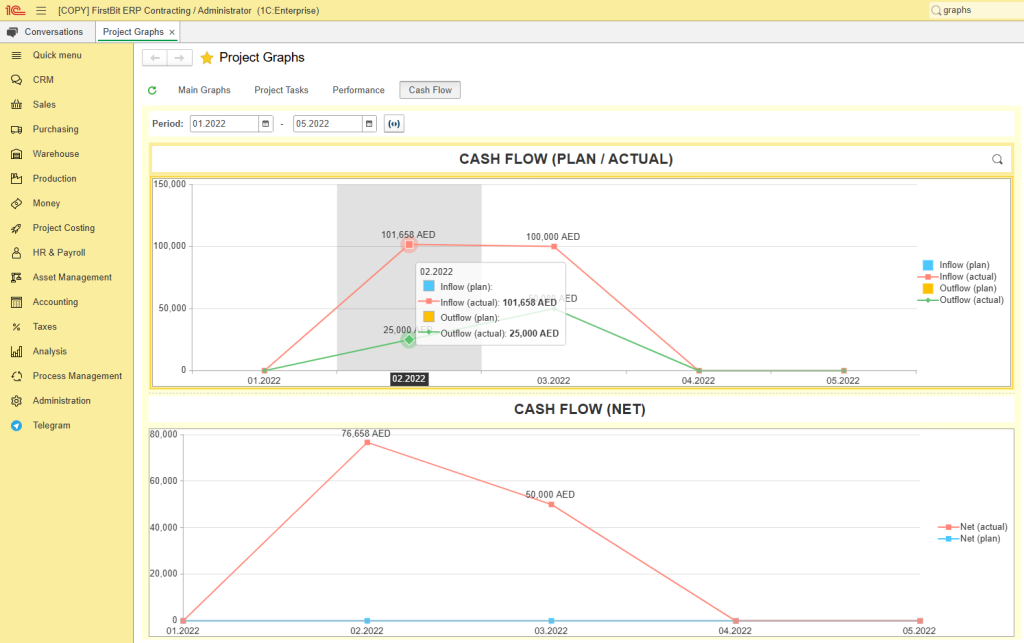
Project graphs in FirstBit ERP Contracting
Conclusion
The best AI construction software isn’t the one with the most features — it’s the one that delivers real value on actual projects. For contractors in the UAE, this means selecting tools that align with their teams' workflows, effectively utilize project data, and provide actionable insights.
Ultimately, the best tools are those that help teams anticipate problems, make better decisions, and improve project outcomes — rather than simply adding another layer of technology.
Ready to prepare your business for AI?
See how FirstBit ERP unifies project, cost, and resource data — so your future AI investments actually work.
Request a demo
FAQ
What is AI construction software?
AI construction software is technology that uses AI to help plan, manage, and execute construction projects more efficiently. It can analyze project data, automate repetitive tasks, predict cost or schedule risks, identify safety and quality issues, organize documents and photos. It also assists with estimating and takeoffs, and gives project teams faster answers from their data.
Do I need AI If I Already Use Project Management Software?
Not necessarily — your existing project management software may already handle scheduling, budgets, documents, and collaboration well. AI is most useful as an added layer when you want to automate repetitive work, analyze large amounts of project data, predict delays or cost risks earlier, optimize resources, and get faster insights for decision-making.
In construction, AI typically complements rather than replaces traditional project management tools, helping teams move from tracking what has happened to anticipating what may happen next.
How can AI be used for project management?
AI construction management software can be used to automate workflows, create project plans and status reports, analyze project data, optimize schedules and resource allocation, and identify potential risks before they become problems.
It can also summarize meetings, site reports and documents, forecast delays or budget issues, and provide data-driven recommendations. This allows project managers to spend less time on administration and more time on decision-making and team leadership.
Can AI replace my project manager or estimator?
No. AI is better suited to supporting project managers and estimators than replacing them. It can assist with takeoffs, analyze costs and schedules, flag risks, and quickly process large amounts of project data. But construction still requires human experience, judgment, context, communication, and accountability for final decisions.
The most effective approach is to use AI as a copilot that saves time and provides insights, while your project manager or estimator remains in control.
What data do I need to make AI work on my projects?
To make AI useful on construction projects, you generally need reliable, organized, and connected project data. This includes site reports, estimates and cost records, schedules, drawings and specifications, RFIs, submittals, and historical project results.
The more consistent and complete this information is, the better AI can identify patterns, forecast risks, benchmark costs, summarize documents, and support decisions. Fragmented or poor-quality data can significantly limit the usefulness of its outputs.












'%3e%3cg%20clip-path='url(%23clip1_6548_6055)'%3e%3cpath%20d='M13.974%2015.6195C14.2724%2016.0185%2014.6532%2016.3487%2015.0905%2016.5876C15.5278%2016.8265%2016.0114%2016.9686%2016.5084%2017.0042C17.0055%2017.0398%2017.5043%2016.9681%2017.9712%2016.7939C18.4381%2016.6198%2018.8621%2016.3472%2019.2143%2015.9948L21.2994%2013.9098C21.9324%2013.2544%2022.2827%2012.3766%2022.2747%2011.4654C22.2668%2010.5543%2021.9014%209.68269%2021.257%209.03839C20.6127%208.39408%2019.7412%208.02862%2018.83%208.0207C17.9189%208.01278%2017.0411%208.36305%2016.3857%208.99606L15.1902%2010.1845M16.754%2014.2295C16.4555%2013.8305%2016.0747%2013.5003%2015.6374%2013.2614C15.2002%2013.0225%2014.7166%2012.8804%2014.2196%2012.8448C13.7225%2012.8092%2013.2237%2012.8809%2012.7568%2013.0551C12.2899%2013.2292%2011.8659%2013.5018%2011.5136%2013.8542L9.42861%2015.9392C8.7956%2016.5946%208.44534%2017.4724%208.45326%2018.3836C8.46117%2019.2947%208.82664%2020.1663%209.47094%2020.8106C10.1152%2021.4549%2010.9868%2021.8204%2011.898%2021.8283C12.8091%2021.8362%2013.6869%2021.4859%2014.3423%2020.8529L15.5308%2019.6645'%20stroke='%235F7896'%20stroke-width='1.39002'%20stroke-linecap='round'%20stroke-linejoin='round'/%3e%3c/g%3e%3c/g%3e%3crect%20x='0.438953'%20y='0.438953'%20width='28.9709'%20height='28.9709'%20rx='14.4855'%20stroke='%235F7896'%20stroke-width='0.877907'/%3e%3cdefs%3e%3cclipPath%20id='clip0_6548_6055'%3e%3crect%20width='29.8488'%20height='29.8488'%20rx='14.9244'%20fill='white'/%3e%3c/clipPath%3e%3cclipPath%20id='clip1_6548_6055'%3e%3crect%20width='16.6802'%20height='16.6802'%20fill='white'%20transform='translate(7.02344%206.58435)'/%3e%3c/clipPath%3e%3c/defs%3e%3c/svg%3e)