Post-handover defects can create serious pressure for contractors during the DLP in construction. They may delay retention release, increase rectification costs, extend project closeout, and lead to disputes over responsibility. These risks become harder to control when defect reports, deadlines, approvals, and supporting documents are managed separately.
The defects liability period in construction provides the contractual framework for identifying, correcting, and closing these issues. Contractors need to understand when the period starts, which defects fall within their obligations, and how completion certificates, retention money, and formal notices affect the process.
This guide explains how the DLP works in UAE construction, including FIDIC terminology, contractor responsibilities, defect rectification procedures, common risks, and practical quality control during the post-handover stage.
What is the Defect Liability Period in Construction
The defects liability period, or DLP, is a contractually defined stage after completion of the construction work. During this period, the contractor must return to the site and correct qualifying defects attributable to its work.
The contract establishes the duration of the DLP, the scope of the contractor’s obligations, and the procedures for notifying and remedying defects. A structured DLP process supports an orderly project handover, improves defect tracking, and reduces the risk of rework, claims, and disputes.
How the Defects Liability Period Works in the UAE Construction?
In UAE construction projects, the DLP is administered according to the executed contract and applicable UAE law. The contract defines the responsibilities of the employer, contractor, consultant, and contract administrator, together with the required notification and rectification procedures.
When an issue is identified, the employer or its representative reports it to the contract administrator. The contract administrator assesses whether the issue qualifies as a construction defect or relates to maintenance, operational damage, design information, or another cause. A confirmed contract defect may lead to an instruction requiring the contractor to complete the necessary remedial work within a reasonable period.
The UAE Civil Transactions Law requires the contractor to complete the work according to the contract terms and recognised professional standards.
Article 818 addresses defective performance identified during the execution of the work. Post-handover defect obligations primarily depend on the executed contract, without prejudice to other statutory liabilities under UAE law, which cannot be overridden.
To help reduce risk of costly disputes and improve project close-out during the defects liability period, UAE contractors should consider the following practical measures:
- Maintain comprehensive project records.Construction project management software helps keep detailed inspection reports, test results, photographs, material certificates, and correspondence to demonstrate compliance if a defect is disputed.
- Carry out pre-handover quality audits. Conduct internal inspections and resolve outstanding issues before requesting taking-over to minimise defect notifications during the DLP.
- Establish a dedicated DLP response team. Assign personnel to manage defect notifications, coordinate site visits, and monitor rectification progress to ensure timely close-out.
- Protect retention and security release. Complete outstanding remedial works promptly to facilitate the release of retention monies, performance bonds, and other contractual securities at the end of the DLP.
- Monitor recurring defects and identify root causes. Analyse repeated issues across projects to improve construction methods, subcontractor performance, and quality management systems, reducing future defect claims.
Duration of the Defects Liability Period in Construction
The duration of the defects liability period in construction is established in the contract. It usually begins from the completion or handover date recorded under the relevant contractual procedure.
The contract may set one period for the entire project or separate periods for individual Sections. It should also specify the events that can extend the DLP, including additional time required to assess or correct particular defects.
The contractual DLP should not be confused with longer statutory liabilities under UAE law. These obligations may continue after the contractual defects period has ended, particularly in cases involving structural integrity or building safety.
Note
In addition to defect liability during the DLP, UAE law also provides for Decennial Liability under Articles 821 to 824 of the UAE Civil Transactions Law (Federal Decree-Law No. 25 of 2025), effective from 1 June 2026.
It imposes strict liability on the contractor and the supervising engineer for 10 years from the handover date regarding the total or partial collapse of a building or fixed structure, or defects that threaten its structural stability or safety.
Practical Completion vs. Taking-Over Certificate (TOC)
Practical Completion and a Taking-Over Certificate are completion milestones defined by the applicable construction contract. They confirm that the works have reached the required stage for handover and may establish the start of the relevant defects period.
Practical Completion is commonly used to confirm that the works are ready for their intended use, with only minor defects or outstanding items remaining. The exact certification requirements and contractual consequences should be stated in the agreement. A Taking-Over Certificate formally records the completion and handover of the Works or a specific Section under contracts that use this procedure.
The completion date stated in the certificate may determine when the post-completion defects period begins. The distinction lies in the terminology and certification process established by the contract. Project teams should apply the exact milestone, definition, and procedure stated in the signed agreement.
Protect your rights under UAE law
Manage contracts efficiently with FirstBit ERP
Request a demo
Defects Liability Period Under FIDIC Contracts
The FIDIC MDB Harmonised Construction Contract regulates post-completion defects under Clause 11, titled Defects Liability. This clause covers outstanding work, defect rectification, cost allocation, access to the Works, further testing, and final confirmation of the contractor’s performance.
The specific requirements depend on the General Conditions, Contract Data, and any amendments included in the Particular Conditions. Project teams should therefore check the signed contract before applying the standard FIDIC procedures.
Key implications include:
Contractor's obligation to remedy defects. The Contractor must complete any outstanding work and rectify defects, shrinkages, or faults that become apparent during the DLP and are attributable to its design (where applicable), workmanship, or materials, at its own cost.
Employer's remedies for non-compliance. If the Contractor fails to correct notified defects within a reasonable time, the Employer may arrange for others to perform the remedial work and recover the associated costs from the Contractor, subject to the contract provisions.
Extension of the DLP. Where defects are remedied during the DLP, the defects liability period for the affected parts of the Works may be extended in accordance with the contract. On UAE projects, Particular Conditions commonly extend the overall DLP from the FIDIC default of 12 months to 24 months, particularly for complex building and infrastructure projects.
Performance Certificate. Clause 11 concludes with the issue of the Performance Certificate after all outstanding work and notified defects have been satisfactorily completed, confirming that the Contractor has fulfilled its contractual obligations under Clause 11.
Interaction with UAE law. While Clause 11 governs the contractual DLP, it does not replace or limit the UAE's mandatory decennial liability regime for serious structural defects. Under UAE law, contractors and, where applicable, designers may remain jointly liable for structural collapse or defects affecting the stability of the structure for 10 years after completion, regardless of the contractual DLP.
Defects Notification Period (DNP) vs. Defects Liability Period (DLP)
Defects liability period in construction is a common industry term for the stage during which the contractor remains responsible for qualifying defects. In the FIDIC MDB Harmonised Construction Contract, the defined term is Defects Notification Period, or DNP. Clause 11 retains the title Defects Liability, and the contractual period itself is called the DNP.
The standard DNP is 365 days unless another period is stated in the Contract Data. It starts from the date on which the Works or the relevant Section were completed, as certified under Sub-Clause 10.1. Separate Sections may have their own DNP start dates.
The DLP in construction may be extended when a defect or contractor-related damage prevents the Works, a Section, or a major item of Plant from being used for its intended purpose. Under this FIDIC form, the extension cannot exceed two years.
In practical terms, DLP describes the general post-completion liability stage, and DNP is the exact contractual term used in this FIDIC form. Using DNP in contract notices, certificates, and formal correspondence helps maintain consistency with the signed agreement.
Responsibilities During the DLP in Construction
The DLP requires coordinated action from the contractor, client, consultant, and contract administrator. Each party follows the notification, inspection, rectification, and approval procedures stated in the construction contract.
Clear allocation of responsibilities helps the project team determine whether an issue is a construction defect, a maintenance requirement, operational damage, or a design-related matter. This assessment affects who must arrange the corrective work and who bears the related cost.
Accurate records are also essential throughout the process. Defect notices, inspection reports, photographs, instructions, completion evidence, and approval documents create a clear audit trail and support the formal closure of each issue. Effective coordination reduces delays, repeated site visits, and disputes during the post-handover stage.
| Comparison point | Contractor is liable | Contractor is not liable |
| Cause of the defect | Defect results from the contractor's design, workmanship, Plant, Materials, or another contractual breach. | Defect results from the Employer's use of the works, third parties, or another cause outside the contractor's contractual responsibility. |
| Who pays for rectification? | The contractor bears the cost and risk of the remedial work. | The Employer pays, or the work is valued under the Variation procedure if the contractor is not responsible. |
| Typical examples | Defective concrete, substandard materials, faulty installation, contractor-controlled design errors, or failure to comply with contract requirements. | Damage caused by improper operation after taking over, accidental third-party damage, Employer-instructed changes, or fair wear and tear. |
| Applicable contractual mechanism | Defects are remedied under Clause 11 (Defects Liability). | Work outside the contractor's responsibility is addressed through Clause 13 (Variations) or other applicable contract provisions. |
Contractor Obligations During Liability Period Under FIDIC Clause 11
Under Sub-Clause 11.1, the contractor must complete any work recorded as outstanding in the Taking-Over Certificate. This work must be completed within the reasonable time instructed by the Engineer.
The contractor must also remedy defects or damage notified by the Employer or its representative before the relevant DNP expires. Rectification may continue after the expiry date when additional time is reasonably required to complete the work.
The contractor bears the risk and cost of remedial work caused by contractor-controlled design, non-compliant plant, supplied materials or workmanship, installations or failure to meet another contractual obligation. Work arising from another cause is handled under the applicable Variation procedure.
The Engineer may require the contractor to investigate the cause of a defect. Further tests may also be required when remedial work could affect the performance of the Works. The contractor retains reasonable access for these activities until the Performance Certificate is issued, subject to the Employer’s security requirements.
The contractor’s obligations are formally recognised as complete when the Engineer issues the Performance Certificate. This takes place after the relevant DNP has expired and the required documents, completion work, tests, and defect corrections have been finalised.
Contractor's Responsibilities Under UAE Civil Code: Decennial Liability
In addition to the contractual obligations that apply during the Defects Liability Period (DLP), contractors in the UAE may also be subject to statutory liability under
Federal Decree-Law No. 25 of 2025 (UAE Civil Code).
Articles 821-824 establish a mandatory decennial liability regime that applies independently of the contractual DLP and cannot be excluded by agreement. This statutory liability applies to serious structural defects that threaten the stability or safety of a building or other fixed installation.
Key aspects of the UAE decennial liability framework include:
Joint liability. The main contractor and the supervising architect or engineer are jointly liable for structural defects or collapse that threaten the stability or safety of a building or other fixed installation. Subcontractors are excluded from direct decennial liability to the employer.
Ten-year liability period. The statutory liability applies for ten years from the date of delivery or handover of the completed works.
Ground conditions are not a defence. Liability may still arise even where structural failure results from defects in the land or ground conditions.
Employer approval does not remove liability. The contractor and supervising designer remain liable even if the employer approved the construction or accepted the completed works.
Mandatory statutory obligation. Decennial liability cannot be excluded or reduced by contractual agreement, although parties may agree to a longer liability period.
Note
The statutory decennial liability under Articles 880–883 is separate from the contractual DLP. While the DLP primarily covers the contractor's obligation to rectify defects identified after handover, decennial liability applies specifically to serious structural defects affecting the stability or safety of the completed works.
| Feature | Contractual DLP (Defects Liability Period) | Decennial Liability |
| Source | Defined by the executed construction contract (e.g., FIDIC). | UAE Civil Transactions Law (Federal Decree-Law No. 25 of 2025), Articles 821–824. |
| Duration | Typically 12–24 months from the date of taking over/andover, depending on the contract. | Exactly 10 years from handover. |
| Scope | Covers all defects, including minor defects, finishes, MEP issues, and workmanship. | Covers only major structural defects, including total or partial collapse or defects that threaten the stability, safety, or structural integrity of the building. |
| Flexibility | Can be negotiated, amended, extended, shortened, or waived by agreement between the parties. Cannot be excluded, limited, or reduced by contractual agreement. | Cannot be excluded, limited, or reduced by contractual agreement. |
Client and Contract Administrator’s Role
The client or its representative is responsible for reporting defects found during the DLP and providing the contractor with access to the affected areas. Reports should include clear descriptions, locations, photographs, and any information that helps assess the issue.
The contract administrator reviews each report and determines whether the issue falls within the contractor’s obligations. This assessment may require site inspections, technical input, maintenance records, and a review of the contract specifications.
When a defect is confirmed, the contract administrator issues the required instruction, monitors the rectification work, and checks whether it has been completed to the agreed standard. The client also maintains the supporting records needed for approvals, cost recovery, retention release, and formal closure of the defect.
Based on the UAE construction literature and standard construction contract principles (including FIDIC), compensation or reimbursement to the contractor may be justified in the following circumstances:
The defect results from the client's misuse, improper operation, or failure to carry out routine maintenance after handover, as these issues fall outside the contractor's DLP obligations.
The reported issue is caused by errors, omissions, or inadequacies in the employer's or consultant's design or specifications rather than the contractor's workmanship, supplied materials, or installations.
The client appoints another contractor to modify, repair, or maintain the affected work during the DLP without notifying or coordinating with the original contractor, preventing the original contractor from exercising its contractual right to rectify the defect.
Navigate UAE construction laws with an ERP built for the UAE market
Request a demo
Types of Defects Covered by the Liability Period in Construction
The DLP generally covers defects connected with the contractor’s completed work and contractual obligations. These issues may become visible during inspections, handover, or the early operation of the asset.
Common categories include poor workmanship, defective materials, incorrect installation, and work that does not meet the approved drawings or contract specifications. Each reported issue should be assessed against the contract to confirm its cause, responsibility, and required corrective action.
Clear classification helps project teams assign defects correctly, track recurring quality problems, and maintain consistent records throughout the rectification process.
Workmanship Defects
Workmanship defects result from poor execution, incorrect installation, or failure to follow approved construction methods. Common examples include:
These defects are usually assessed against approved drawings, method statements, quality standards, and inspection records. When the issue is linked to the contractor’s work, the contractor must correct it and restore the affected area to the required standard.
Proper defect records help identify repeated workmanship problems and support improvements in supervision, training, and quality control on future projects.
Material Defects
Material defects arise when products or components fail to meet the required quality, performance, or durability standards. Examples include:
The assessment should consider approved material submittals, manufacturer specifications, test certificates, and contract requirements. It should also confirm whether the issue results from the material itself, improper storage, poor handling, or incorrect installation.
When responsibility falls under the contractor’s scope, the defective material must be repaired or replaced with a compliant product. The contractor may also need to repeat testing and provide updated warranties or technical documents before the issue can be closed.
Non-Compliance with Contract Specifications
This type of defect occurs when completed work does not meet the approved drawings, technical specifications, performance criteria, or other contractual requirements. It may involve:
The assessment should compare the installed work with the contract documents, approved submittals, inspection records, and test results. Once non-compliance is confirmed, the contractor must correct the work, replace the affected elements, or provide another approved remedy.
Formal approval should only be issued after the corrective work has been inspected and all required documents have been updated. Clear records help prevent similar specification issues from recurring on future projects.
How Retention Money Is Linked to the DLP in the UAE
Retention money is a portion of the contractor’s payment temporarily withheld by the client as financial security. It helps protect the client when outstanding work remains or defects require correction after handover.
In UAE practice, the retained amount is commonly around 5% of the total contract price, although the exact percentage is determined by the contract[?].
In UAE construction projects, the retention percentage, payment limits, and release conditions are defined in the contract. The first release is commonly connected to completion or taking over, while the remaining balance is held during the DLP. This gives the contractor a financial incentive to complete remedial work and close all confirmed defects.
The outstanding retention is released after the relevant defects period has expired and the required corrections have been completed and approved. The contract may also allow the contractor to replace the retained amount with an approved guarantee, subject to the stated conditions.
Accurate defect records and formal approval are important because unresolved issues may delay certification and the final release of retention money.
Standard Phased Release Schedule
Retention money is usually released in two stages. The first portion becomes eligible for release after completion or taking over has been certified. Before approving payment, the contract administrator may confirm that the required handover documents have been submitted and major outstanding items have been completed.
The remaining portion is held during the DLP. It is released after the relevant period expires, the contractor remedies all confirmed defects, and the required certification is completed. The contract administrator may retain an amount equal to the estimated cost of any outstanding corrective work.
Under the
FIDIC MDB Harmonised Construction Contract, half of the retention is certified following the Taking-Over Certificate. The outstanding balance is certified after the relevant Defects Notification Periods expire. The contract may also allow the contractor to replace the remaining retention with an approved guarantee. Exact percentages, conditions, and release dates should always follow the signed contract.
Stay compliant with UAE laws
Automate VAT, payroll, and documentation
Request a demo
Procedures for Rectifying Defects during the DLP in Construction
Defect rectification during the DLP in construction should follow the procedure stated in the construction contract. The process normally starts with a formal defect notice and continues through inspection, responsibility assessment, corrective work, verification, and closure.
Each defect should be recorded with a clear description, location, date, supporting photographs, and required completion deadline. The contract administrator then reviews the issue, confirms whether it falls within the contractor’s obligations, and issues the necessary instruction.
The contractor completes the remedial work and submits evidence for inspection. The defect is closed only after the authorised representative confirms that the correction meets the contract requirements. A consistent process helps prevent missed deadlines, incomplete repairs, and disputes over responsibility.
Reporting Defects
A defect should be reported as soon as it is identified during the liability period in construction. The notice should describe the issue clearly and include its location, date of discovery, photographs, and any available evidence of its impact.
The report should also reference the relevant drawing, specification, inspection record, or contract requirement when possible. This helps the contract administrator assess the issue and determine whether it falls within the contractor’s obligations.
Each defect should receive a unique reference number and status. Consistent tracking supports follow-up, prevents duplicate reports, and creates a reliable record for inspection, rectification, and final closure.
Pro tip
Record any temporary mitigation measures taken before rectification, such as isolating the affected area, installing temporary protection, or restricting access. Documenting these actions demonstrates that risks were managed promptly while the permanent repair is being arranged.
Rectification Process
After receiving a defect notice, the contractor inspects the affected area, confirms the cause, and defines the required corrective work. The proposed method should follow the contract specifications, approved materials, and relevant quality and safety requirements.
The contractor then arranges labour, equipment, specialist support, and site access. Remedial work should be completed within the agreed timeframe and with minimum disruption to building operations. Any affected finishes, systems, or surrounding areas should also be restored to the required condition.
Once the work is complete, the contractor submits supporting evidence for inspection. This may include photographs, test results, service reports, and updated defect records. The rectification remains open until the authorised representative confirms that the issue has been resolved.
Pro tip
Before closing the defect, verify that the root cause — not just the visible symptom — has been addressed. Where appropriate, carry out follow-up inspections or performance testing after the repair to confirm the defect will not reoccur. This provides stronger evidence that the rectification is complete and compliant with the contract requirements.
Certification of Making Good Defects (CMGD)
The contract administrator verifies whether the corrective work meets the contract requirements . This may involve a site inspection, technical review, or confirmation that the required testing has been completed. A defect is certified as made good when the remedial work has been accepted and no further action is required.
The certification creates a formal record that the issue has been closed. Completion of this process may support retention release, final account settlement, and confirmation that the contractor has fulfilled the relevant post-completion obligations.
Pro tip
Keep the signed certificate together with all supporting evidence—such as inspection records, test certificates, commissioning reports, and approved as-built documentation. Maintaining a complete audit trail simplifies future maintenance, warranty claims, and dispute resolution if questions arise after project completion.
Consequences of Failure to Rectify Defects During the DLP in the UAE
If these contractors don’t fulfill the obligations during the liability period in construction, employers may exercise a range of contractual remedies and legal rights to protect their interests.
In the UAE, these remedies are primarily governed by the construction contract —commonly based on FIDIC forms — and supplemented by the UAE Civil Transactions Law (Civil Code), which preserves certain statutory liabilities regardless of the contractual DLP.
Below are the most common consequences of failure to rectify defects:
Employer may carry out repairs at the contractor's cost. If the contractor fails to rectify notified defects within the required time, the employer may engage a third party to complete the remedial works and recover the associated costs from the contractor.
Retention money may be withheld or set off. The employer may retain or deduct amounts from retention sums to cover the cost of outstanding defect rectification.
Performance security may be called. Where provided under the contract, the employer may call on the performance bond or bank guarantee if the contractor fails to fulfil its DLP obligations.
Extension of the DLP for remedied works. Contracts commonly extend the DLP for repaired defective works, meaning the contractor's obligations continue beyond the original expiry date for those items. In the UAE it is common for the DLP to restart or be extended for the affected portion of the repair works (for example, up to 48 months from the Taking-Over Certificate under some FIDIC-based contracts).
Exposure to breach of contract claims and damages. Failure to rectify defects may constitute a contractual breach, entitling the employer to claim damages, terminate the contract in certain circumstances, or appoint another contractor to complete the works at the defaulting contractor's expense.
Potential statutory liability beyond the DLP. Expiry of the contractual DLP does not extinguish statutory liabilities. According to Federal Decree-Law No. 25 of 2025, contractors and supervising engineers may still face the UAE's mandatory decennial liability for structural defects affecting the stability or safety of the building.
Meet all of the UAE legal requirements with FirstBit ERP
Request a demo
Common Risks During the Defects Liability Period and Tips for Managing Them
The DLP can create financial, operational, and contractual risks when defects are not managed through a clear process.
| Risk | Typical cause | Consequence | Control |
| Incorrect classification | Unclear defect cause | Dispute over cost | Technical assessment |
| Late rectification | Poor deadline control | Retention delay | Automated tracking |
| Incomplete evidence | Scattered documentation | Defect remains open | Central record |
| Recurring defects | Weak root-cause analysis | Repeated costs | Trend analysis |
Unresolved defects may affect building operation, client satisfaction, retention release, final certification, and project closeout. Regular reviews, clear deadlines, and complete documentation help keep the DLP under control.
How to manage risks during the defects liability period in construction:
Define responsibilities clearly. Assign responsibility for each defect to the relevant contractor, subcontractor, or supplier to avoid accountability gaps.
Maintain resource availability. Keep key personnel, specialist subcontractors, and spare materials available throughout the DLP to prevent delays in corrective work.
Verify repairs before closure. Inspect and test completed remedial works to confirm the defect has been fully resolved before closing the case.
Manage subcontractor obligations. Ensure back-to-back warranty and DLP obligations are enforced so the main contractor is not exposed to unrecoverable costs.
Monitor contractual milestones. Track retention release dates, warranty expiries, and DLP extensions to avoid missed contractual obligations or financial exposure.
Prepare for dispute resolution. Establish a clear escalation process for unresolved defects, including technical reviews and contractual claim procedures, to minimise project closeout disputes.
How Can FirstBit ERP Help Ensure Quality Control During the Defects Liability Period in Construction?
During the DLP,
FirstBit ERP can support contractors in centralising defect-related tasks, supporting documents, corrective work, project costs, and retention information within one integrated system.
Centralised Task and Document Tracking
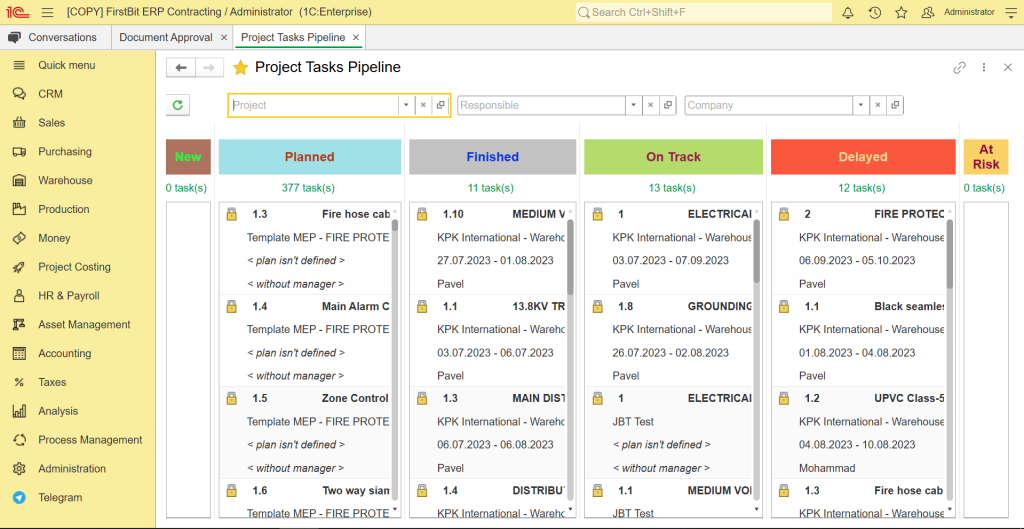
Project teams can use tasks and project records to document reported defects, add descriptions and photographs, assign responsible employees, set deadlines, and monitor progress. Files, notes, inspection evidence, and approval documents can be attached to the relevant records, helping maintain a traceable history of corrective actions. The exact defect fields and workflow may be configured according to the contractor’s internal procedures.
FirstBit ERP Project Tasks Pipeline showing task responsibilities, deadlines, and progress statuses
Controlled Rectification Workflows
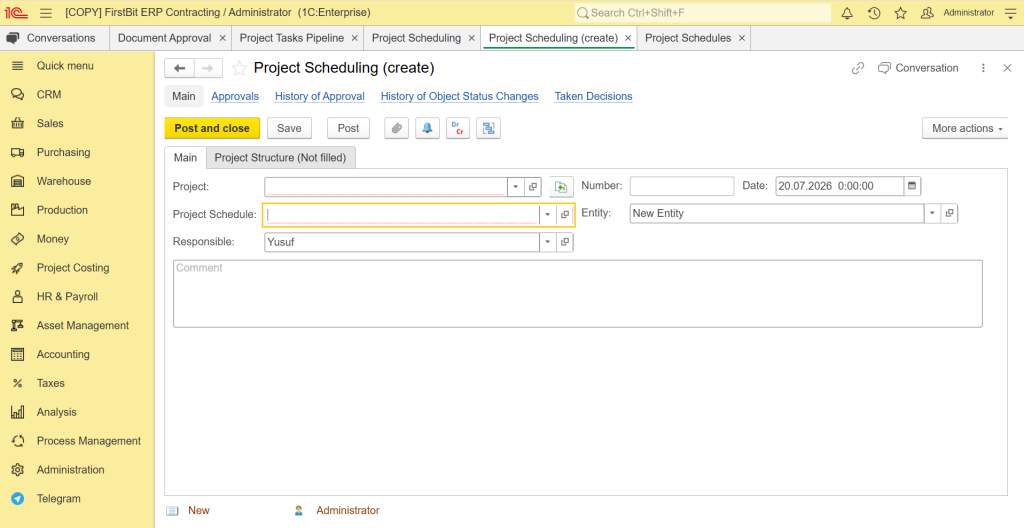
Corrective actions can be scheduled, assigned, prioritised, and monitored through project task and approval tools. Automated notifications and configurable approval workflows help teams follow deadlines and review supporting evidence. Where subcontractors are involved, related tasks, documents, costs, and procurement transactions can be recorded within the project workflow, subject to the company’s system configuration.
FirstBit ERP provides approval histories, status-change records, attachments, and responsible-person assignment
Cost and Resource Control
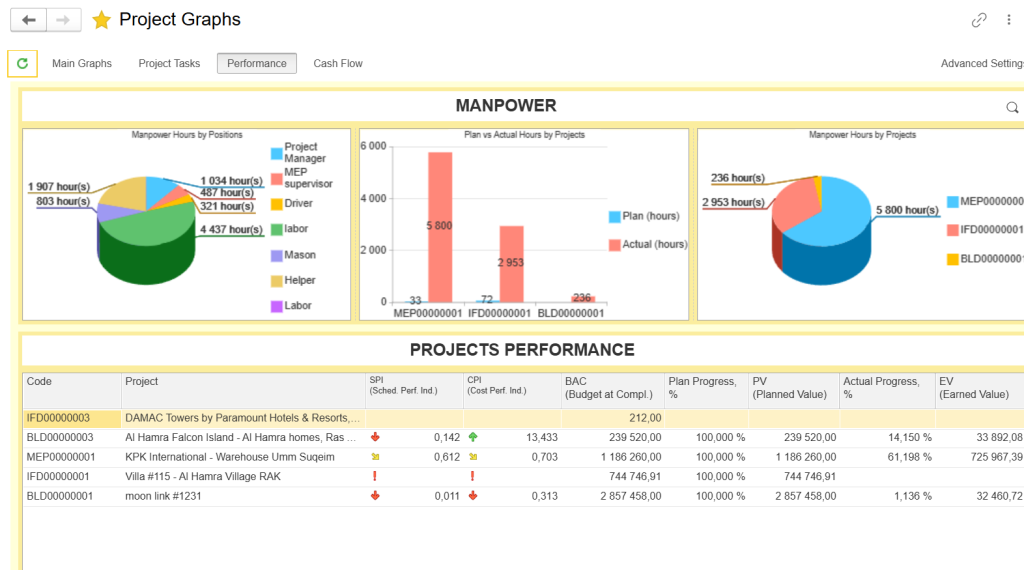
Remedial work can be linked to project tasks, labour, materials, subcontractor costs, procurement requisitions, and other project expenses. Real-time dashboards and reports provide visibility into task progress, resource requirements, project costs, and retention transactions, supporting more controlled defect resolution and project closeout.
FirstBit ERP project dashboard showing manpower allocation, planned versus actual labour hours, and project performance indicators
Protect your rights under UAE law
Manage contracts efficiently with FirstBit ERP
Request a demo
Conclusion
The liability period in construction is a practical test of how well a construction project was planned, documented, and controlled. The speed and accuracy of defect resolution depend heavily on the quality of handover records, responsibility allocation, communication, and approval procedures established before completion.
Defect data also provides valuable insight into recurring weaknesses in workmanship, materials, supervision, and contract administration. When this information is classified and analysed consistently, project teams can improve procurement decisions, quality checks, subcontractor management, and site controls across future developments.
A structured digital process strengthens this approach by connecting defect records with deadlines, costs, resources, inspections, and supporting documents. This gives contractors and clients greater control over post-handover obligations and supports a more reliable transition from construction completion to long-term asset operation.
FAQ
What happens after the Defects Liability Period expires?
The expiry of the Defects Liability Period does not automatically release the contractor from all obligations. Outstanding defects notified within the applicable period may still need to be rectified, and final certification or retention release may depend on their completion. Separate statutory liabilities may also continue after the contractual DLP expires, including the ten-year liability under Article 821 of the UAE Civil Transactions Law for specified structural failures and safety-related defects.
What is the defects liability period in construction?
The Defects Liability Period, or DLP, is a contractually defined post-completion period during which the contractor must remedy qualifying defects attributable to its work or contractual responsibilities. Its duration and commencement date are established by the contract. Twelve months is common and is the default Defects Notification Period under the FIDIC MDB Harmonised 2006 form unless the Contract Data states otherwise. Other contracts may provide for shorter or longer periods.
What does DLP stand for in construction?
DLP stands for Defects Liability Period. It is the contractual stage following the relevant completion, handover, or taking-over milestone during which the contractor must correct qualifying defects in its workmanship, materials, installations, or other contractual work. The contractor normally bears the cost when the defect is attributable to its contractual responsibility.
What is the defect liability period in the UAE?
There is no single statutory Defect Liability Period that applies to every construction project in the UAE. The duration, commencement date, covered defects, and rectification procedure are generally determined by the signed construction contract. The contractual DLP should not be confused with the separate ten-year statutory liability under Article 821 of the UAE Civil Transactions Law, which covers total or partial collapse and defects threatening the structural integrity or safety of buildings and fixed installations.
Navigate UAE construction laws with an ERP built for the UAE market
Request a demo












'%3e%3cg%20clip-path='url(%23clip1_6548_6055)'%3e%3cpath%20d='M13.974%2015.6195C14.2724%2016.0185%2014.6532%2016.3487%2015.0905%2016.5876C15.5278%2016.8265%2016.0114%2016.9686%2016.5084%2017.0042C17.0055%2017.0398%2017.5043%2016.9681%2017.9712%2016.7939C18.4381%2016.6198%2018.8621%2016.3472%2019.2143%2015.9948L21.2994%2013.9098C21.9324%2013.2544%2022.2827%2012.3766%2022.2747%2011.4654C22.2668%2010.5543%2021.9014%209.68269%2021.257%209.03839C20.6127%208.39408%2019.7412%208.02862%2018.83%208.0207C17.9189%208.01278%2017.0411%208.36305%2016.3857%208.99606L15.1902%2010.1845M16.754%2014.2295C16.4555%2013.8305%2016.0747%2013.5003%2015.6374%2013.2614C15.2002%2013.0225%2014.7166%2012.8804%2014.2196%2012.8448C13.7225%2012.8092%2013.2237%2012.8809%2012.7568%2013.0551C12.2899%2013.2292%2011.8659%2013.5018%2011.5136%2013.8542L9.42861%2015.9392C8.7956%2016.5946%208.44534%2017.4724%208.45326%2018.3836C8.46117%2019.2947%208.82664%2020.1663%209.47094%2020.8106C10.1152%2021.4549%2010.9868%2021.8204%2011.898%2021.8283C12.8091%2021.8362%2013.6869%2021.4859%2014.3423%2020.8529L15.5308%2019.6645'%20stroke='%235F7896'%20stroke-width='1.39002'%20stroke-linecap='round'%20stroke-linejoin='round'/%3e%3c/g%3e%3c/g%3e%3crect%20x='0.438953'%20y='0.438953'%20width='28.9709'%20height='28.9709'%20rx='14.4855'%20stroke='%235F7896'%20stroke-width='0.877907'/%3e%3cdefs%3e%3cclipPath%20id='clip0_6548_6055'%3e%3crect%20width='29.8488'%20height='29.8488'%20rx='14.9244'%20fill='white'/%3e%3c/clipPath%3e%3cclipPath%20id='clip1_6548_6055'%3e%3crect%20width='16.6802'%20height='16.6802'%20fill='white'%20transform='translate(7.02344%206.58435)'/%3e%3c/clipPath%3e%3c/defs%3e%3c/svg%3e)