





AI in Construction Scheduling: How UAE Contractors Improve Project Timelines with Data
Publication date 24 Jun 2026 •
Updated 22 Jul 2026 •
17 min read

Arina Sherbakova
Author & editor


Construction projects in the UAE demand accurate planning, fast decision-making, and the ability to adapt to constant changes — all of which can be significantly improved through the use of artificial intelligence in construction scheduling.
Today, AI construction scheduling can predict potential delays, optimize resource allocation, automate schedule updates, and create more reliable project timelines using real-time and historical project data.
In this guide, you'll learn how AI can be used in project scheduling, how it is transforming construction planning, what AI scheduling software is available and how you can implement AI for project scheduling to achieve faster, more predictable project delivery.
How AI in Construction Scheduling Works
AI construction scheduling uses artificial intelligence, machine learning, and predictive analytics to build and manage project schedules based on historical performance, real-time site data, resource availability, and task dependencies.
Instead of relying solely on manual updates, AI continuously analyzes changing conditions, identifies scheduling conflicts, and recommends adjustments that help teams keep projects on track.
This is the process behind AI in construction scheduling:
- Data collection. AI gathers project information from multiple sources, including construction ERP software, BIM, project schedules, IoT sensors, weather forecasts, and equipment logs. This creates a centralized dataset that serves as the foundation for scheduling decisions.
- Data analysis. Once data is collected, AI cleans, organizes, and analyzes it to identify productivity trends, task dependencies, resource utilization, and common causes of delays. Machine learning models uncover patterns that help improve schedule accuracy.
- Schedule generation. AI automatically generates an optimized construction schedule by sequencing activities, estimating task durations, defining dependencies, and assigning available resources. It can produce an initial baseline schedule within minutes.
- Resource optimization. AI evaluates labor, equipment, and material availability to recommend the most efficient resource allocation. It helps minimize idle time, avoid conflicts, and improve overall project productivity.
- Risk prediction. AI continuously predicts potential schedule delays caused by weather, labor shortages, equipment failures, material delivery issues, or productivity trends. Early warnings allow project teams to take corrective action before delays occur.
- Scenario simulation. AI evaluates hundreds or even thousands of "what-if" scenarios to determine the most efficient project schedule. It compares different sequencing strategies, resource plans, and constraints to identify the best balance between time, cost, and risk.
- Real-time monitoring. AI continuously compares planned progress with actual site progress using updates from field personnel, IoT sensors, drones, cameras, and other connected devices. As conditions change, the schedule can be automatically updated to reflect the latest project status.
Pro tip: Some AI scheduling platforms can even identify potential delay risks weeks in advance. This can give your project teams valuable time to take corrective action and improve on-time project delivery.
How UAE Contractors Can Use AI Construction Scheduling
AI construction scheduling helps UAE contractors plan projects more accurately, reduce delays, and improve coordination across multiple teams. This is especially valuable in the UAE, where large-scale developments, tight completion dates, and challenging summer working conditions require precise planning.
By integrating AI with ERP solutions in Dubai, contractors can also connect scheduling with procurement, workforce allocation, finance management, and project cost control to make faster, data-driven decisions throughout the project lifecycle.
UAE contractors can use AI in construction scheduling to:
-
Plan around the UAE climate conditions. AI forecasts the impact of extreme summer temperatures and adjusts work sequences to maximize productivity while supporting safe working hours.
-
Coordinate multinational workforces more efficiently.AI helps allocate labour across multilingual teams, reducing idle time and ensuring the right trades are available when needed on site.
-
Adapt to changing workforce availability. AI factors in public holidays, shorter working hours during Ramadan and historical labour availability to create more realistic schedules and minimise productivity disruptions.
-
Reduce delays from material deliveries. AI monitors procurement schedules, import lead times, and supplier performance to identify potential disruptions before they affect construction progress.
-
Track progress across multiple Emirates. Contractors managing projects in Dubai, Abu Dhabi, Sharjah, or other Emirates can use AI to monitor progress in real time and quickly rebalance resources between sites.
-
Support compliance with local project requirements. AI helps track critical milestones, inspection schedules, and documentation, making it easier to meet client expectations and regulatory obligations.
Make fast, data-driven decisions with real-time dashboards
Request a demo
Traditional Scheduling vs AI Construction Scheduling
Traditional scheduling heavily relies on the experience of project managers and periodic updates. Meanwhile, AI-driven scheduling enhances decision-making by identifying risks earlier, optimizing resource allocation, and continuously adapting schedules as project conditions change.
The table below compares the key differences between AI construction scheduling and traditional scheduling approaches.
| Aspect | AI in construction scheduling | Traditional scheduling |
| Planning method | Uses AI, machine learning, and predictive analytics to automate and optimize schedules. | Built manually using planner experience and tools like CPM, Gantt charts, or spreadsheets. |
| Schedule updates | Continuously updates using real-time project data and automated monitoring. | Requires manual updates, making schedules more static and time-consuming to maintain. |
| Risk management | Predicts delays early and recommends mitigation strategies through scenario analysis. | Risks are typically identified only after manual review or when issues occur. |
| Decision making | Supports data-driven decisions with "what-if" simulations and optimization. | Relies primarily on planner expertise and historical experience. |
| Efficiency | Reduces planning time, improves accuracy, and handles complex projects more effectively. | More labor-intensive, with greater potential for human error on large projects. |
| Best use | Large, complex, data-rich construction projects that require continuous optimization. | Small or straightforward projects where manual scheduling is sufficient. |
Proven Results of Using Artificial Intelligence in Construction Scheduling
A review titled "AI and Construction Project Schedules Efficiency" (2025) analyzed seventeen peer-reviewed studies, industry reports, and case studies on AI applications in construction project scheduling published between 2000 and 2024.
Below are its key findings:
-
AI-BIM integration reduced construction schedule planning time by more than 30%.
-
Companies using AI reported a 25–30% reduction in hours spent on manual scheduling.
-
AI models predicted project delays with up to 90% accuracy using project scope, weather, and resource data.
-
Machine learning algorithms called “decision trees” and “support vector machines” predicted residential project delays with approximately 85% accuracy.
-
AI reduced overruns caused by sequencing mistakes by approximately 20%.
| Reported benefit | Numerical result |
| Reduction of planning time | 25–30% fewer hours |
| Delay prediction accuracy | 85-90% accuracy |
| Reduction in project overruns | 20% decrease |
Note: Results of this research were possible because the AI had access to high-quality data. After all, AI is only as effective as the data it relies on. One of the best sources for this data is your ERP system. To find the solution that best fits your business, use our ERP comparison guide.
Another research on the topic found that you can improve predictions of project duration by approximately 30% using machine learning–based forecasting models. (Source: A comparative study of Artificial Intelligence methods for project duration forecasting).
Moreover, according to a 2019 study by the Project Management Institute (PMI), a large construction company deployed an AI-driven scheduling system across 50 projects and achieved its objective of reducing overall project durations by 12%.
You can see a clear difference, using the comparison provided by the research “Innovative Approaches to Project Scheduling” (based on the data from the two studies above):
| Performance metric | Traditional approach | AI-based approach | Improvement |
| Schedule accuracy | 70% | 91% | 30% |
| Resource utilization | 65% | 82% | 26% |
| Project duration reduction | N/A | 12% | 12% |
| Risk identification | 60% | 85% | 42% |
Boost project performance
Assign the right people to the right tasks
Request a demo
Best AI Construction Scheduling Software
The software solutions presented in this comparison were identified as leading AI-enabled construction scheduling platforms based on an editorial assessment during the 2025–2026 period.
The selection was based on three primary criteria:
-
Maturity and capability of AI-driven construction scheduling features
-
Suitability for construction project delivery
-
Compatibility with the requirements of the UAE construction market, particularly for large-scale commercial, infrastructure, and capital projects
Each platform below is purpose-built for the construction industry and incorporates specialized AI capabilities to enhance planning, scheduling, schedule optimization, and project delivery.
The software is presented in descending order according to its overall assessments. This ranking reflects an editorial evaluation rather than a vendor-sponsored comparison or an industry-standard benchmark of artificial intelligence in construction scheduling.
ALICE Technologies

ALICE Technologies has developed AI construction scheduling software that helps contractors and owners improve project planning before work begins and adapt schedules as projects evolve. The platform allows teams to evaluate multiple execution strategies and make data-driven planning decisions.
Best for: AI-driven schedule optimization and scenario planning that can be required by Large infrastructure, industrial, data center, and mega construction projects that require.
Pricing model: Enterprise pricing (custom quotation based on project size, portfolio, and implementation).
Why choose it:
-
True AI scheduling platform rather than traditional CPM software
-
Generates millions of schedule scenarios automatically
-
Optimizes labor, equipment, and sequencing
-
Excellent for schedule recovery after delays
-
Integrates with Primavera P6 and Microsoft Project
-
Strong ROI on large, complex projects through reduced project duration and labor costs
AI construction scheduling: Excellent. Purpose-built for AI-driven generative construction scheduling, it automatically generates and evaluates millions of "what-if" schedule scenarios, optimizes resources and sequencing, and integrates with Primavera P6/MS Project/BIM.
UAE fit: Very good. ALICE is highly suited to UAE mega projects, including airports, rail, data centers, and large mixed-use developments. However, it has a smaller regional deployment footprint than Oracle Primavera or Autodesk and is primarily adopted by large international contractors.
Construction fit: Excellent. ALICE performs best on highly complex projects where multiple construction sequences, resource constraints, and schedule alternatives need to be evaluated. It is particularly valuable for infrastructure, industrial facilities, EPC projects, and data centers.
Considerations:
-
High implementation cost
-
Requires advanced scheduling processes
-
Best suited to projects above approximately $100M rather than smaller commercial jobs
nPlan

nPlan is an AI in construction scheduling focused on improving project controls for large capital construction projects. Its platform is trained on a proprietary dataset of more than 750,000 historical construction schedules, representing over $2 trillion in construction value, enabling organizations to make data-driven planning and delivery decisions.
Best for: Predictive schedule risk analysis and delay forecasting.
Pricing model: Enterprise SaaS with custom pricing.
Why choose it:
-
AI trained on hundreds of thousands of historical construction schedules
-
Predicts likely delays before they occur
-
Identifies high-risk activities
-
Supports project controls and portfolio management
-
Excellent for quantitative schedule risk analysis (QSRA)
AI construction scheduling: Very good. Built specifically for AI-powered scheduling, nPlan uses deep learning trained on historical construction schedules to generate schedules, predict delays, identify risks, and optimize planning decisions.
UAE fit: Good. nPlan is highly valuable for infrastructure and capital projects, but has a more limited market presence in the UAE compared with Primavera, Autodesk, or Procore. It is generally adopted by organizations with mature project controls functions.
Construction fit: Excellent. Designed exclusively for construction and major capital projects, nPlan is used by owners, contractors, and infrastructure teams for projects where accurate schedule forecasting is essential.
Considerations:
-
Schedule generation is available through the Schedule Studio module
-
Other nPlan products primarily analyze, assure, and optimize existing schedules
-
AI-generated schedules should be validated by experienced planners
Outbuild

Outbuild is an AI-powered, cloud-native construction scheduling and planning platform that combines CPM scheduling, lookahead planning and field coordination. Its AI capabilities enable users to interact with schedules using natural language, identify schedule risks, analyze critical paths, assess delay impacts, and generate project insights from live schedule data.
Best for: Collaborative construction scheduling, lookahead planning, and field coordination.
Pricing model: Subscription SaaS (Core starts at approximately US$999/month; enterprise plans available).
Why choose it:
-
AI-powered construction scheduling and planning built specifically for contractors
-
Connects master schedules, lookaheads, and field workflows in one platform
-
Improves collaboration with real-time schedule updates for office and field teams
-
AI helps identify schedule risks and accelerate planning decisions
-
Native integrations with Procore and Autodesk Construction Cloud
AI construction scheduling: Good. Outbuild provides schedule analysis and risk detection through AI assistant. Its latest AI Agents can help with creating, updating, and analyzing schedules, although its AI is less mature than the generative optimization offered by ALICE Technologies or the predictive analytics of nPlan.
UAE fit: Moderate. Suitable for contractors seeking a modern cloud-based scheduling platform, but it has a relatively limited market presence in the UAE compared with established enterprise platforms.
Construction fit: Very good. Built exclusively for construction, Outbuild combines CPM scheduling, look-ahead planning, field coordination, and portfolio management in a collaborative platform designed for contractors.
Considerations:
-
Advanced AI schedule generation feature is still being rolled out (current status: early access)
-
Organizations requiring advanced project control may also need to use construction project management software
-
AI is designed to assist planners rather than replace scheduling expertise; human output ot review is still required for sequencing, contractual milestones, and resource decisions
How AI Is Transforming Construction Scheduling in the UAE
Artificial intelligence in construction scheduling is helping UAE contractors move beyond traditional, static project plans. AI continuously analyzes historical project data, weather forecasts, and equipment performance to identify risks and recommend schedule adjustments before they impact project delivery.
Below are some of the key ways AI is improving construction scheduling in the UAE, with insights into how AI can achieve these improvements.
How AI Forecasts Risks
AI helps construction companies identify risks before they disrupt project timelines. By analyzing large volumes of historical and real-time project data, machine learning models recognize patterns that commonly lead to schedule overruns, allowing project teams to take corrective action before delays become critical.
AI construction scheduling forecasts risks & predicts construction delays by:
-
Predicts weather-related disruptions. AI evaluates UAE weather forecasts, including extreme heat, sandstorms, and heavy rainfall, to identify activities that may require rescheduling before work is affected.
-
Detects supply chain risks. AI monitors procurement schedules, supplier performance, customs clearance, and material deliveries to warn project managers when delayed shipments could affect critical construction activities.
-
Monitors real-time project progress. AI compares actual site progress with planned schedules using data from drones, cameras, IoT devices, and daily reports, quickly identifying schedule deviations.
-
Identifies critical path risks. Machine learning evaluates task dependencies to determine which delayed activities could impact overall project completion, allowing teams to prioritize corrective actions.
-
Forecasts labor shortages. AI tracks workforce availability, subcontractor productivity, and shift performance to predict manpower constraints before they affect construction timelines.
How AI Optimizes Construction Schedules
Rather than producing a fixed schedule at the start of a project, AI continuously refines construction timelines as new information becomes available. This dynamic approach allows contractors to respond quickly to changing site conditions while maintaining project momentum and improving delivery certainty.
AI optimizes construction schedules by:
-
Automatically updating project timelines. AI adjusts schedules whenever design changes, procurement updates, labor availability, or site conditions change, reducing the need for time-consuming manual revisions.
-
Optimizing construction sequences. Machine learning identifies the most efficient order for construction activities, minimizing idle time, reducing workflow interruptions, and improving coordination between different trades.
-
Testing multiple scheduling scenarios. AI rapidly evaluates different "what-if" scenarios, enabling project managers to choose scheduling strategies that minimize risk while maintaining productivity and budget targets.
-
Integrating with BIM for smarter planning. AI combines scheduling data with BIM models to coordinate design modifications, construction sequencing, clash detection, and project timelines within a unified digital environment.
-
Generating alternative schedules for project variations. When design changes, client variation orders, unforeseen site conditions, or regulatory requirements affect the project, AI automatically generates multiple alternative scheduling scenarios.
How AI Improves Resource Allocation
Efficient resource allocation is essential for delivering UAE construction projects on time and within budget. AI helps contractors ensure that labor, equipment, and materials are deployed where they create the greatest value while minimizing idle resources, waste, and unnecessary project costs.
AI in construction scheduling improves resource allocation by:
-
Optimizing workforce deployment. AI assigns workers according to skills, certifications, productivity levels, and project priorities, helping contractors maximize labor efficiency across multiple construction sites.
-
Increasing equipment utilization. AI schedules cranes, excavators, heavy machinery, and specialized equipment based on project demand, reducing idle time and preventing scheduling conflicts.
-
Forecasting material requirements. Predictive analytics estimates future material demand based on construction progress, ensuring materials arrive when needed while avoiding shortages and excess inventory.
-
Coordinating resources across multiple projects. Contractors managing several developments in Dubai, Abu Dhabi, or other Emirates can use AI to balance shared labor, equipment, and subcontractors across different job sites.
Achieve peak productivity on site
Request a demo
How to Implement Artificial Intelligence in Construction Scheduling
Implementing AI in construction scheduling requires more than simply adopting new software. Organizations need reliable project data, clearly defined processes, and a structured rollout plan to ensure AI delivers meaningful improvements in planning, forecasting, and project execution.
The following steps can help contractors successfully integrate AI into their scheduling workflows:
- Assess your current scheduling process. Review existing planning methods, identify bottlenecks, and determine where AI can provide the greatest value, such as delay prediction, resource planning, or progress tracking.
- Collect and standardize project data. Organize historical schedules, productivity records, resource data, and daily site reports. High-quality, structured data is essential for accurate AI predictions and recommendations.
- Select the right AI scheduling platform. Choose a solution that can be integrated with existing ERP software for contractors to avoid workflow disruptions.
- Create a reliable project baseline. Build an accurate baseline schedule with verified activity logic, dependencies, milestones, and resource assignments before introducing AI-driven optimization.
- Integrate real-time project data. Connect field reports, progress updates, and BIM models so the AI system can continuously monitor project performance and detect schedule deviations.
- Train project teams. Educate planners, project managers, and site engineers on how to interpret AI recommendations and combine them with professional judgement rather than relying solely on automation.
- Start with a pilot project. Test AI scheduling on a single project before deploying it across the organization. This allows teams to refine processes, evaluate performance, and build confidence in the technology.
- Monitor performance and improve continuously. Measure key performance indicators such as schedule accuracy, delay reduction, resource utilization, and project completion times. Use these insights to improve both the AI models and internal scheduling practices over time.
How FirstBit ERP Supports AI Construction Scheduling
Artificial intelligence relies on accurate, real-time project data to generate meaningful scheduling insights. FirstBit ERP provides a centralized platform that connects project management, procurement, finance, workforce, and site operations, creating a reliable data foundation for AI-powered construction scheduling and project control.
This is how FirstBit ERP helps organizations get the maximum value from AI-enhanced construction scheduling:
-
Centralizes project data. FirstBit ERP consolidates budgets, BOQs, procurement, payroll, inventory, equipment, and financial information into a single system, giving AI access to consistent and structured project data for scheduling analysis.
-
Provides real-time project visibility. Live project progress reports, Gantt charts, project cash flow, and milestone tracking enable AI tools to compare planned schedules with actual site performance and identify potential delays early.
-
Supports predictive scheduling. Historical project records, cost data, productivity metrics, and resource utilization stored within the ERP can be used by AI models to forecast schedule risks and recommend optimized project timelines.
-
Improves resource planning. Integrated HR, payroll, equipment management, warehouse, and procurement modules help AI optimize labor allocation, material availability, delivery dates, and equipment usage to reduce scheduling conflicts.
-
Enhances cost and schedule control. Real-time monitoring of project budgets, cash flow, purchase orders, subcontractor costs, and project profitability allows AI to identify activities that may impact both schedule performance and financial outcomes.

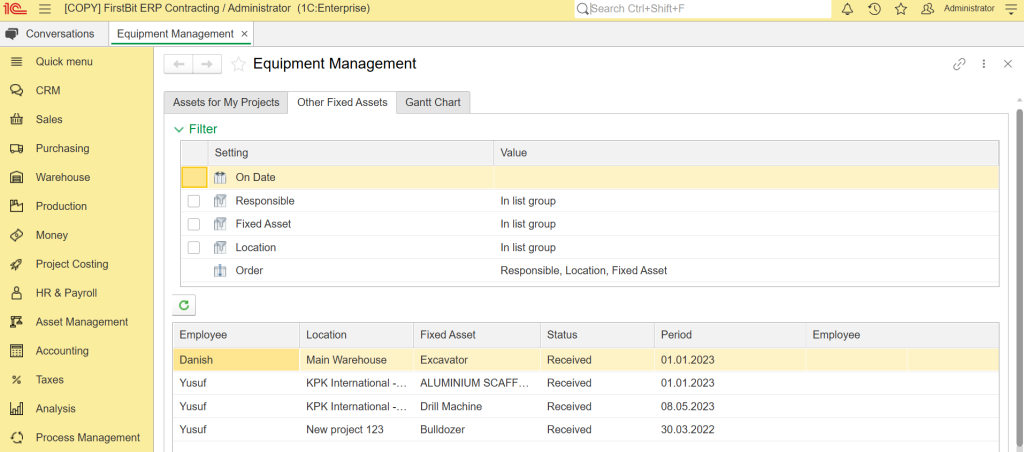
Equipment management in FirstBIt ERP Contracting
Achieve flawless teamwork
Coordinate roles and schedules through FirstBit ERP
Request a demo
Conclusion
Artificial intelligence in construction scheduling is expected to evolve from a standalone planning tool into part of a connected digital ecosystem, integrating with digital twins, autonomous monitoring technologies, and standardized data platforms. This shift will enable more resilient and adaptive project delivery while supporting collaboration across the entire asset lifecycle.
To fully realize these opportunities, organizations must prioritize digital transformation alongside AI adoption by investing in workforce skills, data governance, and interoperable systems. Companies that establish strong digital foundations today will be better positioned to leverage future AI innovations and maintain long-term competitiveness.
FAQ
How does AI actually improve construction scheduling in the UAE?
What ERP data does AI use to optimize project schedules?
Does AI account for UAE-specific challenges like extreme heat or Ramadan?
Is historical project data required to use AI for scheduling?
Make fast, data-driven decisions with real-time dashboards
Request a demo

Arina Sherbakova
Author & editor
Share this article
'%3e%3cg%20clip-path='url(%23clip1_6548_6055)'%3e%3cpath%20d='M13.974%2015.6195C14.2724%2016.0185%2014.6532%2016.3487%2015.0905%2016.5876C15.5278%2016.8265%2016.0114%2016.9686%2016.5084%2017.0042C17.0055%2017.0398%2017.5043%2016.9681%2017.9712%2016.7939C18.4381%2016.6198%2018.8621%2016.3472%2019.2143%2015.9948L21.2994%2013.9098C21.9324%2013.2544%2022.2827%2012.3766%2022.2747%2011.4654C22.2668%2010.5543%2021.9014%209.68269%2021.257%209.03839C20.6127%208.39408%2019.7412%208.02862%2018.83%208.0207C17.9189%208.01278%2017.0411%208.36305%2016.3857%208.99606L15.1902%2010.1845M16.754%2014.2295C16.4555%2013.8305%2016.0747%2013.5003%2015.6374%2013.2614C15.2002%2013.0225%2014.7166%2012.8804%2014.2196%2012.8448C13.7225%2012.8092%2013.2237%2012.8809%2012.7568%2013.0551C12.2899%2013.2292%2011.8659%2013.5018%2011.5136%2013.8542L9.42861%2015.9392C8.7956%2016.5946%208.44534%2017.4724%208.45326%2018.3836C8.46117%2019.2947%208.82664%2020.1663%209.47094%2020.8106C10.1152%2021.4549%2010.9868%2021.8204%2011.898%2021.8283C12.8091%2021.8362%2013.6869%2021.4859%2014.3423%2020.8529L15.5308%2019.6645'%20stroke='%235F7896'%20stroke-width='1.39002'%20stroke-linecap='round'%20stroke-linejoin='round'/%3e%3c/g%3e%3c/g%3e%3crect%20x='0.438953'%20y='0.438953'%20width='28.9709'%20height='28.9709'%20rx='14.4855'%20stroke='%235F7896'%20stroke-width='0.877907'/%3e%3cdefs%3e%3cclipPath%20id='clip0_6548_6055'%3e%3crect%20width='29.8488'%20height='29.8488'%20rx='14.9244'%20fill='white'/%3e%3c/clipPath%3e%3cclipPath%20id='clip1_6548_6055'%3e%3crect%20width='16.6802'%20height='16.6802'%20fill='white'%20transform='translate(7.02344%206.58435)'/%3e%3c/clipPath%3e%3c/defs%3e%3c/svg%3e)


Related articles


See all








See FirstBit ERP solutions in action
Discover how our system solves the unique challenges of contractors in a personalized demo.
After the demo you will get a quotation for your company.
After the demo you will get a quotation for your company.