





AI in Construction Safety: How UAE Contractors Reduce Site Incidents with Data-Driven Monitoring
Publication date 06 Jul 2026 •
Updated 18 Sep 2026 •
17 min read

Arina Sherbakova
Author & editor


Construction safety remains one of the biggest priorities for contractors delivering complex projects across the UAE. That’s why many companies are starting to use AI in construction safety to identify hazards before they become costly incidents and create safer, more efficient worksites.
In this guide, you'll learn how AI for construction safety can reduce site incidents, how it works, practical industry use cases, and leading platforms with AI construction safety capabilities. You'll also discover how ERP modules provide high-quality data to enable smarter, more proactive safety management.
Why Construction Safety Remains a Priority in the UAE
The UAE’s construction sector remains one of the country's most important economic drivers, making workplace safety a critical priority. It’s essential not only for protecting workers but also for maintaining productivity, ensuring that projects are completed efficiently and in compliance with regulations.
The importance of construction safety is further emphasized by industry research. The study titled “Construction Safety and Health Performance in Dubai” surveyed 58 registered construction companies operating under Dubai Municipality (DM), DTMFZA, and TRAKHEES to assess construction safety practices throughout Dubai.
The study identified several key findings that illustrate the safety challenges facing the UAE construction industry:
- 25% of construction companies did not provide Personal Protective Equipment (PPE) to workers.
- 34% reported having no dedicated safety personnel on site.
- 16% did not keep accident records, limiting opportunities to improve safety practices.
- 63% of surveyed companies had experienced fatal accidents in the past.
- 71% said workers received no safety training, while 74% believed existing training was outdated.
- 86% admitted they did not follow accident reporting procedures.
While these challenges are common across the construction industry, they also highlight where AI in construction safety can make the biggest difference. AI provides an additional layer of support by helping companies detect hazards earlier, monitor compliance in real time, and strengthen existing safety processes.
How Effective Is AI in Construction Safety?
Research consistently demonstrates that AI is highly effective in improving construction safety. One study illustrating these benefits is “Smart Construction Sites: AI for Safety and Risk Management”, published in the International Journal on Science and Technology (IJSAT) in 2025.
The research used a case study analysis, synthesizing findings from previously published studies and real-world AI implementations. Key statistics on AI effectiveness in construction safety from this research include:
- 31.7% reduction in recordable workplace incidents after implementing AI-based visual monitoring systems.
- 92.3% accuracy in detecting personal protective equipment (PPE) compliance violations.
- 94.6% accuracy in identifying unauthorized entries into hazardous work zones.
- 78.4% of serious safety incidents were predicted before they occurred, with an average warning time of 7.3 days.
- 43.8% reduction in incident rates when AI-assisted preventive measures were implemented.
- 59.3% reduction in heat-related illnesses, a 42.7% reduction in slip-and-fall incidents, and a 36.9% reduction in struck-by accidents due to the implementation of wearable AI technologies.
- 78.9% reduction in inspection-related injuries through autonomous drone inspections, while robotic systems achieved a 42.8% reduction in severe injuries.
- 497% return on investment (ROI) from AI predictive safety systems over a two-year period, saving approximately $4.97 million for every $1 million invested.
While these results demonstrate AI's potential to transform construction safety, their success depends on the quality of the data used to train and operate AI systems. Inaccurate, incomplete, or inconsistent data can reduce the reliability of AI predictions and limit its ability to identify safety risks effectively.
Construction ERP software helps address this challenge by centralizing project, workforce, equipment, and safety data into a single, reliable source of truth. ERP system provides accurate, real-time data, enabling AI to generate more reliable insights, improve risk prediction, and support better safety decision-making.
Make fast, data-driven decisions with real-time dashboards
Request a demo
How Does AI Identify Safety Hazards on Construction Sites?
Artificial intelligence identifies safety hazards on construction sites by analyzing live video feeds, images, and sensor data in real time. Using computer vision, deep learning, and vision-language models, AI can recognize workers, equipment, materials, and environmental conditions.
AI construction safety compares what it sees against predefined safety rules and immediately flags unsafe situations for supervisors to review. Modern systems can also understand the context of a scene, allowing them to detect more complex hazards instead of simply identifying individual objects.
AI can detect a wide range of construction safety risks, including:
- Missing personal protective equipment (PPE) such as hard hats, safety vests, gloves, boots, and eye protection.
- Workers entering restricted or hazardous zones without authorization.
- Unsafe proximity between workers and heavy machinery, cranes, or moving vehicles.
- Open floor edges, uncovered holes, trenches, and fall hazards.
- Improper ladder placement or unsafe scaffolding conditions.
- Trip hazards caused by debris, tools, cables, or poor housekeeping.
- Unsafe worker behaviors, including improper climbing, overreaching, or unsafe body positioning.
- Equipment left in dangerous positions or operating outside designated work areas.
Case Study
Key findings from the “Real-time safety detection on construction sites” (2026) by Advanced Engineering Informatics:
- AI model YOLOv11-s detects personal protective equipment (PPE) and identifies hazards, such as uncovered floor openings.
- Vision-Language Model (VLM) analyzes the overall construction scene, evaluating factors like lighting quality and the availability of key safety features.
- Natural Language Processing (NLP) pipeline interprets the VLM's descriptions to determine whether the observed safety measures meet the project's safety requirements.
Transform your business
Embrace innovation with FirstBit ERP
Request a demo
Key AI Technologies for Construction Safety
Modern AI for construction safety relies on several complementary technologies that work together to identify hazards, predict safety risks, automate compliance monitoring, and support faster, data-driven decision-making on construction sites.
This table is primarily based on the 2025 systematic review titled “ Artificial Intelligence (AI) in Construction Safety”, which analyzed 122 studies published between 2016 and 2025 and identified core AI technologies transforming construction safety management.
| AI technology | Main construction safety applications |
| Deep Learning (DL) | Detect workplace hazards in real time; learn complex patterns from images, video, and sensor data; generate early warnings for emerging safety risks; improve hazard detection accuracy through continuous model training. |
| Computer Vision (CV) & VLM in CCTV cameras and drones | Analyze live video footage, detect missing PPE, recognize unsafe worker postures and behaviors, track workers across sites, monitor equipment proximity to prevent collisions, and identify unauthorized access to restricted areas. |
| Machine Learning (ML) | Predict accidents before they occur, assess safety risks across construction projects, forecasting equipment failures and maintenance needs, support safety planning with predictive analytics. |
| Natural Language Processing (NLP) | Summarize accident reports, extract root causes, classify incidents and support voice-enabled safety assistants. |
| IoT in smart helmets, wearable sensors, GPS trackers, and environmental sensors | Monitor workers' heart rates, fatigue levels, and locations; detect gas leaks, temperature changes, and equipment conditions. |
| AI-enabled robotics | Inspect hazardous areas, perform demolition, handle dangerous materials, conduct environmental assessments and reduce human exposure to high-risk tasks. |
ERP solutions in Dubai can further enhance these AI capabilities by supplying high-quality operational data that improves safety management. For example, FirstBit ERP can provide AI with equipment usage and maintenance records, workforce attendance, labor allocation, material movements, equipment locations, and inspection schedules.
AI Platforms for Construction Safety
As AI in construction safety continues to reshape jobsite safety, contractors have access to a growing number of software platforms. The table below highlights some of the leading AI-powered solutions for construction safety, each offering different strengths depending on your organization's needs and workflows. This is not a formal ranking.
| Software | AI capabilities | Best for |
| Newmetrix (formerly Smartvid.io) | Computer vision engine, machine learning, safety monitoring, and predictive analytics. | Predictive safety management and multi-project risk analysis. |
| viAct | AI-powered video analytics, hazard detection, and real-time alerts. | Live construction site safety monitoring with existing CCTV cameras. |
| OpenSpace AI | Spatial AI, computer vision, machine learning, SLAM, and generative AI. | 360° site documentation, progress tracking, and remote inspections. |
| DroneDeploy | AI-powered hazard detection from drone and 360°camera imagery. | Drone-based site inspections, aerial surveys, and automated safety audits. |
| HammerTech Intelligence | AI-powered safety workflows, summaries, trend analysis, and predictive insights. | Construction safety management, compliance, and workflow automation. |
| Intenseye | Computer vision, ergonomics AI, and real-time risk detection. | Enterprise-wide workplace safety monitoring and serious injury prevention. |
Newmetrix (formerly Smartvid.io)
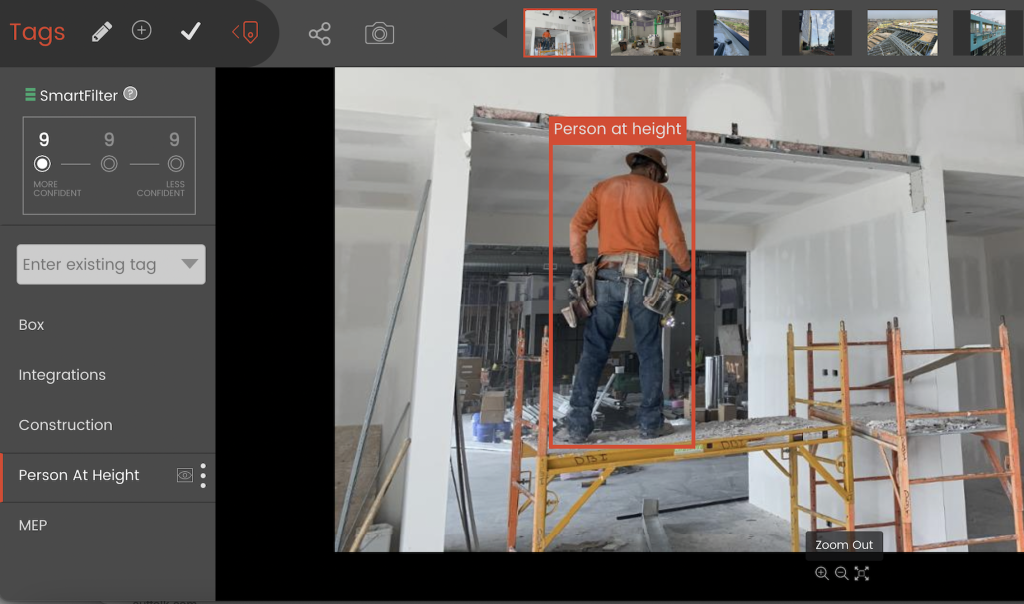
Newmetrix (formerly Smartvid.io) is an AI-powered construction safety platform that helps contractors identify, predict, and reduce jobsite risks using photos, videos, and structured project data.
Originally launched as Smartvid.io, the platform evolved into Newmetrix by combining computer vision with machine learning and predictive analytics to uncover leading safety indicators, automate hazard detection, and provide actionable insights.
Key capabilities of AI in construction safety:
- Computer vision for detecting PPE violations, fall hazards, and unsafe jobsite conditions from photos and videos.
- Machine learning to analyze historical and real-time project data for safety risk prediction.
- Predictive analytics that identifies high-risk projects and forecasts potential incidents before they occur.
- AI image analysis that automatically tags construction images and extracts safety-related insights without manual review.
viAct
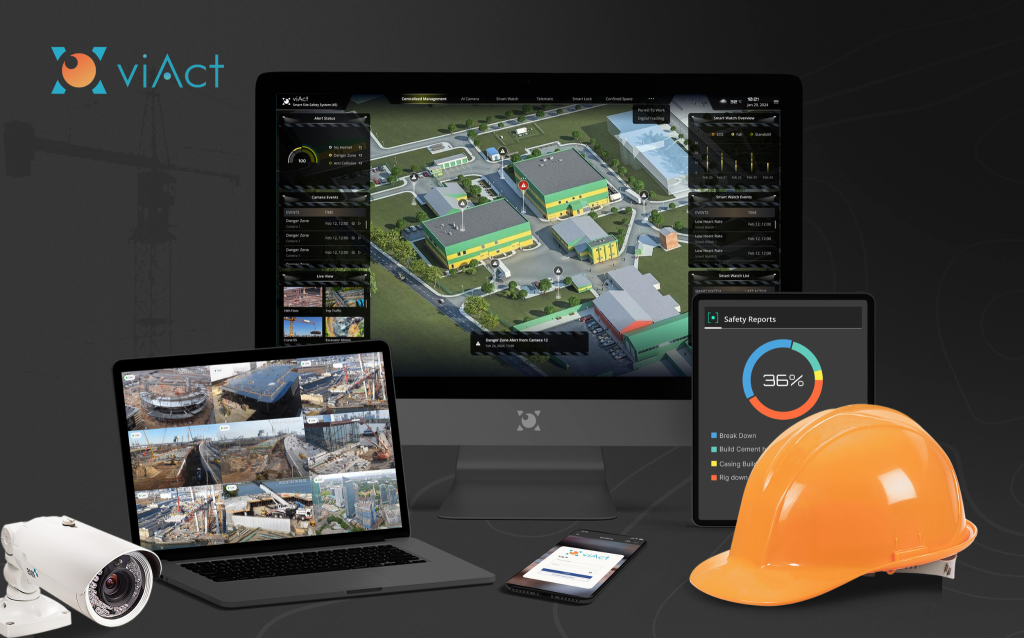
viAct is an AI construction safety platform that uses computer vision, video analytics, edge AI, and IoT technologies to help construction companies proactively identify safety risks, improve compliance, and enhance operational efficiency.
Designed to work with existing CCTV infrastructure, viAct continuously monitors job sites in real time, automatically detects unsafe conditions and behaviors, and sends instant alerts to safety teams.
AI capabilities in construction safety:
- AI-powered safety observations. Automatically generates safety insights from images and field data to support inspections and improve worker engagement.
- PPE compliance monitoring. Detects missing or improperly worn personal protective equipment (PPE), including hard hats, safety vests, gloves, goggles, masks, and safety footwear, to improve worker safety and compliance.
- Danger zone detection. Identifies unauthorized entry into hazardous or restricted work areas and sends real-time alerts to help prevent accidents.
- Work-at-height monitoring. Monitors work on scaffolds, ladders, rooftops, and elevated platforms to detect unsafe activities and trigger immediate safety notifications.
- Vehicle and fleet safety monitoring. Monitors vehicle movement, speeding, restricted-zone access, and equipment interactions to improve operational and site safety.
- Real-time AI alerts. Sends instant notifications when safety violations or hazardous conditions are detected, enabling rapid response and proactive risk management.
OpenSpace AI
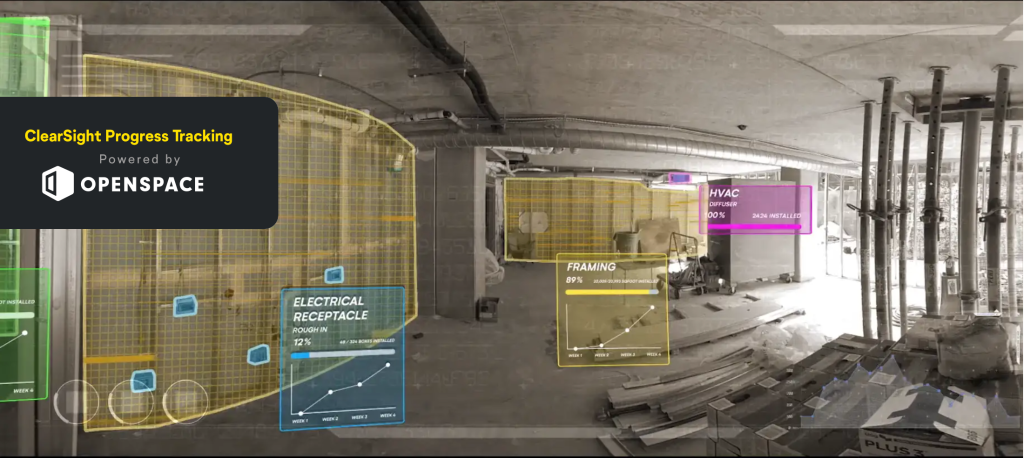
OpenSpace AI is a visual intelligence platform for the construction industry that uses AI, computer vision, and spatial mapping to transform 360° imagery, smartphone captures, and drone data into actionable jobsite insights.
By automatically mapping captured images to floor plans and BIM models, OpenSpace enables project teams to remotely monitor progress, improve collaboration, document site conditions, and proactively identify safety risks.
Key capabilities of AI for construction safety:
- AI-powered visual site documentation. Automatically captures and maps 360° imagery to create a searchable visual record of jobsite conditions for safety reviews.
- Remote safety monitoring. Enables safety managers to virtually inspect job sites, identify hazards such as unsafe work areas, and reduce the need for frequent site visits.
- AI voice notes and field documentation. Converts spoken observations into structured safety records, automatically populates details, and assigns corrective actions to the appropriate personnel.
- Spatial AI. Uses AI-powered computer vision to analyze conditions and provide rapid access to safety information.
- Automated safety reporting and compliance. Generates visual safety reports, categorizes hazards with custom tags, tracks corrective actions, and integrates with construction management platforms to streamline compliance.
DroneDeploy
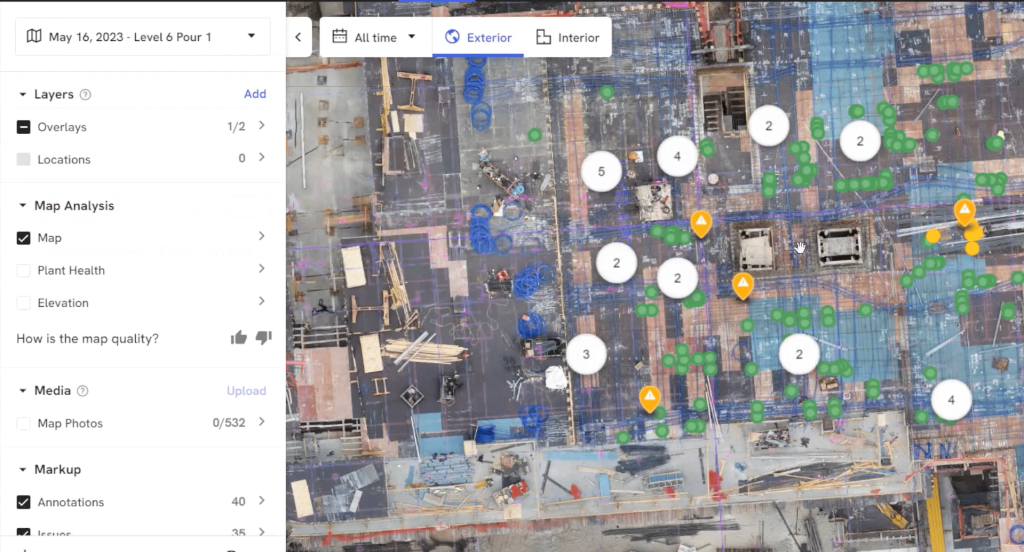
DroneDeploy is an AI construction safety platform that analyzes drone imagery, 360° walkthroughs, and site documentation to automatically identify safety hazards, monitor project conditions, and generate actionable insights.
Its Safety AI solution uses computer vision to detect safety risks from existing site imagery, automatically creating reports and field notes that help safety managers proactively identify, prioritize, and resolve hazards.
Key AI capabilities for construction safety:
- Automated hazard detection. Identifies visible safety hazards such as missing PPE, fall risks, exposed edges, ladder issues, and housekeeping hazards from 360° site imagery using AI.
- Automated safety reporting. Generates AI-powered safety reports with hazard descriptions, locations, confidence scores, and field notes to streamline documentation and follow-up.
- Portfolio-wide safety insights. Aggregates safety data across multiple projects to identify recurring risks, monitor trends, and improve enterprise-wide safety performance.
- Proactive risk management. Prioritizes hazards based on AI confidence and severity, enabling safety teams to address risks early and reduce the likelihood of incidents.
HammerTech Intelligence
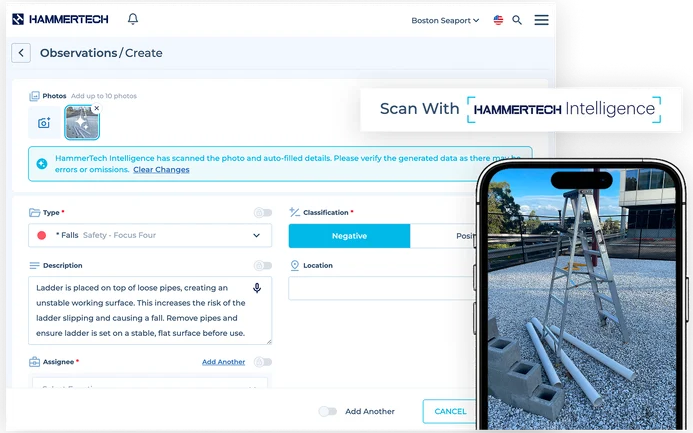
HammerTech Intelligence is an AI capability embedded directly into the HammerTech construction safety platform that streamlines safety workflows by reducing manual administration, improving the quality of safety records, and providing actionable insights to help construction teams make faster, more informed safety decisions.
Key capabilities of AI in construction safety:
- Observation photo recognition. Analyzes safety observation photos and automatically suggests classifications, descriptions, and observation types.
- Safety Data Sheet (SDS) autofill. Extracts information from uploaded SDS documents and automatically populates required form fields.
- AI-generated summaries. Drafts site diary entries and safety reports to reduce administrative effort and improve documentation consistency.
- Safety intelligence and risk insights. Identifies trends, patterns, and leading indicators across safety workflows to support proactive risk management and decision-making.
Intenseye
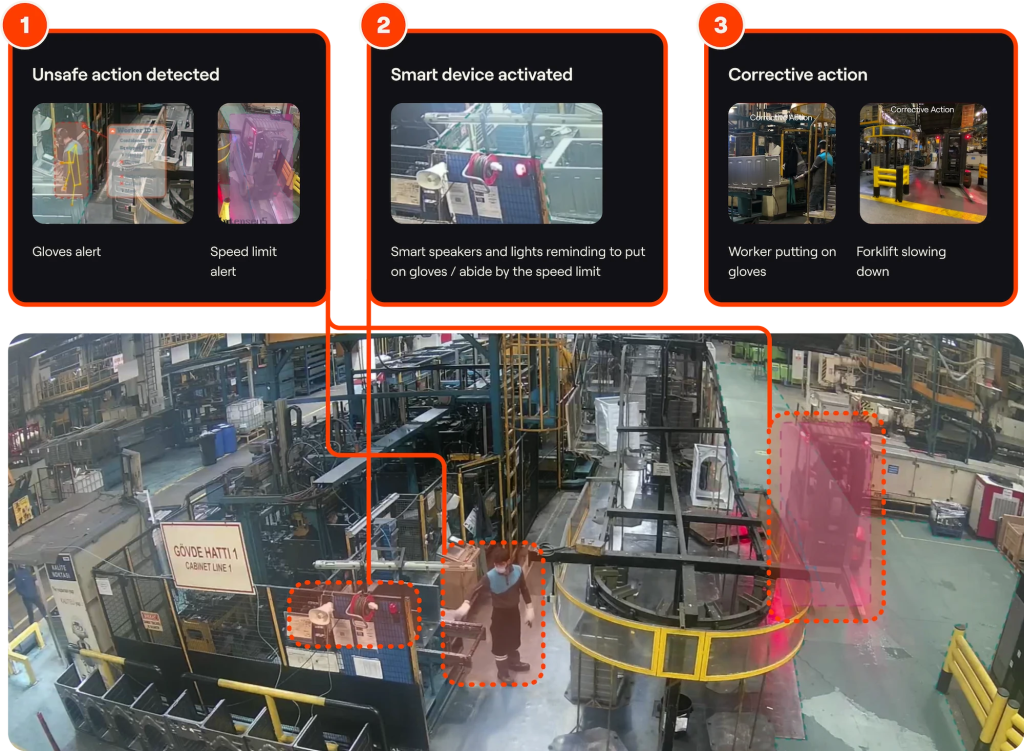
The Intenseye Platform is an AI construction safety solution that uses computer vision to continuously monitor workplace operations through existing CCTV infrastructure. The platform analyzes live video feeds in real time to identify unsafe behaviors, hazardous conditions, and leading indicators of risk before incidents occur.
By combining AI-powered hazard detection with analytics, reporting, workflow automation, and industrial system integrations, Intenseye helps safety teams proactively reduce workplace injuries, improve compliance, and drive continuous safety improvement across industrial and construction environments.
Key capabilities of AI for construction safety:
- Real-time PPE compliance monitoring. Detects missing hard hats, high-visibility vests, gloves, safety glasses, and other required personal protective equipment.
- Work-at-height and restricted area detection. Identifies workers entering hazardous zones, climbing without proper protection, or accessing restricted work areas.
- Heavy equipment and vehicle interaction monitoring. Detects unsafe proximity between workers and construction vehicles, cranes, and mobile equipment to help prevent struck-by incidents.
- Real-time hazard alerts and automated responses. Integrates with speakers, lights, sensors, and operational technology (OT) systems to trigger immediate alerts or safety actions when hazards are detected.
- AI-driven safety analytics and corrective actions. Aggregates safety observations into dashboards, heatmaps, risk trends, and task management workflows, enabling safety managers to prioritize high-risk areas and continuously improve site safety performance.
Choose the right technology for your construction business
Request a demo
Case Study: AI for Construction Safety Inspection in the UAE
The paper, "A Novel Implementation of an AI-based Smart Construction Safety Inspection Protocol in the UAE" presents an artificial intelligence system that automatically monitors whether construction workers are following essential fall-protection safety rules using computer vision.
- Background: Construction sites in the UAE experience a high number of workplace accidents, particularly falls from height. Despite strict safety regulations, ensuring compliance through manual inspections is challenging because of the large number of construction sites.
- Problem: Traditional safety inspections are labor-intensive, time-consuming, and cannot provide continuous monitoring. As a result, workers may fail to wear essential safety equipment such as helmets, safety harnesses, and lifelines, increasing the risk of fatal accidents.
Solution
The researchers developed an AI-powered safety inspection system using a Convolutional Neural Network (CNN) and the YOLOv3 object detection algorithm. The model was trained on approximately 1,000 labeled images collected from real construction sites and web sources.
It was designed to automatically detect whether workers were wearing three critical safety components:
- Safety helmet
- Safety harness
- Lifeline (Personal Fall Arrest System)
The AI model was tested using images and videos under different environmental conditions, including normal lighting, grayscale, bright sunlight, dust, blur, and live video footage. This ensured the system could operate effectively in realistic construction site environments.
Results
The system successfully identified workers' safety equipment with:
- Approximately 91–94% detection accuracy
- Around 99% precision
- Approximately 90% recall
The results demonstrated that the AI system could reliably detect safety violations and support real-time monitoring of construction sites.
How FirstBit ERP Supports AI in Construction Safety
AI has the potential to make construction sites safer by identifying risks earlier, analyzing patterns across projects, and supporting faster decision-making. However, AI is only as effective as the quality of the data it receives. Without accurate, structured project information, AI tools cannot generate reliable safety insights.
FirstBit ERP provides the centralized data foundation that AI needs. By connecting project management, procurement, equipment tracking, workforce data, and warehouse management in one system, it creates a single source of truth that can support AI-powered safety analytics, risk monitoring, and operational decision-making.
With FirstBit ERP, construction companies can:
- Centralize project and site data to give AI access to consistent, structured information across all projects.
- Track workforce attendance and labor allocation with integrated attendance tracking, giving AI accurate data on workforce availability, shift patterns, and on-site staffing levels to identify potential safety risks related to understaffing or excessive overtime.
- Track site progress and incidents through digital project reporting with photos, creating a reliable history for identifying recurring safety risks.
- Monitor equipment use and maintenance with real-time equipment tracking, maintenance schedules, and asset allocation to reduce risks caused by equipment failures, unavailable machinery, or improper utilization.
- Automate notifications and approval workflows so safety-related issues and corrective actions reach the right people without delay.
- Leverage the built-in AI Assistant to quickly access ERP information, reports, and operational data, helping managers retrieve critical project information and make faster, data-driven safety decisions.

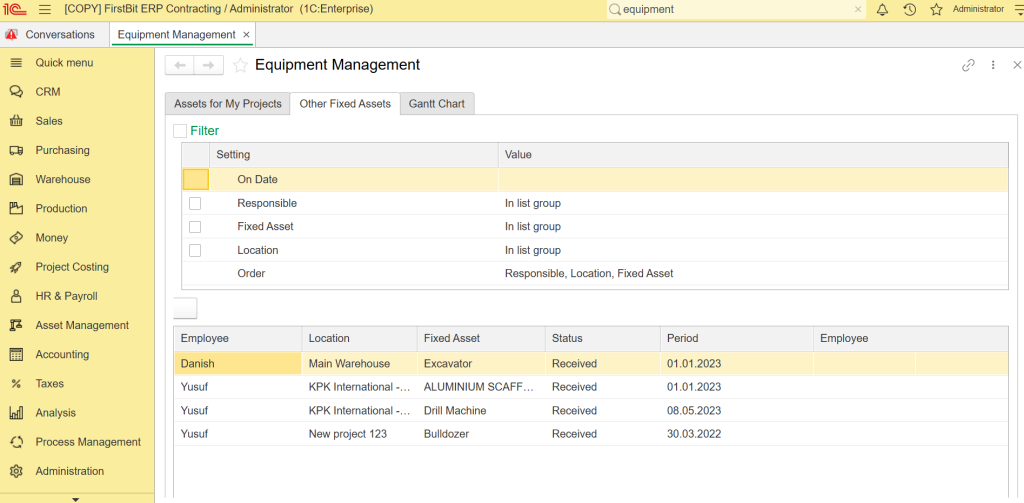
Equipment management in FirstBit ERP Contracting
FirstBit ERP enables AI by organizing the operational data that AI models rely on. As companies accumulate clean, connected information from ERP modules, they become better positioned to adopt AI applications for predictive risk analysis, trend detection, and smarter safety management.
Keep projects running like clockwork
Schedule tasks in FirstBit ERP
Request a demo
Conclusion
The rapid evolution of AI in construction safety is transforming construction safety from a reactive process into a proactive, data-driven strategy. By combining computer vision, machine learning, IoT devices, and predictive analytics, contractors can identify hazards earlier, improve compliance, and reduce workplace incidents.
However, the success of AI for construction safety depends on more than advanced algorithms. Reliable ERP systems, standardized processes, and high-quality operational data provide the foundation that enables AI to generate accurate insights and meaningful safety recommendations.
FAQ
How does AI actually help reduce site incidents on UAE construction projects?
Do we need to install special cameras or sensors to use AI for safety monitoring?
What data from the ERP system is used to power AI safety tools?
Does computer vision work with photos taken on a regular smartphone?
Make fast, data-driven decisions with real-time dashboards
Request a demo

Arina Sherbakova
Author & editor
Share this article
'%3e%3cg%20clip-path='url(%23clip1_6548_6055)'%3e%3cpath%20d='M13.974%2015.6195C14.2724%2016.0185%2014.6532%2016.3487%2015.0905%2016.5876C15.5278%2016.8265%2016.0114%2016.9686%2016.5084%2017.0042C17.0055%2017.0398%2017.5043%2016.9681%2017.9712%2016.7939C18.4381%2016.6198%2018.8621%2016.3472%2019.2143%2015.9948L21.2994%2013.9098C21.9324%2013.2544%2022.2827%2012.3766%2022.2747%2011.4654C22.2668%2010.5543%2021.9014%209.68269%2021.257%209.03839C20.6127%208.39408%2019.7412%208.02862%2018.83%208.0207C17.9189%208.01278%2017.0411%208.36305%2016.3857%208.99606L15.1902%2010.1845M16.754%2014.2295C16.4555%2013.8305%2016.0747%2013.5003%2015.6374%2013.2614C15.2002%2013.0225%2014.7166%2012.8804%2014.2196%2012.8448C13.7225%2012.8092%2013.2237%2012.8809%2012.7568%2013.0551C12.2899%2013.2292%2011.8659%2013.5018%2011.5136%2013.8542L9.42861%2015.9392C8.7956%2016.5946%208.44534%2017.4724%208.45326%2018.3836C8.46117%2019.2947%208.82664%2020.1663%209.47094%2020.8106C10.1152%2021.4549%2010.9868%2021.8204%2011.898%2021.8283C12.8091%2021.8362%2013.6869%2021.4859%2014.3423%2020.8529L15.5308%2019.6645'%20stroke='%235F7896'%20stroke-width='1.39002'%20stroke-linecap='round'%20stroke-linejoin='round'/%3e%3c/g%3e%3c/g%3e%3crect%20x='0.438953'%20y='0.438953'%20width='28.9709'%20height='28.9709'%20rx='14.4855'%20stroke='%235F7896'%20stroke-width='0.877907'/%3e%3cdefs%3e%3cclipPath%20id='clip0_6548_6055'%3e%3crect%20width='29.8488'%20height='29.8488'%20rx='14.9244'%20fill='white'/%3e%3c/clipPath%3e%3cclipPath%20id='clip1_6548_6055'%3e%3crect%20width='16.6802'%20height='16.6802'%20fill='white'%20transform='translate(7.02344%206.58435)'/%3e%3c/clipPath%3e%3c/defs%3e%3c/svg%3e)


Related articles


See all








See FirstBit ERP solutions in action
Discover how our system solves the unique challenges of contractors in a personalized demo.
After the demo you will get a quotation for your company.
After the demo you will get a quotation for your company.