Every construction project — from a small villa to a multi-lane highway — starts with a blueprint. But turning that plan on paper into a great structure is rarely simple.
Along the way, budgets can fluctuate, deadlines can shift, and site conditions can change. The most challenging part for
construction project managers is keeping everything on track. They have to handle uncertainty, coordinate expertise, and make decisions that impact the project. It’s a tough job because even a minor error in planning or documentation can delay the entire process.
This article breaks down the process of construction projects from start to finish. It also highlights the types of construction projects, factors that influence each type, and ways to classify them.
What Is a Construction Project
A construction project is an organized process that aims to build, renovate, or expand physical structures. It could be a housing complex, a power plant, or a public transportation hub. Each project has a set plan, a budget, a finish date, and clear goals
[?].
Construction projects also involve multiple phases, from planning and design to execution and handover. Every step must be coordinated to meet safety standards, client expectations, and legal requirements.
Note: A construction project can range from small residential units to large infrastructure programs that span years. Each project is unique, shaped by location, size, materials, and the team behind it. But all projects have the same goal: to build a durable structure that meets an owner’s expectations and complies with local regulations.
Purpose of a Construction Project
The purpose of a construction project is to fulfill specific needs — residential, commercial, industrial, or infrastructure-related. It’s about creating usable spaces that improve living standards, support economic activity, or deliver essential public services.
For example:
Residential projects provide housing and community spaces
Commercial projects drive business operations and public interaction
Industrial projects support manufacturing, storage, and logistics needs
Infrastructure projects strengthen mobility, energy supply, and public safety
Each purpose dictates the project’s design, complexity, and regulatory requirements. For example, building a hospital requires strict compliance with health codes, while constructing a warehouse focuses more on the use of space and load-bearing capacity.
Key Stakeholders in a Construction Project
Every construction project depends on a
high-performing construction team. It’s driven by people — each with a specific role, responsibility, and impact on the outcome. From project funding to final inspection, every stakeholder contributes to the project's success.
Here’s a breakdown of the main participants involved:
Owners and developers. They define objectives, fund the project, and set expectations.
Architects and engineers. They design the structure, plan the systems, and verify if the project is possible to build.
Contractors and subcontractors. They handle the physical construction, manage labor, and coordinate site activities.
Regulatory authorities. They issue permits, inspect work, and enforce compliance with safety and building codes.
Pro tip: To avoid delays and miscommunication, set up a stakeholder map early in the project. Define who makes decisions, who approves changes, and who needs regular updates. A clear chain of command prevents confusion later in the project.
For smoother coordination across teams, many firms use ERP systems.
FirstBit ERP helps centralize communication, track approvals, and manage documentation — especially useful when working with multiple subcontractors and vendors.
Key Traits of Construction Projects
Every construction project has its own scope, challenges, and goals — yet certain characteristics remain consistent across all types. These traits define how the project operates and how success is measured. They also explain why construction projects differ from everyday business operations.
Here are the traits that define a construction project:
Defined goal. Every project starts with a clear objective, and the entire team works toward achieving this measurable goal.
Unique conditions. Each site has its own conditions — soil type, climate, budget, and workforce capabilities. Even when the design looks similar, environmental and logistical challenges make every project unique.
Client-driven. Projects are designed to meet the owner’s preferences and needs. Their vision shapes the design, material selection, and functional layout.
Non-repetitive. A construction project is non-repetitive. It involves one-time design, procurement, and site execution. Even if some steps are the same, every project has its own location, budget, and challenges.
Interconnected tasks. From surveying to plumbing, projects depend on hundreds of linked tasks. If one step stalls, the rest suffer. Good planning and teamwork are essential to keep the project on track.
Fixed timeline. Every construction project has a defined deadline. Missing it can cost more money and hurt the company’s reputation. Having a clear schedule with realistic goals helps ensure each part, like design or buying materials, is completed on time.
Complex coordination. Construction involves engineers, suppliers, safety officers, accountants, and more. Collaboration among these diverse specialists keeps the project moving.
Built-in flexibility. Plans may change due to weather conditions, design updates, or supply issues. Being flexible can help the team adjust without going over budget or missing deadlines.
Uncertainty and risks. Projects face internal and external risks — from cost overruns to safety hazards. These risks can’t be entirely avoided, but they can be managed with good planning, careful tracking, and having backup plans.
Budget limits. Work must stay within the approved financial plan. Exceeding it affects margins and client trust. Transparent cost control ERP systems like
FirstBit ERP offer real-time budget tracking, ensuring expenses stay in line with actual progress.
Skill development. Teams learn and get better at planning, working, and solving problems. Continuous improvement builds stronger project culture and more efficient teams for future work.
Achieve peak productivity on site
Manage teams, equipment, and materials in FirstBit
Request a demo
What Factors Influence the Type of a Construction Project?
Not all construction projects are done the same way. The type of project depends on several key factors. These influence the design, materials, timeline, and even the delivery method.
Here are the most common factors that shape construction project types:
Purpose of the Building
The primary reason for any construction project is its intended use. A hospital, for instance, requires strict hygiene systems, complex MEP (mechanical, electrical, plumbing) networks, and emergency access routes — very different from a simple office tower or storage warehouse.
Examples:
Residential projects focus on comfort, aesthetics, and cost efficiency.
Commercial builds prioritize accessibility, parking, and customer flow.
Infrastructure works emphasize durability and public safety.
Industrial facilities require high-capacity structural systems and safety protocols.
Pro tip: Match design strategy to functional needs. A warehouse built like a shopping mall is not practical, nor cost-effective.
Size and Complexity
Large projects have more systems, stakeholders, and risks. One contractor can manage a small housing project. A multi-site highway, on the other hand, requires layers of subcontractors, regulators, and logistics planning.
Factors that make a project complex include:
Large buildings or many buildings in one project
Specialized systems like HVAC or automation
Strict design rules and high-performance standards
That’s why large projects use ERP software like
FirstBit ERP to understand scope, assign resources, and track dependencies across massive jobs.
Timeframe
Delivery speed is another important factor. Some projects, such as emergency schools, hospitals, or temporary homes, need to be constructed quickly. For these, teams use methods like Design-Build or Integrated Project Delivery (IPD) to save time.
Other larger projects that require multiple government approvals may use the traditional Design–Bid–Build method. This method takes more time but is ideal for projects with many rules and details.
Pro tip: Use scheduling buffers for any project with seasonal work. Rain, heat, or wind can slow productivity even with perfect planning.
Budget Constraints
The
budget influences almost every decision — from the choice of materials and number of workers to the overall design approach. So, knowing how to plan a
budget for construction projects is important to stay on track.
Cost-related choices include:
Type I and II fire-resistant materials cost more but reduce insurance risks.
Type V wooden frames are cheaper but less durable.
Prefabrication saves labor but may increase transport expenses.
Real-time cost tracking in
FirstBit ERP can help project managers monitor expenses. This helps them identify problems early and ensure the project stays on budget.
Environmental Conditions
Every construction site is influenced by nature. The weather, land, and soil all impact how a project is built and which materials are used.
For example, building in a flood-prone area may require elevated foundations and water-resistant materials. In contrast, a high-rise in a dense city center might need deep piling and noise control measures.
Regulatory Framework and Approvals
Government regulations oversee much of what happens in construction. Zoning laws, environmental permits, fire safety, and accessibility standards affect both design and schedule. Public-sector projects have strict bidding rules, which can affect the cost and schedule of a project.
Using an ERP with compliance tracking can help avoid penalties or stop-work orders.
FirstBit ERP, in particular, helps teams receive alerts for license renewals, safety audits, and documentation deadlines.
Stages of a Construction Project
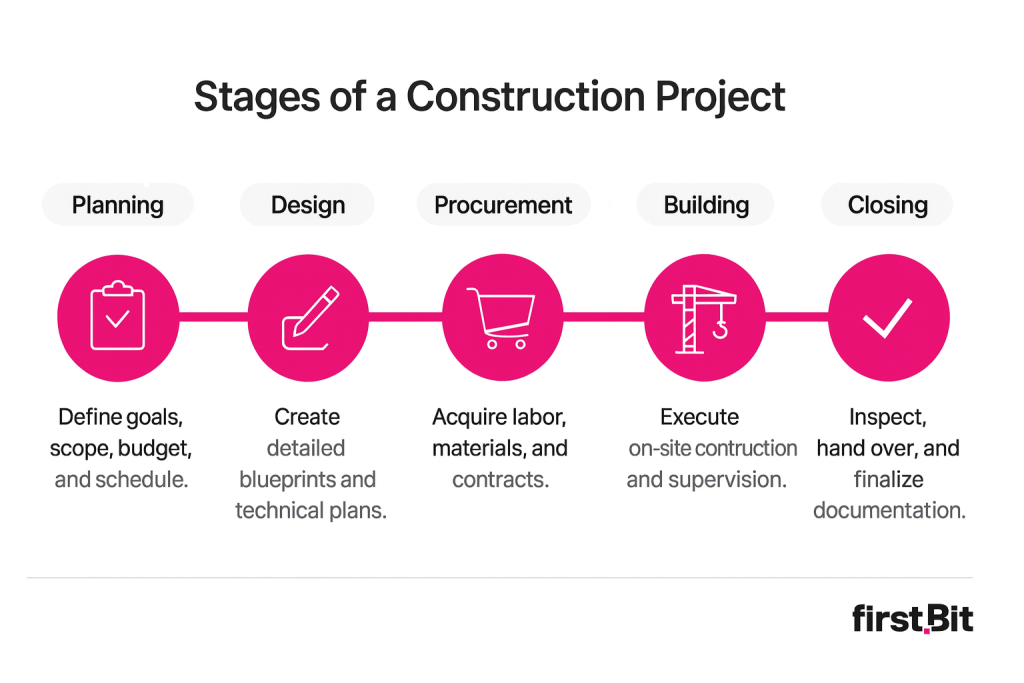
Every construction project follows a structured path from initial idea to handover. These stages ensure that the work stays organized, funded, and compliant. While details vary by project type, the overall flow remains the same—plan, design, procure, build, and close.
The Five Stages of a Construction Project
Here’s a breakdown of the five main phases of a construction project:
Planning Stage
Every project starts with a question: What are we building, and why?
The planning phase defines the project’s purpose, scope, estimated timeline, and available resources. It’s also where stakeholders identify risks and build a financial framework.
Key activities include:
Conducting feasibility studies and site analysis
Estimating costs and creating budget baselines
Selecting delivery methods (e.g., Design–Build, IPD, or traditional contract)
Securing permits and regulatory approvals
Assigning roles and responsibilities
Pro tip: Treat planning as your roadmap. A few extra weeks of analysis can save months of rework later.
Design Stage
Next comes design, where concepts turn into technical blueprints. Architects, engineers, and consultants work together to define the building’s appearance, structure, and systems. This phase ensures that every dimension and material aligns with codes, safety standards, and client expectations.
Sub-stages often include:
Concept design. Rough layouts addressing client goals and zoning limits.
Detailed design. Engineering drawings with calculated loads and materials.
Construction documentation. Final packages for tenders and approvals.
Procurement Stage
After designs are approved, it’s time to get the resources needed to complete the project. This means hiring workers, buying materials, and hiring subcontractors. Procurement ensures that resources arrive on time, in the right quantity, and at the right cost.
This stage is about good planning and careful spending. It connects contracts and payments to the progress of the project.
Typical procurement tasks:
Creating tender documents and scope packages
Evaluating supplier bids
Negotiating prices and delivery schedules
Issuing purchase orders
Inspecting received materials for quality compliance
Construction (Execution) Stage
This is when the actual building happens. The execution phase involves on-site work such as foundation laying, steel framing, plumbing, electrical installation, and finishing. Constant supervision and coordination are necessary here to maintain quality and keep the project on track.
Project managers focus on:
Workforce scheduling and safety compliance
Daily progress tracking and reporting
Quality assurance and inspections
Handling change orders and delays
Managing cash flow and expenses
Pro tip: Set up regular cross-team reviews (e.g., site + design + procurement) every week. It’s an easy way to spot early warning signs of delay before they grow into serious bottlenecks
Closing Stage
Once construction is complete, the focus shifts to handover and administrative closure. This phase ensures that all work meets the contract, safety, and regulatory requirements before official delivery to the owner.
Final activities often include:
Conducting inspections and fixing any problems found
Submitting as-built drawings and warranties
Settling final payments and closing purchase orders
Obtaining occupancy certificates and client acceptance
Holding a post-project review to record lessons learned
Pro tip: Save all your project data in digital form. This makes future repairs, warranty claims, or checks much easier because all information is in one system.
To manage these stages efficiently, many firms use ERP platforms.
FirstBit ERP helps track progress, manage procurement, and store documentation — all in one system. This reduces manual errors and keeps the team aligned.
Boost project performance
Request a demo
Types of Construction Projects
Every construction project has its unique purpose, standards, and level of complexity. Whether it’s a school, shopping mall, or bridge, the main goal remains the same — follow the design, maintain quality, finish on time, and stay within budget.
Here are the seven main types of construction projects:
Residential construction. Residential projects focus on spaces where people live. This includes villas, duplexes, apartments, and housing complexes. The primary goal is to create spaces that are both comfortable and safe.
Commercial construction. Commercial projects cover offices, hotels, malls, restaurants, and entertainment venues. These structures often require HVAC systems, elevators, and fire safety plans.
Mixed-use construction. Mixed-use projects combine different types of spaces (usually homes, shops, and offices) in one location. These projects require careful planning to comply with zoning rules, ensure safety, and provide comfort for all occupants.
Green construction. Green construction aims to minimize environmental impact and enhance occupant well-being. These projects focus on sustainability and energy efficiency through eco-friendly materials and design strategies.
Institutional construction. Institutional projects. Includes schools, hospitals, and government buildings. These projects must meet strict codes and serve large groups of people.
Industrial construction. These projects support manufacturing, logistics, energy, and production operations. They often feature specialized equipment, heavy-duty foundations, and rigorous safety measures.
Heavy civil construction. Heavy civil projects are extensive infrastructure endeavors such as roads, bridges, railway tunnels, and airports that support cities and national economies.
Pro tip: Before starting any project, check local zoning laws and building codes. These rules often vary by project type and location.
Specialized Types of Construction Projects
Beyond traditional project types, modern construction requires new methods that help improve efficiency, promote sustainability, and adapt to the evolving industry needs.
These specialized types of construction projects use advanced techniques, technology, and materials to achieve faster delivery, lower waste, and better performance.
Here are examples of specialized construction types:
Modular Construction
Modular construction builds complete sections or modules off-site in a controlled factory environment. Each module contains plumbing, wiring, and interior finishes before being transported and assembled on-site.
Benefits include:
Shorter construction timelines because site preparation and module fabrication happen simultaneously,
Improved quality control under factory conditions,
Reduced on-site disruption and waste.
Use case: Modular hotels and residential buildings can reduce construction time by up to 40% compared to traditional builds[?].
Prefabricated Construction
Prefabrication involves manufacturing building components off-site, such as wall panels, columns, or roofing units, and then assembling them on location. Unlike modular construction, which moves entire units, prefabrication focuses on parts and sections.
Benefits include:
Faster construction once materials arrive on-site
Consistent quality of building parts
Less on-site labor and fewer delays caused by weather.
Applications: Often used in warehouses, bridges, and hospitals, where repeated structural designs make it easy to produce many identical parts.
Land Reclamation Projects
Land reclamation creates new usable land by filling coastal waters, rivers, or wetlands with soil, sand, or rock. These projects expand urban areas, ports, and airports in regions where available land is scarce, like in Dubai, Hong Kong, and Singapore.
Key features:
Extensive geotechnical and environmental studies are required before execution
Heavy use of dredging and soil-stabilization techniques
Requires long-term monitoring to prevent erosion and subsidence
Example: Palm Jumeirah in Dubai was built through large-scale reclamation, adding more than 560 hectares of premium coastal land for residential and hospitality use[?].
Environmental Engineering Projects
Environmental engineering projects focus on protecting and restoring the natural environment. They include work on sustainable water use, flood prevention, and soil restoration. The main goal is to build in ways that support and protect ecosystems.
Key benefits:
Did you know?
Environmental restoration projects such as wetland and stream rehabilitation can reduce flood damage by up to 40% in specific high-risk areas, depending on the scope and design[?].
Agricultural Technology (Agri-Tech) Infrastructure
With urbanization and food security challenges, agri-tech construction projects are rapidly expanding. These include vertical farms, hydroponic systems, and climate-controlled greenhouses that use automation and smart sensors.
Key features:
Intensive use of IoT, temperature controls, and irrigation systems,
Requires integration of mechanical and electrical precision equipment,
Often designed for compact urban zones with limited land.
Example: Agri-tech hubs across the UAE combine renewable power with automated crop systems to increase efficiency under harsh climates.
Hyperscale Data Centers
The digital economy relies on hyperscale data centers — specialized buildings hosting thousands of servers for AI, cloud services, and global communications. These are among the most technically demanding construction projects today.
Key features:
Precise climate control and high-capacity cooling systems,
24/7 energy backup and acoustic insulation,
Rigorous fire suppression and cybersecurity standards.
Pro tip: Specialized projects often require permits from multiple agencies. Start the approval process early to avoid delays.
Using an ERP system like
FirstBit ERP helps keep all construction data, such as schedules and costs, organized and up to date across all departments. This reduces coordination mistakes, especially in fast-paced, high-tech environments.
Keep projects running like clockwork
Schedule tasks in FirstBit
Request a demo
Ways to Classify Construction Projects
A construction project can be categorized in many ways — by occupancy use, fire safety level, or ownership and funding. This classification helps engineers, regulators, and investors understand the project’s requirements and risks before work begins.
Here are the most common ways to group construction projects:
The International Building Code (IBC) serves as a global reference for most construction classifications. It standardizes how structures are designed, built, and maintained by defining safety ratings, occupancy groups, and material limits[?].
Classification by Use (Occupancy Group)
This method classifies buildings based on who uses them and how. The character of occupancy determines the required safety, fire exits, ventilation, and structure type.
Major IBC groups include:
Group A – assembly. For large gatherings, such as theaters, stadiums, restaurants, and auditoriums.
Group B – business. For offices, banks, and administrative buildings.
Group E – educational. For schools and childcare centers up to 12th grade.
Group F – factory. For manufacturing or processing that requires air filtration and fire separation.
Group H – high-hazard. For sites storing or using hazardous materials such as chemicals.
Group I – institutional. For hospitals, prisons, or facilities where occupants need assistance.
Group M – mercantile. For stores, supermarkets, or showrooms open to the public.
Group R – residential. For permanent or temporary living, such as houses, apartments, or hotels.
Group S – storage. For warehouses or parking structures where storage load and ventilation matter.
Group U – utility & miscellaneous. For facilities that don’t fit other groups—barns, tanks, or sheds.
Classification by Fire Safety Level
Fire safety classification defines the materials and resistance capacity of a building. This determines how long it can withstand fire before structural failure.
Five construction types under the IBC include:
Type I – fire-resistive. Non-combustible materials such as concrete and steel with protection lasting 3–4 hours. Used in high-rises and hospitals.
Type II – non-combustible. Similar materials but less resistance (1–2 hours). Common in mid-rise offices and schools.
Type III – ordinary construction. Non-combustible exterior walls with combustible wooden interiors.
Type IV – heavy timber. Large solid wood beams that resist burning through charring. Found in churches or adaptive reuse projects.
Type V – wood-framed. Fully combustible structure; faster and cheaper, but requires added fireproofing for code compliance.
Classification by Ownership or Funding
Ownership defines who finances and controls the project — a local government, a private company, or a collaboration of both. This affects procurement processes, contract terms, and reporting obligations.
Types of ownership models include:
Public projects. Funded by government budgets or grants. Strict procurement laws apply to ensure fairness and transparency. Examples: Roads, schools, hospitals, and public housing.
Private projects. Financed by individuals, developers, or corporations. Procurement is flexible — based on relationships, value, or speed. Examples: Hotels, resorts, office towers, or data centers.
Public-private partnerships (PPP or P3). Joint ventures between the public and private sectors. Examples: Suited for complex, long-term projects like toll roads, airports, or transit systems.
The Dubai Metro system was developed under a PPP structure, allowing continuous private-sector maintenance and operations while remaining under government ownership.
Large projects often involve multiple classifications, including commercial blocks with residential units above, or mixed-use zones with overlapping fire codes. Coordinating all these through emails or spreadsheets increases the risk of errors.
With
FirstBit ERP, teams can centrally manage compliance data and automatically track documentation deadlines.
Ensure timely and profitable project completion with FirstBit
Request a demo
Track Project Progress in Real Time With FirstBit ERP
Construction projects involve many processes, including schedules, materials, labor, budgets, and compliance tasks. Keeping all this aligned is challenging, especially when sites, offices, and subcontractors operate in different locations.
FirstBit ERP connects every part of this process, allowing managers to see the complete picture as work unfolds.
Here are key features that help construction teams stay on track:
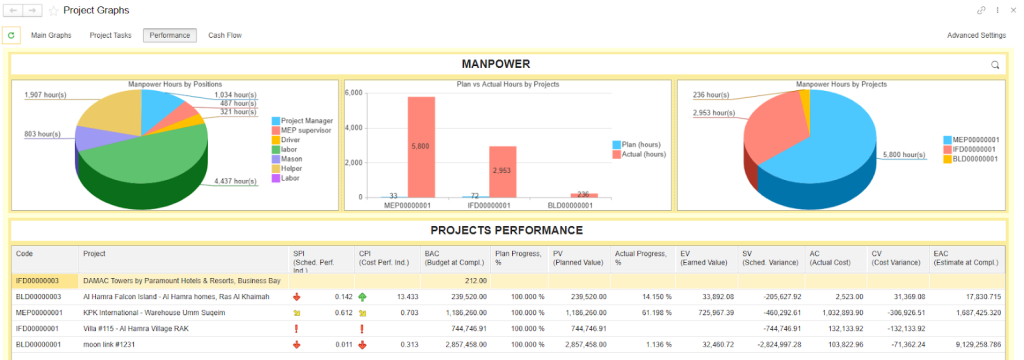
Project Performance Dashboard
With a project performance dashboard, get a real-time view of KPIs like cost progress, schedule status, and task completion. This helps managers make informed decisions with accurate, current insights.
Project Performance Report in FirstBit ERP
Resource Planning
Efficiently allocate materials and equipment. This prevents resource shortages and reduces idle time, keeping the project on schedule and within budget.
Equipment management in FirstBit ERP
Time Cards and Attendance Tracking
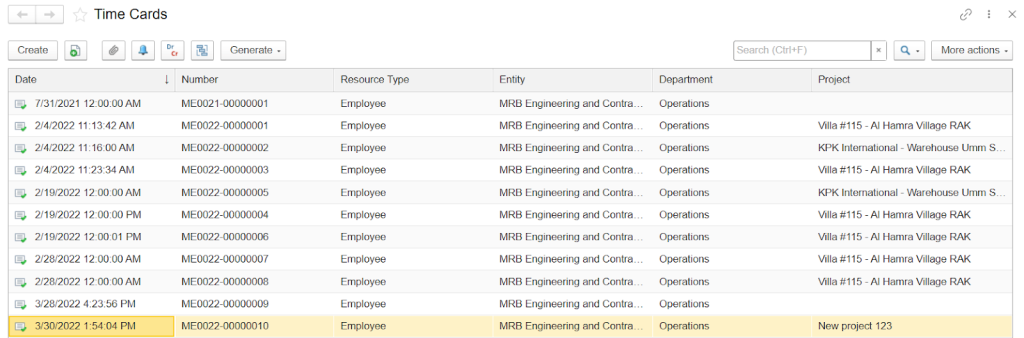
On large job sites, tracking employee attendance manually can lead to payroll mistakes. FirstBit ERP integrates digital time cards and attendance logs from mobile devices or biometric scanners.
FirstBit ERP Showing Employee Attendance with Time Cards
This ensures accurate payroll, compliance with UAE Labor Law, and better insight into labor productivity. It also links attendance data with project costs, so the time spent on each task is automatically reflected in the overall project expenses.
Conclusion
You’ve seen how projects are defined, classified, and managed. You’ve learned about the key stakeholders, the delivery stages, and the types of construction projects.
Now, delivering a project successfully requires more than planning and teamwork. It requires a system that tracks progress in real time, connects site data with financial records, and spots potential issues before they escalate.
FirstBit ERP helps make that possible. It connects field teams with the office, provides real-time updates, and keeps your project on schedule and within budget.
As the UAE and global construction industries continue to evolve, integrated digital tools will no longer be an option — they’ll be the foundation of success for every project.
Achieve peak productivity on site
Manage teams, equipment, and materials in FirstBit
Request a demo
FAQ
What is a construction project?
A construction project is a planned effort to build or improve structures like homes, offices, or roads. It involves organized stages to meet time, cost, and quality goals.
What are the main types of construction projects?
The types of construction projects include residential, commercial, industrial, institutional, and infrastructure builds. Each type serves a specific purpose and requires different materials, budgets, and expertise.
Why is project management important in construction?
Project management keeps a construction project on schedule, within budget, and compliant with safety standards. It helps teams work efficiently and reduces costly delays.
What are the key stages of a construction project?
A typical construction project goes through five stages. These are planning, design, procurement, construction, and closing. Each stage plays a vital role in successful completion.
What factors influence the type of a construction project?
Project purpose, budget, site conditions, and timeline all influence the type of construction project. These factors shape the design, materials, and delivery method.
Margaret Oboigbe
Contributing Author
Margaret Oboigbe combines industry knowledge with practical experience. She delivers content that empowers construction teams to improve performance, safety, and profitability across their projects.










'%3e%3cg%20clip-path='url(%23clip1_6548_6055)'%3e%3cpath%20d='M13.974%2015.6195C14.2724%2016.0185%2014.6532%2016.3487%2015.0905%2016.5876C15.5278%2016.8265%2016.0114%2016.9686%2016.5084%2017.0042C17.0055%2017.0398%2017.5043%2016.9681%2017.9712%2016.7939C18.4381%2016.6198%2018.8621%2016.3472%2019.2143%2015.9948L21.2994%2013.9098C21.9324%2013.2544%2022.2827%2012.3766%2022.2747%2011.4654C22.2668%2010.5543%2021.9014%209.68269%2021.257%209.03839C20.6127%208.39408%2019.7412%208.02862%2018.83%208.0207C17.9189%208.01278%2017.0411%208.36305%2016.3857%208.99606L15.1902%2010.1845M16.754%2014.2295C16.4555%2013.8305%2016.0747%2013.5003%2015.6374%2013.2614C15.2002%2013.0225%2014.7166%2012.8804%2014.2196%2012.8448C13.7225%2012.8092%2013.2237%2012.8809%2012.7568%2013.0551C12.2899%2013.2292%2011.8659%2013.5018%2011.5136%2013.8542L9.42861%2015.9392C8.7956%2016.5946%208.44534%2017.4724%208.45326%2018.3836C8.46117%2019.2947%208.82664%2020.1663%209.47094%2020.8106C10.1152%2021.4549%2010.9868%2021.8204%2011.898%2021.8283C12.8091%2021.8362%2013.6869%2021.4859%2014.3423%2020.8529L15.5308%2019.6645'%20stroke='%235F7896'%20stroke-width='1.39002'%20stroke-linecap='round'%20stroke-linejoin='round'/%3e%3c/g%3e%3c/g%3e%3crect%20x='0.438953'%20y='0.438953'%20width='28.9709'%20height='28.9709'%20rx='14.4855'%20stroke='%235F7896'%20stroke-width='0.877907'/%3e%3cdefs%3e%3cclipPath%20id='clip0_6548_6055'%3e%3crect%20width='29.8488'%20height='29.8488'%20rx='14.9244'%20fill='white'/%3e%3c/clipPath%3e%3cclipPath%20id='clip1_6548_6055'%3e%3crect%20width='16.6802'%20height='16.6802'%20fill='white'%20transform='translate(7.02344%206.58435)'/%3e%3c/clipPath%3e%3c/defs%3e%3c/svg%3e)