





Understanding RFI vs RFP vs RFQ in Construction: When to Use



The Procurement Lifecycle: Where RFI, RFP, and RFQ Fit In
Project Planning & Market Research: RFI
-
The project is in the concept or feasibility stage
-
The scope of work is not yet fully defined
-
You need to understand the current supplier market
-
You want to identify qualified contractors or vendors
-
Alternative materials need to be explored
-
Budget estimates are still being developed
-
You are creating a shortlist of potential suppliers
-
You want to reduce procurement and project risks before tendering
Scope Definition & Solution Selection: RFP
-
The project objectives are defined, but multiple technical solutions are possible
-
The project is technically complex
-
Design-build or EPC procurement is planned
-
Engineering methodology needs to be evaluated
-
Innovation or value engineering is encouraged
-
Supplier expertise is an important selection criterion
-
Project execution plans need to be compared
-
Quality and technical performance are more important than the lowest cost
Pricing & Supplier Selection: RFQ (Request for Quotation)
-
The project scope is fully defined, and the drawings, specifications, and BOQ are complete
-
Procurement is for materials, equipment, or subcontract packages
-
All suppliers are pricing the same scope
-
The objective is to obtain competitive quotations
-
You need to compare delivery schedules and lead times
-
Commercial terms (payment, warranty, validity) need to be compared
-
The procurement process is ready for a purchase order or a contract award
Side-by-Side Comparison: RFI vs RFP vs RFQ
Table: RFI, RFP and RFQ Comparison
| Parameter | RFI (Request for Information) | RFP (Request for Proposal) | RFQ (Request for Quotation) |
| Purpose | Gather market information, vendor capabilities, or clarify requirements before formal procurement. | Obtain comprehensive technical and commercial proposals for a defined project or package where methodology and expertise matter. | Obtain competitive pricing for a clearly defined scope, specification, or Bill of Quantities (BOQ). |
| Project stage | Early planning, feasibility, or pre-tender stage. | Tendering stage, after the project requirements are substantially defined. | Final procurement stage, when drawings, specifications, and quantities are finalized. |
| Focus | Information gathering, market research, innovation, supplier capabilities, and available solutions. | Best overall solution, including technical approach, methodology, schedule, team, experience, and commercial offer. | Price comparison, delivery time, compliance with specifications and payment terms. |
| Level of commitment (Binding nature) | Non-binding. Responses are informational only and do not constitute an offer. | Moderately binding. Proposals may form the basis for negotiations, but are typically not a contract by themselves. | High commitment. Quotations are expected to be firm commercial offers and may be used directly for purchase orders or subcontract awards. |
| Example use case in the UAE construction | A Dubai contractor planning a high-rise project sends an RFI to concrete suppliers to understand the availability of low-carbon concrete mixes & delivery lead times. | A main contractor invites MEP contractors to submit complete proposals for the design-and-build mechanical, electrical, and plumbing package of a mixed-use tower in Abu Dhabi. | A contractor requests quotations from approved suppliers for 2,000 m² of porcelain tiles or structural steel based on finalized drawings and BOQ. |
Compare quotes side‑by‑side, evaluate cost and quality with FirstBit ERP
Decision Framework: How to Choose Between RFI, RFP and RFQ?
Step 1: Do you know exactly what you need to buy?
Pro tip: Keep your RFI focused on open-ended questions about supplier capabilities, technologies, and industry best practices. Avoid asking for detailed pricing at this stage — you'll receive more useful and unbiased responses.
A Dubai developer is planning a new Grade A office tower, but hasn't decided on the façade system. The choice is between curtain wall glazing, ACP cladding, or a hybrid solution. Before making a decision, the project team issues an RFI to leading façade contractors to gather details on energy performance, fire compliance, maintenance requirements, sustainability credentials, and local installation experience.
Step 2: Have you selected the type of solution, but need to choose the best vendor?
Pro tip: Define your evaluation criteria (e.g., technical capability, experience, schedule, commercial terms, and innovation) before issuing the RFP. This ensures proposals are scored consistently and objectively.
A developer in Abu Dhabi has finalized the decision to install a Building Management System (BMS) for a new mixed-use development. However, several qualified vendors can deliver the solution using different platforms, integration strategies, implementation schedules, and post-handover support models.
Instead of requesting prices alone, the developer issues an RFP to compare each vendor's technical approach, project methodology, BIM integration capabilities, cybersecurity features, maintenance strategy, and lifecycle value before selecting the contractor that offers the best overall solution—not simply the lowest bid.
Step 3: Are your specifications finalized, and you're simply looking for the best price?
Pro tip: Before issuing an RFQ, verify that all bidders receive identical specifications, quantities, and commercial assumptions. Small differences in scope make price comparisons misleading and can lead to costly change orders later
A contractor is building a residential tower in Dubai, and the consultant has already approved the final drawings, bill of quantities (BOQ), and technical specifications for the lighting package. With the scope fully defined, the procurement team issues an RFQ to several prequalified lighting suppliers.
Because every bidder receives the same drawings, BOQ, and specifications, the contractor can compare quotations based primarily on price, delivery lead times, warranty terms, and payment conditions before awarding the purchase order. This is the typical use case for RFQs on UAE construction projects.
Common Mistakes to Avoid When Using RFI, RFP, and RFQ
-
Using an RFQ instead of an RFP for complex construction packages. If suppliers are expected to recommend different technical solutions, methodologies, or implementation strategies, issuing an RFQ too early limits competition to price. The result may be the lowest bid — but not the best long-term value. Use an RFP whenever technical quality and approach are part of the evaluation.
-
Skipping the RFI stage during early project planning. Bypassing an RFI means missing valuable market intelligence on new technologies, material alternatives, sustainability options, and supplier capabilities. This can result in procuring incompatible materials or setting unrealistic performance requirements, which may lead to costly redesigns later.
-
Confusing an RFP with an RFQ in tender documents. Asking suppliers to submit detailed technical proposals while evaluating only price — or requesting quotations when methodology should be assessed — creates inconsistent submissions that are difficult to compare fairly. In formal tenders, inconsistent procurement documentation can also result in non-compliant bids or procurement disputes.
-
Issuing an RFQ before drawings and specifications are finalized. If bidders receive incomplete drawings, changing BOQs, or unclear specifications, each supplier will make different assumptions. The quotations will not be directly comparable, increasing the risk of variations and change orders during construction.
-
Failing to define evaluation criteria before issuing an RFP. Without a clear scoring methodology for technical capability, experience, programme, commercial terms, and innovation, vendor selection becomes subjective and difficult to justify—especially on large UAE developments.
-
Requesting pricing in an RFI. An RFI is intended for market research, not commercial negotiations. Including pricing requests often results in incomplete or inconsistent responses because suppliers don't yet have a clearly defined scope.
-
Providing different information to different bidders. Whether issuing an RFP or RFQ, every invited supplier should receive the same drawings, specifications, BOQs, clarifications, and addenda. Unequal information can produce incomparable proposals and undermine the fairness of the procurement process.
How RFI, RFP, and RFQ Work Together in Construction
- RFI (Request for Information) – Explore the market. The project team gathers information about available technologies, materials, supplier capabilities, and regulatory considerations before finalizing project requirements.
- RFP (Request for Proposal) – Evaluate competing solutions. Once the project's objectives are defined, qualified vendors submit detailed proposals explaining how they would deliver the solution, including methodology, schedule, technical approach, and commercial offering.
- RFQ (Request for Quotation) – Compare prices. After the scope, drawings, specifications, and BOQs are finalized, suppliers provide quotations for the same requirements, allowing procurement teams to compare bids on price, delivery, warranties, and commercial terms.
How They Fit Together
-
RFI reduces uncertainty and helps define requirements.
-
RFP identifies the supplier that offers the best overall value.
-
RFQ secures the most competitive commercial offer for a clearly defined scope.
How FirstBit ERP Simplifies RFI, RFP, and RFQ Management
-
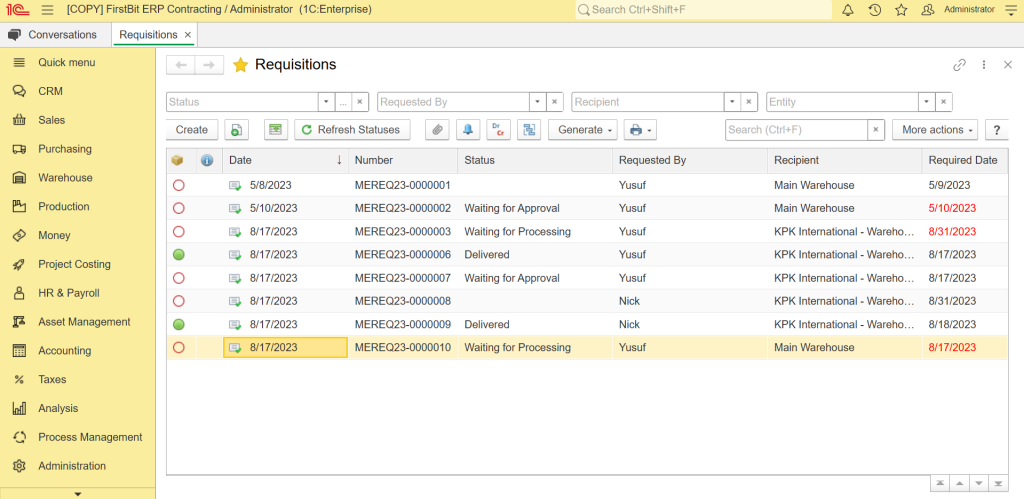
Manage RFIs and site requests in a centralized system, improving communication between project teams and procurement.
-
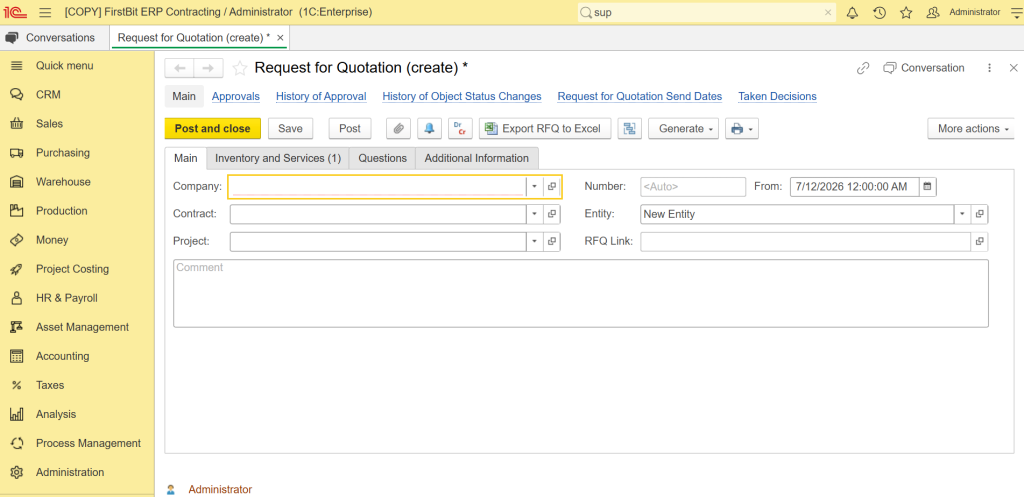
Create and send RFQs and RFPs to multiple suppliers while managing approvals digitally.
-
Compare supplier quotations side by side using pricing and custom evaluation criteria to identify the best-value vendor.

-
Convert approved requisitions into purchase orders automatically, reducing manual work and procurement cycle times.
-
Track procurement costs against project budgets with real-time dashboards and consolidated purchase order analysis.
-
Monitor supplier performance and procurement KPIs, giving project managers better visibility into purchasing efficiency and vendor reliability.
Optimize procurement with FirstBit ERP
Conclusion
FAQ

'%3e%3cg%20clip-path='url(%23clip1_6548_6055)'%3e%3cpath%20d='M13.974%2015.6195C14.2724%2016.0185%2014.6532%2016.3487%2015.0905%2016.5876C15.5278%2016.8265%2016.0114%2016.9686%2016.5084%2017.0042C17.0055%2017.0398%2017.5043%2016.9681%2017.9712%2016.7939C18.4381%2016.6198%2018.8621%2016.3472%2019.2143%2015.9948L21.2994%2013.9098C21.9324%2013.2544%2022.2827%2012.3766%2022.2747%2011.4654C22.2668%2010.5543%2021.9014%209.68269%2021.257%209.03839C20.6127%208.39408%2019.7412%208.02862%2018.83%208.0207C17.9189%208.01278%2017.0411%208.36305%2016.3857%208.99606L15.1902%2010.1845M16.754%2014.2295C16.4555%2013.8305%2016.0747%2013.5003%2015.6374%2013.2614C15.2002%2013.0225%2014.7166%2012.8804%2014.2196%2012.8448C13.7225%2012.8092%2013.2237%2012.8809%2012.7568%2013.0551C12.2899%2013.2292%2011.8659%2013.5018%2011.5136%2013.8542L9.42861%2015.9392C8.7956%2016.5946%208.44534%2017.4724%208.45326%2018.3836C8.46117%2019.2947%208.82664%2020.1663%209.47094%2020.8106C10.1152%2021.4549%2010.9868%2021.8204%2011.898%2021.8283C12.8091%2021.8362%2013.6869%2021.4859%2014.3423%2020.8529L15.5308%2019.6645'%20stroke='%235F7896'%20stroke-width='1.39002'%20stroke-linecap='round'%20stroke-linejoin='round'/%3e%3c/g%3e%3c/g%3e%3crect%20x='0.438953'%20y='0.438953'%20width='28.9709'%20height='28.9709'%20rx='14.4855'%20stroke='%235F7896'%20stroke-width='0.877907'/%3e%3cdefs%3e%3cclipPath%20id='clip0_6548_6055'%3e%3crect%20width='29.8488'%20height='29.8488'%20rx='14.9244'%20fill='white'/%3e%3c/clipPath%3e%3cclipPath%20id='clip1_6548_6055'%3e%3crect%20width='16.6802'%20height='16.6802'%20fill='white'%20transform='translate(7.02344%206.58435)'/%3e%3c/clipPath%3e%3c/defs%3e%3c/svg%3e)









See FirstBit ERP solutions in action
After the demo you will get a quotation for your company.