Construction projects need a clear way to track how contract value is divided, how much work has been completed, and what still remains to be billed.
Many contractors still manage this information in Excel or other manual tools. This may work at an early stage, but larger projects make it harder to keep budgets, progress updates, billing records, and approvals aligned.
This is where a schedule of values becomes useful. This guide explains what an SOV is, how it supports project control and payment management, and how ERP software can make the process more accurate and easier to manage.
What is SOV in construction
A schedule of values, or SOV, is a construction document that breaks the total contract amount into individual work items, activities, or project phases. Each line item has an assigned value, and the total of all line items should match the contract price agreed between the project owner and the contractor.
In practice, the SOV connects the contract scope, actual site progress, and payment applications submitted during the project.
For example, an SOV may include separate line items for:
-
Site preparation
-
Structural works
-
MEP works
-
Finishing works
-
Materials
-
Equipment
-
Subcontractor activities
An SOV is commonly used on medium-sized and large construction projects, especially when payments are made in stages. Instead of billing the client as one lump sum, the contractor submits payment applications based on completed work under each line item.
This makes the SOV useful for contractors, project owners, consultants, quantity surveyors, commercial teams, and finance departments.
In construction markets such as the UAE, where projects often involve complex scopes, phased payments, and multiple subcontractors, a clear schedule of values supports more transparent payment management and financial control.
Purpose of Using a Schedule of Values in Construction
The main purpose of using a schedule of values in construction is to create a clear financial structure for the project.
Without an SOV, it can be difficult to understand how much of the contract value belongs to each part of the work. This becomes especially important when the contractor submits payment applications throughout the project.
A well-prepared SOV helps the project team manage:
For contractors, the SOV supports more predictable
cash flow. Since each line item has an assigned value, the contractor can plan expected payments around actual project progress.
For project owners and consultants, the SOV provides a clearer basis for reviewing payment applications. Instead of approving a general invoice, they can check what work has been completed, what value is being claimed, and what remains in the contract balance.
The SOV also helps reduce disputes. When scope, value, progress, and billing are documented in one place, all parties have a shared reference point for financial discussions.
Prevent cost overruns
Register expenses in FirstBit ERP
Request a demo
What Information is Included in a Schedule of Values in Construction
A schedule of values should give enough detail to understand how the contract amount is divided, billed, and tracked during the project.
The exact format may vary depending on the contract, project size, client requirements, or internal company standards. Some companies use their own format, while others work with a schedule of values template provided by the client, consultant, or contract administrator.
At a basic level, an SOV should help answer three practical questions:
-
What work is included in the contract
-
How much each part of the work is worth
-
How much of that work has been completed and billed
This is why the schedule of values template is usually structured as a table. Each row represents a work item, activity, or project phase. Each column provides financial or progress-related information about that item.
For a small project, the schedule of values template may be relatively simple. For a large construction project, it can be much more detailed, especially when there are multiple subcontractors, cost categories, stored materials, retention, and approved variations.
The goal is not to make the document complicated. The goal is to make it clear enough for contractors, project owners, consultants, finance teams, and commercial teams to use the same reference point when reviewing progress and payments.
Core Information
The core information in a schedule of values should describe the project, the work to be completed, and the value assigned to each part of that work.
This is the minimum information needed to use the SOV as a basis for progress tracking and payment applications. If these details are unclear, the document becomes difficult to review and may lead to billing errors or disputes.
A typical SOV includes the following core fields:
-
Project name and number. This identifies the specific project associated with the schedule of values and helps distinguish it from other contracts, payment applications, and project records.
-
Contractor name. It helps identify which contract the SOV belongs to. This is especially important for companies managing several projects at the same time.
-
Line item number. Each line item is assigned a unique number to simplify payment applications and progress tracking.
-
Description of work. Each line item should have a clear description of work. A vague description such as “Electrical works” may not be enough on a complex project. It is usually better to define the work in a way that can be measured, reviewed, and billed without confusion.
-
Scheduled value. It shows how much each work item is worth within the total contract amount. When all scheduled values are added together, the total should match the agreed contract value.
-
Work completed to date. This field records the cumulative value of work completed for each line item up to the current reporting period. It serves as the basis for calculating earned value and payment amounts.
-
Percentage of completion. This shows how much progress has been made for each line item as a percentage of the total scope. It helps project owners, consultants, and finance teams check whether the requested payment is aligned with actual progress on site.
-
Balance to finish. It shows the remaining value of work that has not yet been completed. This helps the project team understand what is still left in the contract and supports more accurate financial planning until project closeout.
Additional Information
In larger or more complex projects, a schedule of values may include additional fields beyond the basic work description and scheduled value. These details help the project team review payment applications more accurately and keep financial records aligned with site progress.
One common field is the value of work completed during the current billing period. This separates newly completed work from the amount that was already claimed in previous payment applications. The SOV may also show materials stored on site or off site but not yet installed. This is important when the contractor has already purchased materials, but they have not yet become part of the completed work.
Another important field is retention. Retention is a portion of payment withheld until a later project stage or final completion. It helps protect the project owner and ensures that contractual obligations are fulfilled before the full amount is released.
Additional SOV fields may include:
These fields are especially useful when the project has phased payments, many subcontractors, or frequent variations. They give the contractor, consultant, and project owner a clearer view of how the contract value changes over time.
Include enough detail to support accurate billing and progress control. At the same time, keep the document practical for the teams that need to update and review it regularly.
Using a Schedule of Values in UAE Construction Projects
In Dubai and other Emirates, SOVs are commonly used on projects governed by
FIDIC-based contracts, where progress payments are linked to completed and certified work. The SOV serves as the foundation for monthly valuations, payment applications, cash flow forecasting, and project reporting.
UAE-specific examples:
-
Dubai high-rise residential project. On a typical Dubai residential tower procured under a FIDIC
Red Book contract, the contractor may submit monthly valuations based on an approved SOV covering foundations, structure, façade, MEP installations, and fit-out works. The consultant certifies the completed percentage of each item before recommending payment.
-
Infrastructure project in Abu Dhabi. For large infrastructure projects, SOVs are often linked to measurable quantities and milestones. Work packages such as utilities, roads, drainage systems, and landscaping are valued separately to facilitate detailed progress monitoring and payment certification.
-
Design-build developments. Under
Yellow Book contracts, additional SOV categories may be created for design deliverables, authority approvals, procurement activities, and commissioning milestones. This approach ensures that non-construction activities are also recognised within payment applications.
Key Features of UAE Construction Contracts That Affect the Schedule of Values
On most UAE construction projects, the contractor is required to submit the SOV shortly after contract award. The SOV must be reviewed and approved by the consultant or engineer before interim payment applications can be processed. Once approved, it serves as the primary framework for measuring progress and certifying monthly payments.
Widespread Use of FIDIC-Based Contracts
The majority of major construction projects in the UAE are procured using FIDIC contract forms, particularly the
Red Book for traditional design-bid-build projects and the
Yellow Book for design-and-build developments.
Employers frequently modify the standard FIDIC conditions through Particular Conditions to address project-specific requirements and local market practices. As a result, the structure and level of detail required within the SOV may vary from project to project.
Pro tip
Particular Conditions are usually included in the tender documents and form part of the contract. Before preparing the SOV, review the Conditions of Contract section carefully, as amendments to payment, measurement, and certification provisions are often contained there.
Consultant-Certified Payment Procedures
Payment in UAE construction projects is generally subject to certification by the consultant or engineer. Before payment is approved, the consultant reviews and verifies the value of work completed during the reporting period.
Consequently, the SOV must be aligned with the project's agreed measurement and valuation methodology to facilitate efficient review and certification.
Pro tip
Review the consultant's payment application templates and measurement requirements early in the project. Aligning the SOV with the consultant's preferred valuation methodology can help avoid certification delays and reduce payment-related queries.
Strong Emphasis on Supporting Documentation
Employers, consultants, and project stakeholders in the UAE typically require comprehensive supporting records to substantiate progress claims.
Progress percentages reported within the SOV are commonly supported by:
Maintaining accurate and auditable documentation is essential for timely payment certification and minimising valuation disputes.
SOV and Local Payment Procedures
Because interim payments are directly tied to certified progress, the Schedule of Values (SOV) plays a critical role in project cash flow. An inaccurate or poorly structured SOV can delay payment certification and create significant financial pressure for the contractor.
For this reason, contractors often invest considerable effort in developing the SOV before construction begins, ensuring that major work activities are appropriately allocated and measurable.
Monthly Interim Payment Applications
On most UAE projects, contractors submit monthly interim payment applications based on the approved SOV. The application typically shows the percentage completion and value of each SOV item during the reporting period.
A typical payment application includes:
-
Updated schedule of values
-
Progress measurement sheets
-
Variation summaries
-
Material-on-site records
-
Progress photographs
-
Consultant inspection approvals
Pro tip
Structure SOV line items so that progress can be measured and certified easily each month. Overly broad work items often lead to valuation disputes and delayed payments.
Retention and Payment Deductions
The SOV should also account for contractual payment deductions. Most UAE construction contracts include retention provisions, whereby a percentage of each certified payment is withheld until practical completion and, in many cases, until the end of the defects liability period.
Common deductions include:
Pro tip
When forecasting cash flow, use the SOV together with retention and recovery schedules to estimate actual cash receipts rather than certified values.
Requirements Imposed by Consultants and Contract Administrators
Consultants generally expect the SOV to follow a logical work breakdown structure that mirrors the project scope. Excessively front-loaded or unbalanced schedules are often rejected during the approval process.
Typical SOV sections include:
Many consultants also require the SOV to align with the approved baseline programme. This allows progress percentages reported within payment applications to be compared directly against planned construction progress.
Because variations are common in UAE projects, consultants frequently require separate SOV sections for instructed changes. This variation tracking improves transparency and helps avoid disputes regarding valuation and entitlement.
Keep every project on budget
Request a demo
Steps to Create a Schedule of Values in Construction
The process of creating a schedule of values begins with the transformation of the contract scope into a clear, measurable billing structure. The objective is to ensure that every significant work item can be consistently tracked, reviewed, and billed throughout the project lifecycle.
Step 1: Confirm project details
Before preparing the schedule of values, confirm the key contract and billing details that will form the basis of the document. Recording this information clearly helps avoid mismatches during payment review:
-
Project name and number
-
Project location
-
Client or project owner
-
Contractor name
-
Contract reference
-
Total contract value
-
Billing period
Then check the contract requirements for the SOV format. Some projects require a standard form, while others use the client’s template, a schedule of values template, or the contractor’s internal structure.
Confirm these details before breaking the project scope into line items. This gives the SOV a reliable starting point and helps the project team avoid billing errors later.
Step 2: Identify work items
Break the project scope into clear work items using the contract, BOQ, drawings, specifications, and approved project budget as your main references.
Avoid making the line items too broad. A general item such as “Electrical works” may look simple, but it can create confusion later when the team needs to measure progress or review a payment application.
Instead, define each line item so it can be measured, reviewed, and connected to actual progress on site. For example, electrical works can be split into lighting, power distribution, containment, wiring, testing, and commissioning if the project requires that level of detail.
A practical SOV usually includes work items such as:
-
Site preparation
-
Structural works
-
MEP works
-
Finishing works
-
Materials
-
Equipment
-
Subcontractor works
The right level of detail depends on the project size, contract structure, and billing requirements. A small project may only need a simple breakdown. A large project with many subcontractors, phases, and payment milestones will need a more detailed structure.
Step 3: Assign values
Assign costs to each work item in the SOV using the approved contract amount, BOQ, estimate, subcontractor packages, supplier quotations, and internal cost breakdown as your main references.
Each amount should reflect the real cost and commercial weight of the activity within the project. Do not distribute the contract value randomly or copy figures from a previous project without checking whether they match the current scope.
Make sure the total of all line items equals the signed contract amount.
When preparing the breakdown, check the main cost components behind each work item:
-
Labor
-
Materials
-
Equipment
-
Subcontractor costs
-
Indirect costs
-
Approved markups
Avoid frontloading the SOV by placing too much value in early project activities. It may improve short-term cash flow, but it can create problems later if the remaining work is undervalued.
Review the final breakdown with the project, commercial, and finance teams before submitting it for approval. Each amount should be explainable, verifiable, and suitable as a fair basis for future payment applications.
Step 4: Update regularly
Update the schedule of values throughout the project as work progresses and contract conditions change. The SOV should reflect the current status of completed work, approved changes, billed amounts, stored materials, retention, and remaining contract balance.
Use site progress reports, approved work measurements, subcontractor updates, procurement records, and change order approvals to keep the document aligned with the latest project information.
Do not treat the SOV as a static spreadsheet. Set a clear update routine and assign responsibility for maintaining it, so the project, commercial, and finance teams always work from the same current version.
Step 5: Review accuracy
Review the schedule of values before it is used as support for billing. At this stage, the goal is to confirm that the latest SOV is accurate, internally consistent, and supported by project records.
Compare the SOV with the contract, approved budget, site progress reports, work measurements, change orders, and previous payment records. Focus especially on areas where mistakes often happen:
-
Total contract value
-
Line item descriptions
-
Percentage of completion
-
Work completed to date
-
Stored materials
-
Retention
-
Approved change orders
-
Balance to finish
Confirm that the reported progress matches the actual situation on site. Any claimed progress should be supported by reports, measurements, approvals, or other project records. Do not leave the review to one person. Involve the project manager, quantity surveyor, commercial team, and finance team where relevant.
Complete the internal review before the SOV is shared for external billing review. The final version should be clear, supported by records, and consistent with the project’s current status.
Step 6: Submit payment applications
Use the approved schedule of values as the basis for each payment application. The invoice, claimed amount, and supporting details should follow the latest approved SOV rather than being prepared as a separate billing document.
For each billing period, show the amount being claimed now and separate it from amounts already claimed in previous applications. This helps the reviewer understand the current billing period clearly and avoids confusion between previous and current claims.
Prepare the supporting documents required by the contract or approval process. These may include site progress reports, work completion records, consultant approvals, material delivery notes, subcontractor claims, and approved change orders.
Before submission, confirm that the payment application follows the approved SOV and does not exceed the value assigned to each line item.
Submit the payment application to the project owner, consultant, or contract administrator according to the agreed billing schedule. Keep a record of submitted versions, comments, approvals, and revisions so the project team can track the full payment history.
How FirstBit ERP Supports Schedule of Values Management
Managing a schedule of values manually can work at the early stage of a project. However, as the project grows, it becomes harder to keep the SOV aligned with budgets, progress updates, subcontractor claims, materials, change orders, and payment applications.
FirstBit ERP helps construction companies manage this process by connecting project financials with operational data. Instead of maintaining the SOV as a separate spreadsheet, teams can work with project budgets, BOQ items, procurement, subcontractors, progress reporting, and billing in one system.
This is especially useful for contractors who need to control several cost and progress layers at the same time:
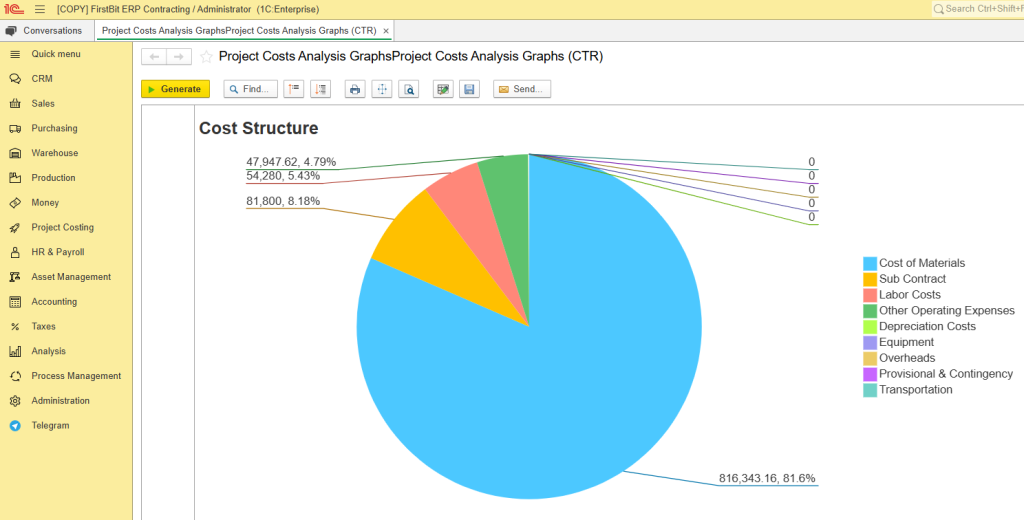
Cost Breakdown in FirstBit ERP Contracting
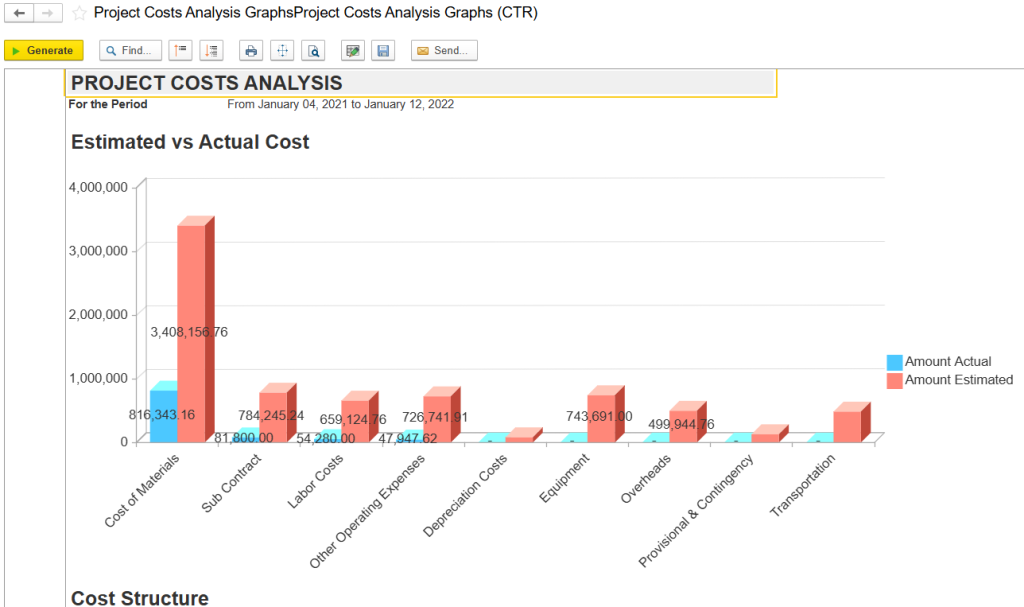
With these records connected, finance and project teams can compare planned values with actual costs, track completed work, and prepare billing based on approved progress data.
FirstBit ERP can also support approval workflows, allowing payment-related documents, procurement requests, subcontractor claims, and project expenses. For CFOs, finance teams, project managers, and commercial teams, this improves control over cash flow, billing status, profitability, completed work, and remaining project scope.
Estimated vs actual cost in FirstBit ERP Contracting
In markets such as the UAE, where contractors often manage multiple projects, subcontractors, progress payments, and compliance requirements, ERP can help reduce manual work and improve financial transparency across the project lifecycle.
Get paid faster and on time
Automate invoice creation by milestones with FirstBit ERP
Request a demo
Conclusion
A schedule of values gives construction teams a disciplined way to connect contract value, site progress, billing, and financial control. It turns the contract into measurable work items and creates a shared reference for contractors, finance teams, project owners, and consultants.
A clear and realistic SOV supports more confident billing, stronger cash flow planning, and more consistent payment reviews. It also helps teams track completed work, approved changes, stored materials, retention, and remaining scope through one structured document.
The strongest SOVs are built around practical detail, reliable project records, and regular updates. They reflect how the project is being delivered on site and give commercial and finance teams a clearer basis for managing costs, claims, and future payments.
As construction companies manage larger projects, more subcontractors, and tighter financial controls, the SOV becomes part of a broader project management process. Keeping it connected with budgets, procurement, progress data, approvals, and billing inside an ERP system can help teams reduce manual work, improve transparency, and make better commercial decisions across the project lifecycle.
F.A.Q.
In construction, SOV means Schedule of Values. It is a document that breaks the total contract value into separate work items and assigns a value to each item. Contractors use it to track completed work, prepare payment applications, and show how much of the contract value has already been billed and how much remains.
What are L1, L2, L3, and L4 schedules in planning?
L1, L2, L3, and L4 schedules show different levels of project planning detail. A Level 1 schedule gives a high-level project overview, usually for executives or senior management. A Level 2 schedule shows major phases and milestones. A Level 3 schedule provides a more detailed project coordination plan. A Level 4 schedule breaks the work down further into execution-level activities, work packages, or discipline-specific tasks used by project teams on site.
Is a Schedule of Values the same as a BOQ?
No. A BOQ, or Bill of Quantities, lists measured quantities of work, materials, and rates used for pricing and tendering. A Schedule of Values uses the contract value to create a billing structure for progress payments. The BOQ can help prepare the SOV, but the two documents serve different purposes.
What is a SOV in construction?
A Schedule of Values, or SOV, is a construction document that divides the total contract amount into individual work items, phases, or cost categories. It helps contractors, project owners, consultants, and finance teams track progress, review payment applications, manage billing, and understand the remaining contract balance.
Protect your profit margins
Request a demo












'%3e%3cg%20clip-path='url(%23clip1_6548_6055)'%3e%3cpath%20d='M13.974%2015.6195C14.2724%2016.0185%2014.6532%2016.3487%2015.0905%2016.5876C15.5278%2016.8265%2016.0114%2016.9686%2016.5084%2017.0042C17.0055%2017.0398%2017.5043%2016.9681%2017.9712%2016.7939C18.4381%2016.6198%2018.8621%2016.3472%2019.2143%2015.9948L21.2994%2013.9098C21.9324%2013.2544%2022.2827%2012.3766%2022.2747%2011.4654C22.2668%2010.5543%2021.9014%209.68269%2021.257%209.03839C20.6127%208.39408%2019.7412%208.02862%2018.83%208.0207C17.9189%208.01278%2017.0411%208.36305%2016.3857%208.99606L15.1902%2010.1845M16.754%2014.2295C16.4555%2013.8305%2016.0747%2013.5003%2015.6374%2013.2614C15.2002%2013.0225%2014.7166%2012.8804%2014.2196%2012.8448C13.7225%2012.8092%2013.2237%2012.8809%2012.7568%2013.0551C12.2899%2013.2292%2011.8659%2013.5018%2011.5136%2013.8542L9.42861%2015.9392C8.7956%2016.5946%208.44534%2017.4724%208.45326%2018.3836C8.46117%2019.2947%208.82664%2020.1663%209.47094%2020.8106C10.1152%2021.4549%2010.9868%2021.8204%2011.898%2021.8283C12.8091%2021.8362%2013.6869%2021.4859%2014.3423%2020.8529L15.5308%2019.6645'%20stroke='%235F7896'%20stroke-width='1.39002'%20stroke-linecap='round'%20stroke-linejoin='round'/%3e%3c/g%3e%3c/g%3e%3crect%20x='0.438953'%20y='0.438953'%20width='28.9709'%20height='28.9709'%20rx='14.4855'%20stroke='%235F7896'%20stroke-width='0.877907'/%3e%3cdefs%3e%3cclipPath%20id='clip0_6548_6055'%3e%3crect%20width='29.8488'%20height='29.8488'%20rx='14.9244'%20fill='white'/%3e%3c/clipPath%3e%3cclipPath%20id='clip1_6548_6055'%3e%3crect%20width='16.6802'%20height='16.6802'%20fill='white'%20transform='translate(7.02344%206.58435)'/%3e%3c/clipPath%3e%3c/defs%3e%3c/svg%3e)