





Modular Construction Growth in GCC: 2026 Forecast



Globally, the modular construction market is projected to grow from $107.83 billion in 2025 to $116.81 billion in 2026, with an 8.3% CAGR, according to Research and Markets: Modular Construction Market Report.
Modular Construction Meaning
GCC Modular Construction Outlook for 2026
2026 Outlook: Market Trends
- Continued government investment in infrastructure, housing, tourism, and industrial developments, particularly in Saudi Arabia and the UAE, sustaining demand for modular construction solutions.
- Increasing adoption of modular construction to reduce project schedules, improve quality control, and mitigate on-site labor constraints.
- Greater focus on local manufacturing and regional supply chain resilience to reduce dependence on imported building components and minimize logistics risks.
- Higher transportation, freight, and construction material costs that are placing pressure on project budgets and encouraging greater cost optimization.
- More cautious private-sector investment due to tighter financing conditions and elevated market uncertainty, potentially delaying selected commercial and real estate developments.
- Resilience of government-backed strategic projects, which are expected to maintain a stable pipeline despite a more challenging macroeconomic environment.
Leading GCC Markets for Modular Construction
- Saudi Arabia. The largest and fastest-growing market, driven by Vision 2030 giga-projects, affordable housing programs, tourism developments, industrial cities, and public infrastructure investments. According to Mordor Intelligence, Saudi Arabia accounted for approximately 45.6% of GCC construction activity in 2025 and is expected to remain the primary driver of modular construction demand.
- United Arab Emirates (UAE). The second-largest market is supported by continued investment in hospitality, residential developments, logistics, healthcare, education, and commercial real estate. The UAE modular construction market is forecast to grow at approximately 7.2% CAGR during 2026–2033 (source: Grand View Research).
- Qatar. Continued investment in urban regeneration, healthcare, education, transport infrastructure, and commercial developments is expected to support increasing adoption of modular building solutions.
- Oman. Rising investment in tourism, logistics, industrial zones, renewable energy projects, and affordable housing is creating new opportunities for modular construction.
- Kuwait. Government investment in residential housing, healthcare facilities, public infrastructure, and mixed-use developments is expected to gradually increase demand for modular construction methods.
- Bahrain. Although the smallest GCC market, Bahrain continues to generate opportunities in residential, healthcare, education, and public-sector construction, where modular solutions can improve delivery speed and project efficiency.
Key Growth Drivers of Modular Construction
- Large government construction programs. Government-funded infrastructure and diversification projects remain the principal driver of modular adoption. Large public-sector investments require faster, standardized, and scalable building solutions for housing, education, healthcare, tourism, and transport infrastructure.
- Labor shortages. The GCC construction sector continues to experience labor availability challenges, rising labor costs, and increasing productivity requirements. Factory-based production reduces dependence on large on-site labor forces while improving safety and quality consistency.
- Faster project delivery. Project schedules are becoming increasingly compressed, particularly for hospitality developments, worker accommodation, hospitals, and social infrastructure. Modular construction can significantly shorten construction timelines by enabling parallel off-site manufacturing and on-site preparation.
- Expansion of hospitality, residential, healthcare, and social infrastructure. Rapid expansion across is generating demand for repeatable building designs that are particularly suitable for modular construction. Large hotel portfolios, hospitals, schools, and residential communities increasingly incorporate prefabricated structural and volumetric solutions.
Most Promising End-Use Segments
- Hotels and resorts
- Residential developments
- Hospitals and healthcare facilities
- Schools and educational buildings
- Workforce accommodation and labor camps
- Temporary and rapidly deployable buildings for infrastructure, industrial, mining, and energy projects
Key Market Constraints
- Transportation of oversized modular units over long distances
- Requirement for early design freeze before manufacturing begins
- Compliance with municipal building regulations and fire safety requirements
- Complex logistics associated with heavy lifting, site access, and crane operations
- Limited flexibility to accommodate design changes after factory production has commenced
Summary of Key Market Indicators
| Indicator | 2026 outlook | Supporting source |
| GCC modular construction market size | Approximately USD 2.1 billion (2025 base) with 5.6% CAGR through 2034 | IMARC Group |
| Overall GCC construction market | USD 174 billion (2026 estimate) | P&S Intelligence |
| Largest national market | Saudi Arabia | Mordor Intelligence |
| Primary growth sectors | Hospitality, residential, healthcare, education, and workforce accommodation | P&S Intelligence, Grand View Research Horizon (for the UAE market outlook) |
| Major growth drivers | Government megaprojects, labor shortages, faster delivery, quality improvement, and sustainability | IMARC Group |
Control quality in FirstBit ERP
How Modular Construction Works
- Design and engineering
- Approval of modular specifications
- Off-site manufacturing
- Site preparation and foundation works
- Transportation of modules or panels
- On-site installation and assembly
- Utility connections and final inspections
Types of Modular Construction: Techniques and Applications
Types Based on Structure and Assembly Method
| Criterion | Volumetric (3D modules) | Panelized (2D panels) | Hybrid |
| Factory completion | Very high (80–95%) | Medium (30–70%) | High |
| On-site work | Very low | Medium–high | Low–medium |
| Design flexibility | Moderate | High | High |
| Transportation | High-cost | Low-cost | Moderate |
| Typical uses | Hotels, apartments, hospitals | Villas, schools, warehouses | High-rise buildings, hotels, mixed-use projects |
Volumetric Modular Construction (3D Modules)
- Definition: A construction method where complete three-dimensional modules (rooms or building sections) are manufactured in a factory with finishes and MEP services, then transported and assembled on-site.
- Production principle: Maximize factory completion by producing nearly finished modules under controlled conditions to reduce on-site work.
- Application areas: Apartments, hotels, hospitals, schools, student housing, worker accommodation, healthcare facilities, offices.
This technique works best when the design is stable, modules are repetitive, and the project team can plan transport, lifting, MEP interfaces, and inspections before production starts. Factory-controlled manufacturing improves quality, reduces material waste, and enhances worker safety through standardized production processes.
Needs higher initial factory investment. Late design changes can be difficult and expensive once module production has started. This technique requires stronger upfront planning, especially around design freeze, module dimensions, and MEP interfaces. Transporting and lifting large modules also presents logistical challenges.
- Earth Tower, Abu Dhabi, UAE. 16-storey residential apartment building in Zayed City. Constructed using 259 fully finished volumetric steel modules (BROAD Holon system). One of the UAE's first high-rise permanent volumetric modular residential buildings.
- LINQ Modular G+6 building system, Dubai, UAE. Dubai Municipality approved the UAE's first multi-storey volumetric modular building system. Designed for residential, hospitality, and commercial developments up to seven storeys (G+6). Modules are fully manufactured off-site, including MEP and interior finishes.
- Habshan workforce accommodation camp, Abu Dhabi, UAE. Large-scale workforce accommodation village. Uses prefabricated volumetric accommodation modules for approximately 6,000 occupants. Delivered using modular off-site construction methods.
- NEOM Residential Community 5 (NRC-5), Saudi Arabia. NRC-5 is a self-contained residential community designed to accommodate approximately 10,000 residents. The community supports NEOM's industrialized construction strategy, with relocatable modular buildings enabling rapid deployment and future reuse.
- NEOM Residential Community 9 (NRC-9), Saudi Arabia. NRC-9 is another residential community developed to support NEOM's construction program. Like NRC-5, it is designed as a self-sustaining village with modular accommodation, social infrastructure, healthcare, retail, and community facilities.
Panelized Modular Construction (2D Panels)
- Definition: A prefabrication method where flat building elements such as walls, floors, roofs, and partitions are manufactured off-site and assembled at the construction site.
- Production principle: Standardize flat components for efficient factory production while allowing flexibility during site assembly.
- Application areas: Residential housing, villas, schools, warehouses, industrial buildings, commercial buildings, hotels.
Panelized construction offers lower transportation costs and simpler logistics because flat panels can be stacked efficiently. It also provides greater design flexibility than volumetric construction, reduces material waste through factory manufacturing, and requires lower factory investment.
Panelized systems require more on-site assembly and finishing than volumetric construction. This results in higher on-site labor demands and longer project completion times. Small errors in panel alignment can also lead to rework, delays, and interface issues on-site. Therefore, it is important to plan the installation sequence, lifting method, and coordination with MEP and façade systems in advance.
- Expo City Dubai (formerly Expo 2020 Dubai), UAE. Several pavilions and support buildings incorporated LGS wall panels, insulated sandwich panels, and prefabricated façade panels to accelerate construction and enable future disassembly and reuse.
- The Red Sea Project, Saudi Arabia. Resorts and support facilities utilize panelized light-steel wall systems and prefabricated building components for rapid site delivery to improve sustainability and speed.
- Sobha Hartland Developments, UAE. Extensive use of prefabricated façade panels and factory-manufactured bathroom pods; increasing adoption of panelized DfMA systems.
Hybrid Modular Construction
- Definition: Combines 3D volumetric modules with 2D panels. Typically, complex spaces (e.g., kitchens and bathrooms) are built as modules, while the remaining structure uses panelized systems.
- Production principle: Combine the productivity of volumetric construction with the flexibility and transport efficiency of panelized construction.
- Application areas: High-rise residential buildings, hotels, hospitals, mixed-use developments, commercial buildings, healthcare, and education facilities.
Hybrid modular construction combines speed with flexibility. It is well-suited for complex buildings featuring repetitive, service-intensive spaces while also supporting larger, open-plan layouts. The use of both 2D panels and 3D modules also improves transportation efficiency and cost-performance balance.
The integration of multiple prefabrication systems requires greater design coordination and planning than single-system approaches. Successful implementation depends on accurate BIM-based coordination. You’ll have to mange the production, transportation, and installation of both panels and volumetric 3D modules at the same. This increases logistical complexity.
- Hamdan Bin Rashid Cancer Hospital, Dubai, UAE. Planned as the Middle East's first fully modular-built cancer hospital. The project combines off-site prefabricated healthcare modules with advanced hospital engineering systems to accelerate construction while maintaining healthcare quality standards.
- FIFA World Cup 2022 infrastructure, Qatar. Stadiums and permanent facilities built conventionally while integrating prefabricated seating systems, bathroom pods, MEP modules, modular accommodation, and temporary modular buildings for operations, media, and workforce facilities.
- Atlantis The Royal, Dubai, UAE. The project incorporated prefabricated bathroom pods, MEP modules, and façade elements within a conventionally constructed reinforced concrete superstructure, making it a notable hybrid modular application for luxury hospitality.
Types of Modular Construction Based on Intended Lifespan
| Feature | Permanent Modular Construction (PMC) | Relocatable Modular Buildings (RMB) |
| Purpose | Permanent buildings | Temporary or reusable buildings |
| Foundation | Permanent concrete foundation | Temporary or reusable foundation |
| Service life | 50+ years (similar to conventional buildings) | Months to several years; designed for repeated relocation |
| Mobility | No | Yes |
| Typical applications | Housing, hotels, schools, hospitals, offices | Construction camps, classrooms, clinics, worker housing, site offices |
Permanent Modular Construction (PMC)
- Definition: Permanent Modular Construction (PMC) is an off-site construction method in which building modules are manufactured in a controlled factory environment, transported to the site, and permanently installed on foundations. The completed building meets the same building codes, durability, and performance standards as conventional construction.
- Production principle: Uses industrialized manufacturing to maximize factory completion (typically 60–90%) before transporting modules for permanent assembly. Site preparation and module fabrication occur simultaneously to shorten project schedules.
- Application areas: Residential housing, apartment buildings, hotels, hospitals and healthcare facilities, schools and universities, commercial offices, government buildings and student accommodations.
PMC can reduce construction time by 30–50% through parallel off-site manufacturing and on-site preparation. Factory-controlled production ensures high quality, reduces material waste, minimizes weather-related delays, lowers on-site labor requirements, and supports more sustainable construction practices.
PMC requires transporting large modules, leading to higher transportation costs and size restrictions. Installation depends on heavy crane lifting, and the method involves higher upfront manufacturing investment. In addition, design changes become difficult and costly once module fabrication has begun.
- AMAALA Staff Village Project, Saudi Arabia. Permanent modular housing and community facilities built to support the long-term operation of the AMAALA tourism destination.
- Sindalah Marriott Serviced Apartments, NEOM, Saudi Arabia. According to Modular Building Institute, 218 permanent modular serviced apartments were installed on Sindalah Island using fully finished volumetric steel modules. The buildings are designed as permanent hospitality assets rather than temporary accommodation.
- Modular Townhouse Development, Dubai, UAE. LINQ has developed a permanent two-storey modular townhouse system (approximately 2,000 sq ft) targeting mainstream residential developments in the UAE. The homes are designed as permanent residential buildings rather than relocatable units.
Relocatable Modular Buildings (RMB)
- Definition: Relocatable Modular Buildings (RMBs), also called portable modular buildings, are factory-built structures designed to be installed, removed, transported, and reused at multiple locations. They are intended for temporary or semi-permanent use while complying with applicable building codes.
- Production principle: Employs standardized, lightweight modular units designed for repeated transportation and rapid installation. The emphasis is on flexibility, reuse, and fast deployment rather than permanent installation.
- Application areas: Construction site offices, temporary classrooms, emergency housing, military facilities, worker accommodation camps, sales offices and showrooms, event facilities and remote project buildings.
RMB is ideal for temporary facilities and emergency applications. They are designed for relocation and reuse, minimizing site disturbance while providing flexible space management, lower costs for short-term projects, and efficient solutions for remote locations.
RMBs generally offer less architectural flexibility and are typically limited to smaller buildings. They have a shorter intended service life than permanent modular buildings, may provide lower structural capacity for some applications, and are generally unsuitable for high-rise or long-term developments.
- Dubai Metro Route 2020 Site Offices, UAE. Contractors used relocatable modular site offices, meeting rooms, and welfare facilities throughout the construction phase. These units were designed to be dismantled and relocated as work progressed along the alignment.
- Etihad Rail сonstruction сamps, UAE. The Etihad Rail project utilized relocatable modular accommodation camps, administration buildings, dining facilities, and portable site offices for contractors working across multiple construction sections.
- COP28 temporary operations village, Dubai, UAE. The conference used relocatable modular offices, security checkpoints, media facilities, medical clinics, and operational support buildings that were designed for rapid installation and removal after the event.
- Lusail City Construction Site Offices, Qatar. Large-scale urban development contractors deployed portable modular offices, security buildings, and welfare units that were relocated as different construction packages progressed.
Modular Construction Companies Operating in the UAE
The companies below are presented as examples based on their UAE presence, modular capabilities and publicly documented projects. This is not a formal ranking.
LINQ Modular
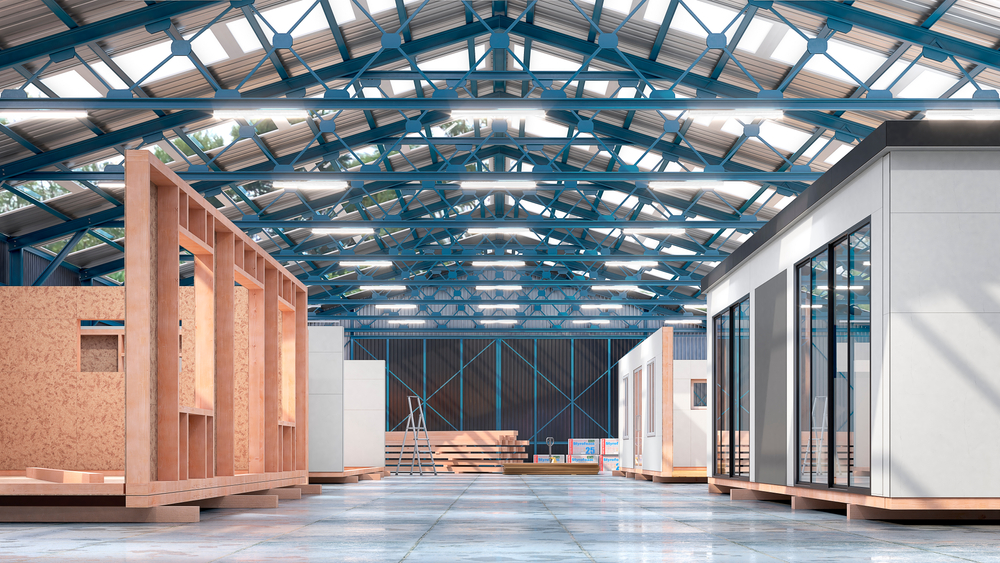
- Beach resort project, Abu Dhabi, UAE. A modular resort development where LINQ was selected to deliver high-quality off-site manufactured hospitality accommodation for a remote beachfront location.
- Dubai Municipality pilot modular building project. LINQ received approval to develop a pioneering multi-storey modular building in Dubai, demonstrating advanced off-site construction technologies and sustainable building systems.
AMANA Group
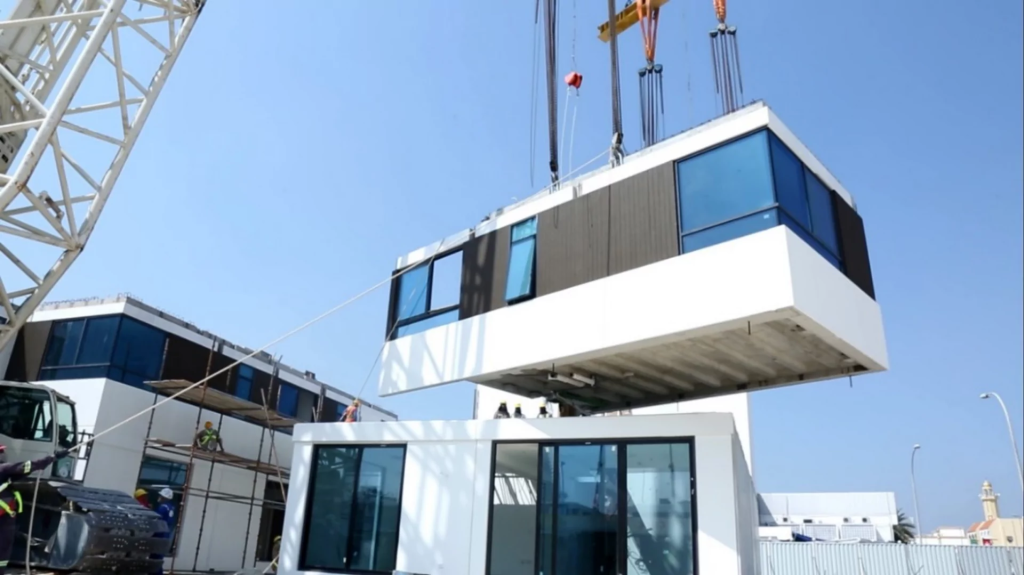
- Al Dhiyafa Village, Dubai. A DuBox modular residential development comprising 26 villas, delivered using volumetric concrete construction.
- Wasl Gardenia Townhouses, Dubai. A DuBox modular townhouse community delivered using off-site manufacturing and design-build methodologies.
- Vida Creek Beach Residence, Dubai Creek Harbour. A DuPod project utilizing prefabricated bathroom and utility pods to accelerate residential construction.
NAFFCO
- Modular hospital projects. Prefabricated healthcare facilities that can be rapidly deployed and expanded for medical use.
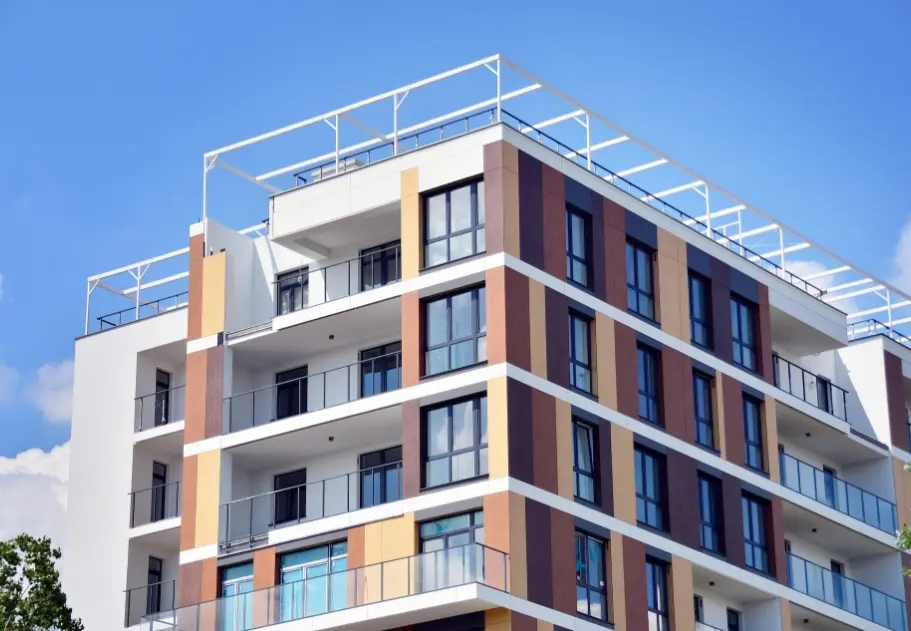
- High-rise modular residential buildings (up to 10 storeys). Steel-frame modular systems designed for multi-storey residential developments.
- Modular education buildings (schools and training facilities). Modular solutions for educational facilities that enable faster construction and future expansion.
- Modular commercial buildings. Prefabricated office and commercial facilities designed for rapid delivery and reduced site disruption.
- Worker accommodation and residential camp buildings. Modular accommodation blocks built using volumetric construction methods for workforce housing.
Trojan Construction & Holding Group
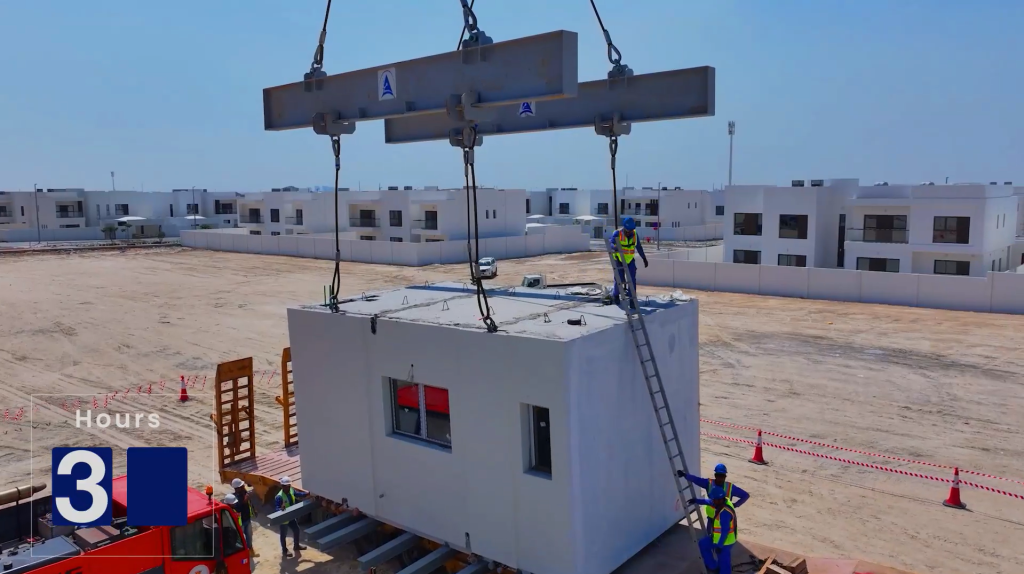
- Rabdan Façade Villas, Abu Dhabi. A large-scale residential development where prefabricated and modular construction techniques were utilized to improve delivery speed and quality.
- Nurai Island Resort Villas, Abu Dhabi. Luxury hospitality and residential villas incorporating off-site manufactured building components to accelerate construction.
- Worker accommodation and camp facilities, Abu Dhabi. Modular accommodation developments delivered for industrial and infrastructure projects, using prefabricated building systems to reduce site construction time.
Speed House Group
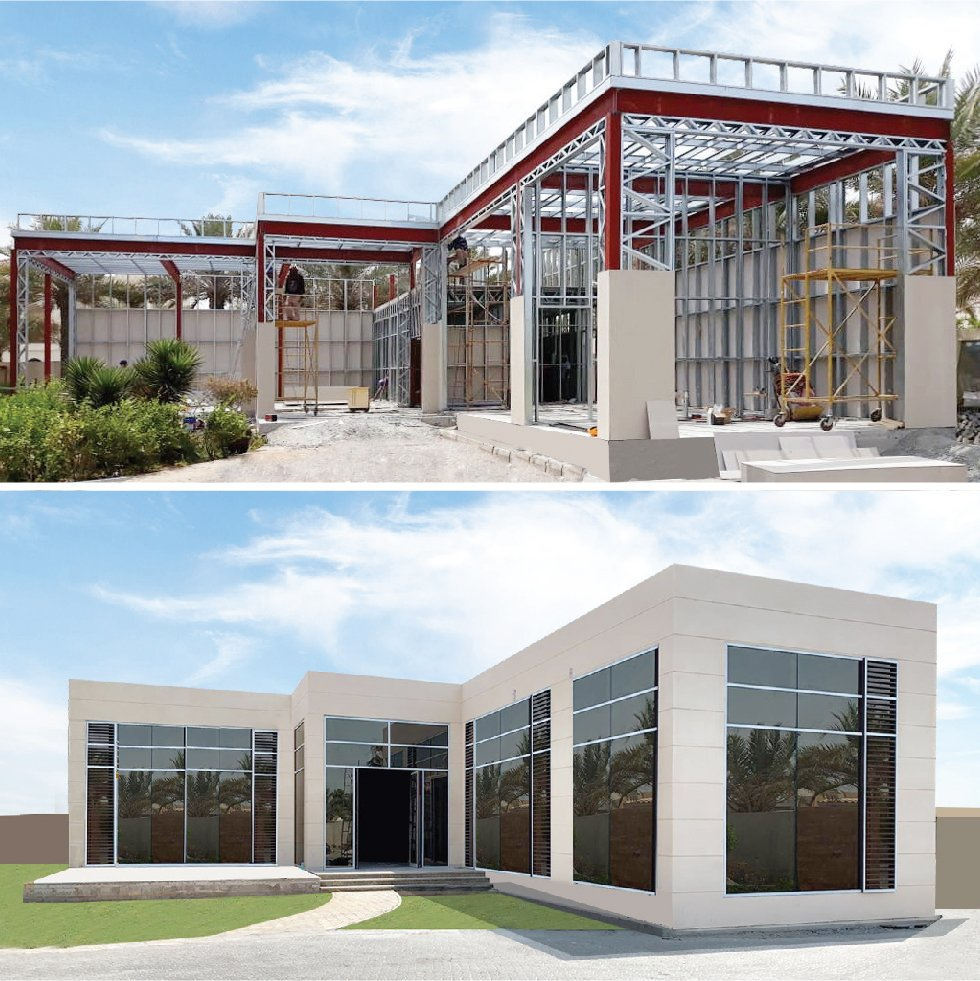
- Dubai South staff accommodation project, Dubai – Modular workforce accommodation delivered using off-site construction methods to provide rapid, scalable housing solutions.
- Al Marmoom desert resort accommodation, Dubai – Prefabricated hospitality and accommodation units designed for fast installation in a remote desert environment.
- Government and military accommodation facilities, UAE – Modular residential and operational buildings supplied for government and defense-sector applications, leveraging Speed House's prefabricated construction systems.
Why Are Contractors Choosing FirstBit ERP for Construction and Modular Building Management?
- Project budgets
- BOQ and estimates
- Procurement and materials
- Subcontractor work
- Equipment and labour costs
- Approvals and payment requests
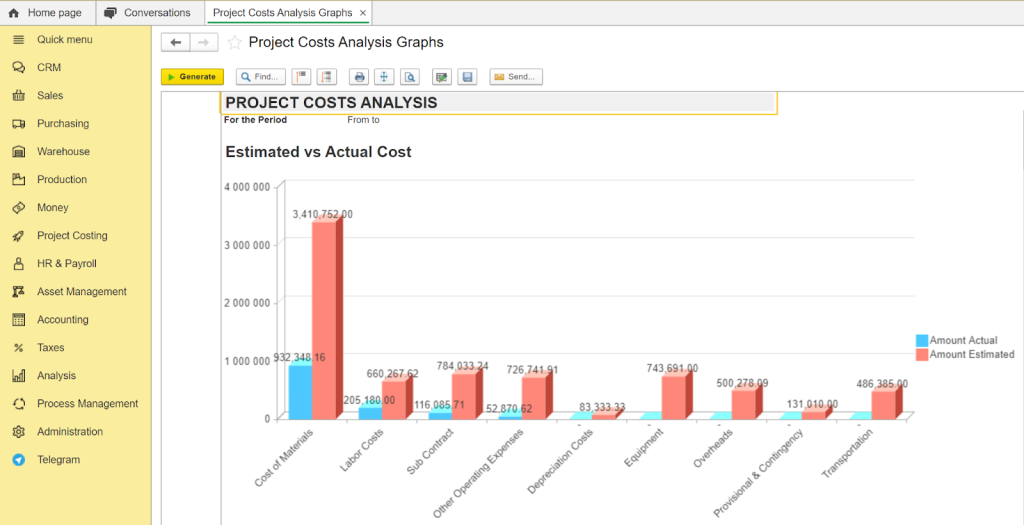
- Budget vs actual reporting

Monitor cash flows, project P&L, and KPIs
Conclusion
F.A.Q.
Embrace innovation with FirstBit ERP

'%3e%3cg%20clip-path='url(%23clip1_6548_6055)'%3e%3cpath%20d='M13.974%2015.6195C14.2724%2016.0185%2014.6532%2016.3487%2015.0905%2016.5876C15.5278%2016.8265%2016.0114%2016.9686%2016.5084%2017.0042C17.0055%2017.0398%2017.5043%2016.9681%2017.9712%2016.7939C18.4381%2016.6198%2018.8621%2016.3472%2019.2143%2015.9948L21.2994%2013.9098C21.9324%2013.2544%2022.2827%2012.3766%2022.2747%2011.4654C22.2668%2010.5543%2021.9014%209.68269%2021.257%209.03839C20.6127%208.39408%2019.7412%208.02862%2018.83%208.0207C17.9189%208.01278%2017.0411%208.36305%2016.3857%208.99606L15.1902%2010.1845M16.754%2014.2295C16.4555%2013.8305%2016.0747%2013.5003%2015.6374%2013.2614C15.2002%2013.0225%2014.7166%2012.8804%2014.2196%2012.8448C13.7225%2012.8092%2013.2237%2012.8809%2012.7568%2013.0551C12.2899%2013.2292%2011.8659%2013.5018%2011.5136%2013.8542L9.42861%2015.9392C8.7956%2016.5946%208.44534%2017.4724%208.45326%2018.3836C8.46117%2019.2947%208.82664%2020.1663%209.47094%2020.8106C10.1152%2021.4549%2010.9868%2021.8204%2011.898%2021.8283C12.8091%2021.8362%2013.6869%2021.4859%2014.3423%2020.8529L15.5308%2019.6645'%20stroke='%235F7896'%20stroke-width='1.39002'%20stroke-linecap='round'%20stroke-linejoin='round'/%3e%3c/g%3e%3c/g%3e%3crect%20x='0.438953'%20y='0.438953'%20width='28.9709'%20height='28.9709'%20rx='14.4855'%20stroke='%235F7896'%20stroke-width='0.877907'/%3e%3cdefs%3e%3cclipPath%20id='clip0_6548_6055'%3e%3crect%20width='29.8488'%20height='29.8488'%20rx='14.9244'%20fill='white'/%3e%3c/clipPath%3e%3cclipPath%20id='clip1_6548_6055'%3e%3crect%20width='16.6802'%20height='16.6802'%20fill='white'%20transform='translate(7.02344%206.58435)'/%3e%3c/clipPath%3e%3c/defs%3e%3c/svg%3e)









See FirstBit ERP solutions in action
After the demo you will get a quotation for your company.