





How Much Does ERP Implementation Cost for a Construction Company in the UAE in 2026? A Complete Breakdown of Pricing and Functionality
09 Apr 2026 • 7 min read

Anna Fischer
Construction Content Writer


In 2026, the UAE construction industry continues to grow, but it also faces intense competition, rising costs, and new regulatory requirements. The VAT system (5%) has been in place since 2018, mandatory e-invoicing is scheduled for 2027, and the WPS system controls salary payments. In such conditions, automating business processes with ERP is no longer optional—it is essential.
In this article, we will explore what ERP for construction entails, the factors influencing its cost, expected budgets for companies of different sizes, and provide practical recommendations (with insights from First Bit) for selecting and evaluating an implementation project.
What Is ERP for Construction and Why Standard Solutions Don’t Work in the UAE
ERP (Enterprise Resource Planning) is a suite of business applications that integrates all key company processes—from accounting and inventory management to project management and procurement.
In the construction industry, ERP focuses on project cost accounting: uploading BOQs, allocating expenses across materials, labor, and overheads, and monitoring budgets and profitability for each project. Contractors also require specialized features such as tracking material movements on-site, managing subcontractors, controlling equipment, and integrating with BIM models.
Standard off-the-shelf ERP systems often fail to address local requirements. To comply with UAE regulations, an ERP must support:
- Automatic VAT reporting in line with FTA standards
- Payroll calculation with WPS file generation
- Multi-currency operations
- Arabic-language interface
Otherwise, significant customization will be required, increasing both cost and implementation time.

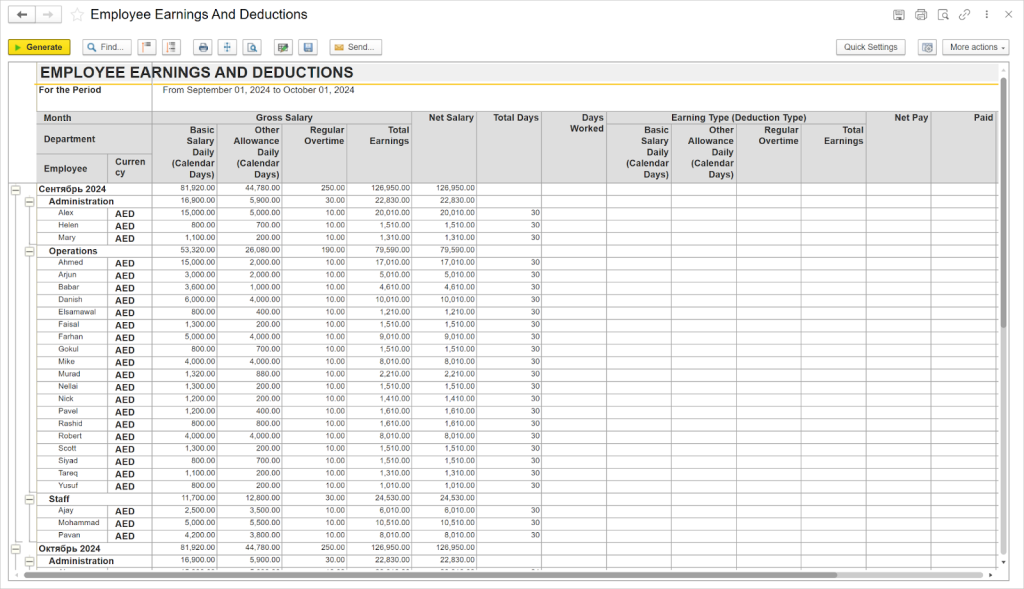
Payroll run: earnings, overtime, deductions, and net salary in FirstBit ERP Contracting
For example, FirstBit ERP Contracting is a solution adapted to the UAE market. It supports BOQ uploads, cost allocation, budget control, VAT reporting, and WPS file generation — eliminating manual work.
That’s why choosing a system tailored to local realities is critical: generic ERP solutions for trading or manufacturing may require costly localization and still fail to meet construction-specific needs.
Key Factors Affecting ERP Implementation Cost in Dubai in 2026
ERP pricing in construction depends on multiple variables. The main cost drivers in the UAE include:
1. Localization
Adapting the system to UAE legislation is essential. This includes VAT reporting, WPS compliance, cost estimation standards, and Arabic interface support. These requirements significantly impact cost.
For example, solutions like FirstBit ERP can support VAT workflows, WPS processes, project cost estimation, and in two languages (English and Arabic) within a single system. This reduces manual work and helps contractors stay compliant.
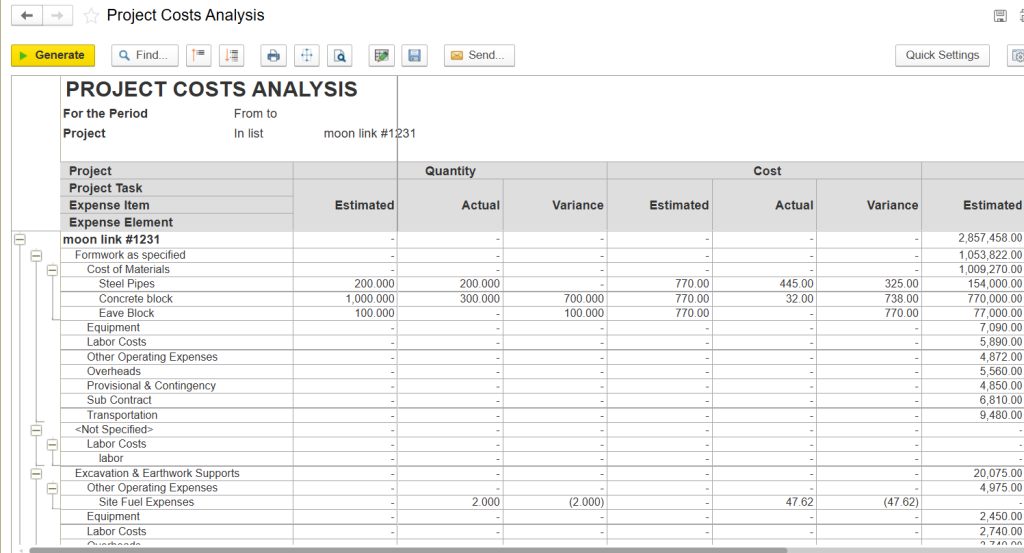
Project cost breakdown in FirstBit ERP
2. Company Size
Larger companies require more users, licenses, and data handling capacity. Construction holdings often include multiple legal entities and offices, requiring complex accounting and intercompany integrations.
For example, FirstBit ERP for contracting supports multi-company operations, including separate legal entities, branches, and intercompany transactions. It can also be customized to match the structure and processes of a growing business. This helps maintain control across the group while keeping records at the entity level.
3. Platform and Licensing Model
- Cloud solutions: Lower upfront cost (subscription-based), but can become more expensive over time
- On-premise solutions: One-time license fee plus ongoing maintenance costs
Some ERP solutions, including FirstBit ERP Contracting, are available in both cloud-based and on-premise versions, depending on a company’s operational needs, IT setup, and internal maintenance preferences. This gives businesses more flexibility in how they plan implementation and long-term system support.
4. Integrations and Customization
ERP systems often need to integrate with:
- Banks (for WPS)
- FTA portal (for e-invoicing)
- Municipality systems
- CRM, e-commerce, BIM tools
Each integration adds to the budget. Each integration increases the budget. In the UAE, this may also include solutions like FirstBit ERP, which addresses some of the most common needs, including FTA-related VAT compliance workflows, WPS file generation for salary transfers, and a built-in CRM module.
5. Modules
The more modules included, the higher the cost. Basic packages include accounting, inventory, and project tracking, while advanced ones include BOQ management, procurement, and analytics.
In practice, systems like FirstBit ERP Contracting can also be expanded with modules such as HR and payroll, warehouse management, equipment management, finance and accounting, procurement, project management, and project cost control, depending on the company’s needs.
6. Implementation and Training
Implementation (setup, data migration, training) typically accounts for 30–50% of total project cost. Proper training significantly improves ROI. This is also where vendor support becomes important. In the case of FirstBit ERP, the team provides training during implementation, helps users work through daily transactions after go-live, and continues to support the system through regular updates and a dedicated support team.
Free up your time with FirstBit ERP
Automate routine work and focus on growth
Request a demo
ERP Pricing Breakdown by Business Size
Small Businesses (up to 50 employees)
Functionality:
- VAT-compliant accounting
- Inventory management
- Payroll with WPS
- Basic project tracking
Budget:
- Starting from AED 15,000–40,000 (5–10 users)
- Up to AED 50,000–80,000 for growing teams
Mid-Sized Businesses (50–200 employees)
Functionality:
- BOQ management
- Budget control
- Procurement automation
- Subcontractor management
- Mobile access for site teams
Budget:
- Approximately AED 40,000–150,000
- Can reach AED 200,000–250,000 with integrations
Large Businesses (200+ employees, holdings)
Functionality:
- Asset and equipment management
- Consolidated financial reporting
- BIM integration
- Advanced BI dashboards
- Multi-currency, multi-entity accounting
Budget:
- Starting from AED 250,000–300,000+
- Can exceed AED 500,000 for fully customized systems
Solutions like FirstBit ERP can be used by companies of different sizes, ranging from smaller contractors to larger construction groups. The system can scale as the business grows, with functionality that can be adapted to changing operational needs.
Realistic ERP Budget in 2026: VAT, Payroll, and Cost Accounting
Total Cost of Ownership (TCO) includes:
- Licensing/subscription
- Implementation (30–50%)
- Training
- Support (15–25% annually)
ERP must also:
- Automatically calculate VAT
- Ensure WPS compliance
- Maintain accurate BOQ estimates
- Track project profitability
Everything you need for success in one powerful ERP solution
Request a demo
Hidden Costs of ERP Implementation in the UAE
Common overlooked costs include:
- Additional training and post-launch support
- Data migration and cleanup
- Business process changes
- Additional modules and users
- Regulatory updates (VAT, WPS changes)
These can add 10–20% to the total budget.
How to Choose the Right ERP: Step-by-Step Guide
- Analyze current processes. Identify inefficiencies, delays, and workflow gaps across departments.
- Define requirements (VAT, WPS, BOQ, mobile access). Make sure the ERP covers both compliance requirements and daily operational needs.
- Request demos from vendors. Assess usability, reporting, and fit for your actual workflows.
- Check integrations (banks, FTA, CRM, BIM). Confirm which connections are available out of the box and which require additional customization.
- Evaluate vendor experience in UAE construction. Review similar projects, implementation approach, and understanding of local requirements.
- Request a detailed pricing breakdown. Analyze the costs associated with licensing, implementation, support, customization, and future scalability.
- Consider starting with a pilot phase. Test key workflows before the full rollout and reduce implementation risks.
The same checklist can be used to evaluate solutions like FirstBit ERP Сontracting against your business requirements, technical setup, and implementation priorities.
Connect your office and site teams
Synchronize workflows and approvals with FirstBit
Request a demo
Conclusion
Implementing ERP for a construction company in the UAE is a major investment—but one that pays off through improved transparency, automation, and cost control.
A properly localized system (VAT, WPS, e-invoicing) tailored to construction specifics can significantly increase efficiency and reduce risks.
To accurately estimate ERP costs and select the best solution, it is recommended to consult experts. First Bit, an international integrator with strong GCC experience, can provide a demo and prepare a customized implementation plan for your business.

Anna Fischer
Construction Content Writer
Share this article
'%3e%3cg%20clip-path='url(%23clip1_6548_6055)'%3e%3cpath%20d='M13.974%2015.6195C14.2724%2016.0185%2014.6532%2016.3487%2015.0905%2016.5876C15.5278%2016.8265%2016.0114%2016.9686%2016.5084%2017.0042C17.0055%2017.0398%2017.5043%2016.9681%2017.9712%2016.7939C18.4381%2016.6198%2018.8621%2016.3472%2019.2143%2015.9948L21.2994%2013.9098C21.9324%2013.2544%2022.2827%2012.3766%2022.2747%2011.4654C22.2668%2010.5543%2021.9014%209.68269%2021.257%209.03839C20.6127%208.39408%2019.7412%208.02862%2018.83%208.0207C17.9189%208.01278%2017.0411%208.36305%2016.3857%208.99606L15.1902%2010.1845M16.754%2014.2295C16.4555%2013.8305%2016.0747%2013.5003%2015.6374%2013.2614C15.2002%2013.0225%2014.7166%2012.8804%2014.2196%2012.8448C13.7225%2012.8092%2013.2237%2012.8809%2012.7568%2013.0551C12.2899%2013.2292%2011.8659%2013.5018%2011.5136%2013.8542L9.42861%2015.9392C8.7956%2016.5946%208.44534%2017.4724%208.45326%2018.3836C8.46117%2019.2947%208.82664%2020.1663%209.47094%2020.8106C10.1152%2021.4549%2010.9868%2021.8204%2011.898%2021.8283C12.8091%2021.8362%2013.6869%2021.4859%2014.3423%2020.8529L15.5308%2019.6645'%20stroke='%235F7896'%20stroke-width='1.39002'%20stroke-linecap='round'%20stroke-linejoin='round'/%3e%3c/g%3e%3c/g%3e%3crect%20x='0.438953'%20y='0.438953'%20width='28.9709'%20height='28.9709'%20rx='14.4855'%20stroke='%235F7896'%20stroke-width='0.877907'/%3e%3cdefs%3e%3cclipPath%20id='clip0_6548_6055'%3e%3crect%20width='29.8488'%20height='29.8488'%20rx='14.9244'%20fill='white'/%3e%3c/clipPath%3e%3cclipPath%20id='clip1_6548_6055'%3e%3crect%20width='16.6802'%20height='16.6802'%20fill='white'%20transform='translate(7.02344%206.58435)'/%3e%3c/clipPath%3e%3c/defs%3e%3c/svg%3e)


Related articles


See all








See FirstBit ERP solutions in action
Discover how our system solves the unique challenges of contractors in a personalized demo.
After the demo you will get a quotation for your company.
After the demo you will get a quotation for your company.