The use of AI in construction is transforming how projects are planned, executed, and financially managed, delivering practical benefits at every stage. From predictive scheduling to automated risk detection, artificial intelligence is helping contractors anticipate challenges, improve efficiency, and make better-informed decisions.
decision-making tomorrow.
However, its success depends on one critical factor: clean, structured ERP data. In this guide, we explore the real benefits of AI in construction, the most impactful AI use cases, and why preparing your data today is the essential first step toward intelligent
Benefits of AI in Construction: Planning, Safety & Cost Control
The benefits of AI in construction come from better use of construction data, automation, and faster access to insights. It helps teams analyze schedules, budgets, procurement, labor, equipment, and site updates, which supports more accurate decisions across the project lifecycle.
The use of AI in construction can also support cost control, safety, quality, and resource management. Its impact is especially visible in planning, where accurate forecasts help teams prepare schedules with fewer blind spots.
One study covering 567 construction projects found that AI-powered planning systems improved schedule accuracy by 42.3%, which highlights the value of data-driven forecasting for site teams[?].
Overall, using AI in construction helps companies improve planning, reduce risks, control costs, and make decisions based on more reliable data. Its value depends on accurate information, connected systems, and clear business goals.
AI Use Cases in Construction: Practical Applications That Deliver Value
Many high-value AI use cases in construction depend on reliable, connected project data. Forecasting, cost control, resource planning, and risk detection become significantly more effective when AI can work with structured information from budgets, schedules, procurement, and site activities. Without such data, even the most advanced algorithms produce unreliable results.
Real AI use cases in construction include:
-
Project planning and scheduling are among the most practical areas where advanced analytics can analyze timelines, task dependencies, labor availability, and procurement plans to help teams identify possible delays earlier. Research on AI in construction project management found that planning, monitoring, and control are among the main lifecycle phases where it is applied.
-
Cost estimation and budget control are also strong use cases. Artificial intelligence can review historical project data, BOQs, purchase orders, labor costs, and progress updates to support more accurate estimates and detect budget deviations sooner.
-
Site monitoring and safety can be improved with cameras, drones, sensors, and computer vision. These tools help teams identify unsafe conditions, missing PPE, equipment risks, and progress issues during active construction.
-
Resource allocation helps contractors manage labor, materials, equipment, and subcontractors across several projects. Advanced analytics can analyze availability, workloads, and operational priorities, then support better planning of resources.
-
Predictive maintenance uses sensor data and maintenance history to identify early signs of equipment problems. This helps companies plan repairs, reduce downtime, and keep critical machinery available for project work.
-
Quality control and inspections are another important part of AI applications in construction. Automated image analysis and digital models can help compare completed work with approved plans, identify defects, and improve reporting accuracy.
These use cases in construction work best when project data is accurate, updated, and connected across departments. Without reliable data, digital tools have limited value for planning, forecasting, and operational control.
Gain full control of your business
Get a 360° project view with FirstBit ERP
Request a demo
Emerging 2026 Trends of AI Applications in Construction
AI applications in construction are becoming more connected to everyday construction workflows. The main trend is the shift from isolated tools to systems that help teams use data for planning, coordination, risk control, and decision support.
Another important trend in the use of AI in construction is its integration with BIM, digital twins, IoT sensors, and predictive analytics to support real-time project monitoring and smarter decision-making. These technologies help construction teams detect risks earlier, improve scheduling accuracy, reduce rework, and increase overall operational efficiency throughout the building lifecycle.
Agentic AI for Project Support
Agentic AI systems are becoming powerful project support tools in construction. These agents can automate scheduling updates, track project risks, manage documentation, and coordinate workflows across multiple teams with minimal manual input.
In 2026, construction companies are increasingly using digital agents to support decision-making throughout the project lifecycle. These systems analyze real-time data and proactively recommend actions to reduce delays, improve communication, and optimize resource allocation.
Pro tip
Start using automated digital agents for repetitive administrative tasks first, such as reporting and document tracking, before expanding into project coordination.
AI-Native BIM Coordination
AI-native BIM coordination is transforming how construction teams detect clashes and manage design collaboration. Automated tools can review BIM models, identify conflicts, and suggest corrections much faster than traditional manual coordination processes.
Modern BIM platforms are evolving from static modeling tools into intelligent construction systems. These platforms now support automated routing, constructability reviews, and design optimization, helping teams reduce rework and accelerate project delivery.
Pro tip
Integrate automated clash detection early during design development to reduce costly field coordination issues later in construction.
Predictive Project Intelligence
Predictive project intelligence is one of the strongest AI applications in construction. It connects schedules, costs, procurement data, site updates, and historical construction records to help teams identify risks earlier. These tools can support delay forecasting, cost exposure analysis, and faster prioritization of corrective actions.
To implement predictive project intelligence, organizations typically:
-
Integrate project data from scheduling, ERP, BIM, and procurement systems
-
Standardize and clean historical project data for analysis
-
Deploy predictive models for forecasting delays, costs, and resource risks
-
Use dashboards and automated alerts for real-time monitoring
-
Train site teams to interpret insights and act on recommendations
-
Continuously refine models using live performance data
Natural-Language Interfaces
Natural-language interfaces are simplifying how construction professionals interact with digital systems. Project managers and site teams can now ask artificial intelligence questions in plain language to retrieve schedules, RFIs, cost data, or BIM information instantly.
These interfaces reduce the learning curve for complex construction software and improve accessibility for non-technical users. Voice commands and digital chat assistants are becoming common tools for field reporting, safety inspections, and project communication.
Pro tip
Use digital chat interfaces connected to project databases to speed up information retrieval during site meetings and inspections.
Role-Based AI Assistants
Role-based digital assistants are being customized for specific construction responsibilities such as estimating, scheduling, procurement, and safety management. These assistants provide targeted recommendations based on the needs of each department or user role.
In 2026, construction companies are increasingly deploying specialized AI assistants to improve productivity and reduce manual workloads. Estimators, project engineers, and BIM managers can use these support tools tailored to their daily workflows and project requirements.
Digital Twins and Asset Intelligence
Digital twins are becoming a major trend in construction and asset management. These virtual replicas combine BIM, IoT sensors, drones, and AI to provide real-time insights into building performance and construction progress.
Asset intelligence platforms use digital twins to monitor equipment health, energy performance, and operational efficiency throughout a building’s lifecycle. Construction firms are increasingly using these systems to support predictive maintenance and smarter facility management.
Challenges of Using AI in Construction and How to Overcome Them
AI adoption in construction can bring practical value, but implementation is rarely simple. Many construction companies still work with fragmented systems, manual processes, and project data stored across different departments. This makes such adoption a technical, financial, and organizational challenge.
High Initial Implementation Costs
Advanced digital tools powered by artificial intelligence often require an investment in software, cloud infrastructure, sensors, integrations, and employee training. For mid sized construction companies, these costs can be difficult to manage at once.
A phased approach can make adoption more realistic. Companies can start with one high-priority area, such as planning, cost control, or equipment maintenance, then expand their automation capabilities after the first results become clear.
Data Quality and Integration Issues
AI depends on accurate, structured, and connected data. Many construction companies still manage project information across separate systems for estimating, procurement, accounting, project management, and site reporting.
Poor data quality can lead to unreliable AI outputs. In one study of 534 construction organizations, 71.3% reported critical issues with data consistency. This shows why companies need better data collection, cleaning, and integration before relying on automated systems for project decisions[?].
Workforce Skills Gaps
AI tools require teams to understand digital workflows, data-driven decisions, and basic system outputs. Many construction professionals have strong project experience, but limited experience with advanced analytics or AI-supported systems.
Training is essential. Employees need to understand how to use digital tools, how to question results, and how to apply insights in daily project work.
Resistance to Change
AI adoption can face resistance from teams that are used to manual processes and familiar reporting methods. Some employees may also worry that automation will reduce their role or make workflows harder to control.
Clear communication helps reduce this resistance. Teams need to understand what artificial intelligence is used for, how it supports their work, and which decisions still require human judgment.
Cybersecurity and Data Privacy Risks
Artificial intelligence often processes sensitive project, financial, contract, supplier, and employee data. As construction companies digitize more processes, they also increase the need for stronger cybersecurity.
Companies need clear access controls, secure integrations, data governance rules, and regular monitoring. This is especially important when digital tools connect with ERP, accounting, procurement, and project management systems.
Overall, the challenges of using AI in construction are manageable when companies treat adoption as a structured business project. Success depends on realistic priorities, clean data, trained teams, secure systems, and gradual implementation.
Explore efficient ERP solutions for your construction business
Request a demo
How AI Assistant in FirstBit ERP Helps Construction Companies Work Smarter
AI in construction works best when it has clean, structured, and connected data. Before companies can use artificial intelligence for forecasting, risk analysis, or smarter decision-making, they need to organize the operational data they already collect. FirstBit ERP modules like
project cost control and
project management structure your project data from day one — creating the foundation for future AI applications.
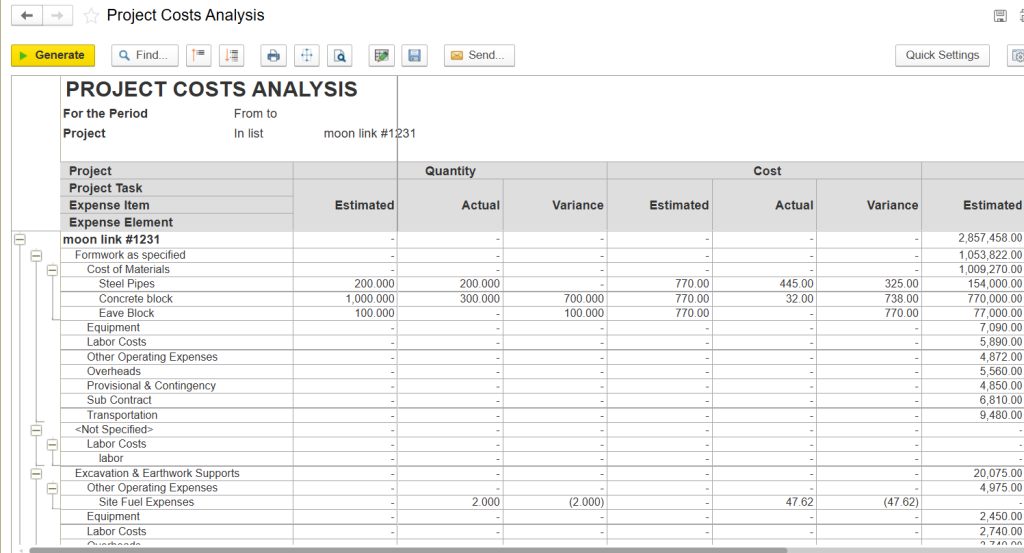
FirstBit ERP helps create this foundation by bringing key construction data into one system. Equipment Tracking, Materials Management, and Project Cost Allocation can structure information about machinery usage, material movement, purchases, deliveries, expenses, and project costs.
This matters because artificial intelligence cannot produce reliable insights from incomplete or disconnected records. If a company wants to forecast equipment needs, procurement risks, budget deviations, or project profitability — or introduce predictive analytics for change order forecasting — it first needs consistent ERP data.
A practical starting point is to standardize cost codes, clean equipment and material records, improve purchase and delivery tracking, and make site updates consistent. After several months of structured data collection, artificial intelligence can be integrated with minimal disruption to existing workflows.
Valuable project costs analysis data in FirstBit ERP
The AI Assistant in FirstBit ERP builds on this data foundation. It helps teams access ERP information faster and use existing project, cost, procurement, finance, and operations data without manually reviewing separate reports.
The main idea is simple: construction companies should organize their data first, then move to predictive forecasting. FirstBit ERP helps create that order and makes AI adoption more practical for daily project management.
Conclusion
Using AI in construction can help companies improve planning, control costs, manage risks, and make project decisions with greater confidence. For UAE contractors exploring the benefits of artificial intelligence in construction, the journey starts not with algorithms but with organized, reliable data stored in a construction-specific ERP system such as FirstBit ERP.
When AI is connected to clean, real-time project data — from schedules and budgets to procurement and site progress — it becomes a practical tool for smarter forecasting, faster decision-making, and better control across the business.
Connect your office and site teams
Synchronize workflows and approvals with FirstBit
Request a demo
FAQ
What are the benefits of AI in construction?
Benefits of AI in construction stem largely from automation, the ability to complete repetitive tasks faster and more accurately, which in turn helps increase efficiency, lower costs, and in some cases improve worker safety.
How can AI help or may help the construction industry?
AI-powered robots can also be used to monitor construction sites, clean up sites, track progress, and successfully identify potential safety hazards before an incident happens.
The seven types of AI are Reactive Machines, Limited Memory, Theory of Mind, Self-Aware, Narrow, General, and Superintelligent.
What are the five disadvantages of artificial intelligence?
The five main disadvantages of artificial intelligence are job displacement, biased decision-making, privacy and security risks, high implementation costs, and the lack of human creativity, empathy, and emotional intelligence. While artificial intelligence can improve efficiency and automate tasks, it still depends on data quality and human oversight, making responsible use essential for businesses and society.
What are some examples of the use of AI in construction?
AI is used in construction to improve safety, efficiency, and planning. For example, smart drones and computer-vision cameras monitor job sites for hazards, while predictive software helps detect delays and manage costs. Intelligent software can also create 3D building models, automate equipment maintenance, and assist architects in designing energy-efficient buildings.
Can AI be used in construction?
Yes, AI can be widely used in construction to improve safety, reduce costs, and increase efficiency. Using AI in construction helps companies manage projects, predict risks, monitor job sites, and automate repetitive tasks. Intelligent digital tools can also improve scheduling, quality control, and resource planning, making construction projects faster and more accurate.












'%3e%3cg%20clip-path='url(%23clip1_6548_6055)'%3e%3cpath%20d='M13.974%2015.6195C14.2724%2016.0185%2014.6532%2016.3487%2015.0905%2016.5876C15.5278%2016.8265%2016.0114%2016.9686%2016.5084%2017.0042C17.0055%2017.0398%2017.5043%2016.9681%2017.9712%2016.7939C18.4381%2016.6198%2018.8621%2016.3472%2019.2143%2015.9948L21.2994%2013.9098C21.9324%2013.2544%2022.2827%2012.3766%2022.2747%2011.4654C22.2668%2010.5543%2021.9014%209.68269%2021.257%209.03839C20.6127%208.39408%2019.7412%208.02862%2018.83%208.0207C17.9189%208.01278%2017.0411%208.36305%2016.3857%208.99606L15.1902%2010.1845M16.754%2014.2295C16.4555%2013.8305%2016.0747%2013.5003%2015.6374%2013.2614C15.2002%2013.0225%2014.7166%2012.8804%2014.2196%2012.8448C13.7225%2012.8092%2013.2237%2012.8809%2012.7568%2013.0551C12.2899%2013.2292%2011.8659%2013.5018%2011.5136%2013.8542L9.42861%2015.9392C8.7956%2016.5946%208.44534%2017.4724%208.45326%2018.3836C8.46117%2019.2947%208.82664%2020.1663%209.47094%2020.8106C10.1152%2021.4549%2010.9868%2021.8204%2011.898%2021.8283C12.8091%2021.8362%2013.6869%2021.4859%2014.3423%2020.8529L15.5308%2019.6645'%20stroke='%235F7896'%20stroke-width='1.39002'%20stroke-linecap='round'%20stroke-linejoin='round'/%3e%3c/g%3e%3c/g%3e%3crect%20x='0.438953'%20y='0.438953'%20width='28.9709'%20height='28.9709'%20rx='14.4855'%20stroke='%235F7896'%20stroke-width='0.877907'/%3e%3cdefs%3e%3cclipPath%20id='clip0_6548_6055'%3e%3crect%20width='29.8488'%20height='29.8488'%20rx='14.9244'%20fill='white'/%3e%3c/clipPath%3e%3cclipPath%20id='clip1_6548_6055'%3e%3crect%20width='16.6802'%20height='16.6802'%20fill='white'%20transform='translate(7.02344%206.58435)'/%3e%3c/clipPath%3e%3c/defs%3e%3c/svg%3e)