Mega projects in the UAE progress fast, and even minor delays can cause significant financial setbacks. This is why an EPC contract has become the preferred project delivery model in construction. Rather than dividing responsibilities among multiple contractors, a single team oversees the entire process, improving efficiency, accountability, and project control from day one.
An EPC company manages engineering, procurement, and construction under a one contract, creating a streamlined workflow that reduces risks, enhances communication, and accelerates project delivery. However, achieving these benefits requires a well-structured approach and effective coordination across every stage of the project.
In this guide, you’ll discover what EPC means and explore the key phases of an EPC project. From initial planning and procurement to execution and final handover, each stage plays a vital role in ensuring timely completion, cost efficiency, and long-term project success.
What is EPC Meaning in Construction & EPC Full Form?
EPC meaning: A project delivery method where one contractor handles engineering, procurement, and construction.
EPC is commonly used in large-scale construction, infrastructure, and industrial projects. In an EPC contract, a single company takes responsibility for designing the project, purchasing materials and equipment, and completing the construction work from
start to finish.
The EPC model simplifies project management by placing all major responsibilities under one contractor. This approach helps improve coordination, reduce communication gaps, and ensure projects are completed within the agreed budget and timeline. It is
widely used in sectors such as power plants, oil and gas, manufacturing facilities, and transportation infrastructure.
EPC Full Form
The full form of EPC is Engineering, Procurement, and Construction. “Engineering” involves project design and technical planning, “Procurement” covers sourcing materials and equipment, and “Construction” includes building, installation, and project
execution. Together, these three phases create a complete turnkey solution for complex projects.
One of the biggest advantages of an EPC project is accountability. Since a single contractor oversees the entire process, clients have one point of contact throughout the project lifecycle. This reduces risks, improves efficiency, and allows businesses
to focus on operations while the EPC contractor manages planning, procurement, construction, and final delivery.
How EPC Works: The Stages of an EPC Project
In this step-by-step guide, you’ll learn how each stage of an EPC project works and what happens throughout the project lifecycle. We’ll break down every phase in simple terms, helping you understand the responsibilities, workflows, and key activities
involved at each step.
Whether you're a project owner, contractor, or industry professional, this guide will show you how to navigate each EPC stage more effectively. By the end, you'll have a clear understanding of how engineering, procurement, construction, and final handover
come together to deliver a successful project.
Engineering Phase in an EPC Project
The engineering phase is the foundation of an EPC project. During this stage, engineers develop technical designs, project specifications, feasibility studies, and detailed construction plans to ensure the project can be executed safely and efficiently.
This phase also includes Front-End Engineering Design (FEED), cost estimation, risk analysis, and coordination between different engineering disciplines. Accurate planning at this stage helps reduce design changes, delays, and unexpected costs
during later project phases.
Research shows that decisions made by an EPC company during the engineering stage largely determine overall project success. Poor design, inaccurate estimates, incomplete planning, and insufficient stakeholder involvement frequently trigger delays,
cost overruns, and quality issues[?].
Key advice:
-
Invest sufficient time in FEED and design reviews before construction begins.
-
Involve all engineering disciplines early to avoid coordination issues later.
-
Conduct thorough
risk assessments and establish mitigation plans from the outset.
-
Maintain clear communication among stakeholders to ensure alignment on project objectives and requirements.
-
Use realistic cost estimates and include contingencies for unforeseen conditions.
Procurement Phase in an EPC Project
The procurement phase focuses on sourcing and purchasing all materials, equipment, and services required for the project. EPC contractors evaluate suppliers, negotiate contracts, and manage purchasing schedules to ensure resources arrive on time and meet
quality standards.
Efficient procurement is critical because delays in material delivery can directly impact construction progress. Strong supplier management, logistics planning, and quality inspections help maintain project schedules and control costs throughout execution.
Research has found that an EPC company adopting supply chain cost management can achieve superior long-term performance. The key is coordinating suppliers, subcontractors, and project teams around shared objectives[?].
Useful tips:
-
Pre-qualify suppliers carefully to ensure reliability and quality.
-
Identify and order long-lead equipment early to prevent schedule delays.
-
Maintain regular communication with vendors to track production and delivery status.
-
Conduct quality inspections before shipment and upon delivery to avoid costly rework.
-
Develop contingency plans for supply chain disruptions and material shortages.
-
Construction Phase in an EPC Project
The construction phase is where project plans are transformed into physical infrastructure. Contractors manage site preparation, civil works, equipment installation, structural construction, and system integration while ensuring compliance with project
specifications.
Project managers closely monitor safety, quality, productivity, and schedule performance during construction. Effective coordination between engineering, procurement, and field teams helps reduce delays and ensures
the project is delivered according to contract requirements.
Key advice:
-
Prioritize
safety through regular inspections, toolbox talks, and risk assessments.
-
Monitor construction progress closely and address issues before they impact the schedule.
-
Maintain strong coordination between site teams, engineers, and suppliers to avoid workflow disruptions.
-
Implement strict quality control procedures to reduce rework and ensure compliance with specifications.
-
Keep clear documentation of construction activities, inspections, and project changes for better project control and accountability.
Handover Phase in an EPC Project
The
handover phase marks the official transfer of the completed facility from the EPC contractor to the client. Before handover, the project
undergoes testing, commissioning, performance verification, and final inspections to ensure all systems operate correctly.
During this stage, contractors also provide operational documentation, maintenance manuals, certifications, and staff training. A successful handover ensures the client receives a fully functional asset that meets contractual and operational requirements.
Pro tip: Create a detailed handover checklist early in the project to ensure all documentation and testing requirements are completed on time.
Quick handover checklist:
-
All testing and commissioning activities completed
-
Performance verification and acceptance tests approved
-
Punch list items closed or documented
-
As-built drawings submitted
-
O&M (Operations & Maintenance) manuals delivered
-
Certifications, permits, and warranties handed over
-
Final inspections and safety reviews signed off
-
Handover certificates and acceptance documents approved
Reduce costs and avoid shortages
Optimize procurement with FirstBit ERP
Request a demo
How to Draft an EPC Contract
A well-drafted EPC contract helps reduce disputes, improve project execution, ensure accountability, and provide a clear framework for project delivery from design through commissioning and handover.
Key elements that should be in an EPC contract include:
- Define the project scope. Clearly describe all engineering, procurement, construction, testing, and commissioning activities to avoid misunderstandings and scope creep.
- Establish roles and responsibilities. Specify the obligations of the owner, EPC contractor, subcontractors, consultants, and suppliers to ensure accountability.
- Set technical and performance requirements. Document engineering standards, quality expectations, performance criteria, and facility performance guarantees.
- Define timelines and payment terms. Include project schedules, milestones, handover deadlines, and milestone-based payment structures.
- Allocate risks and manage changes. Address risks such as delays, cost overruns, and unforeseen conditions, and establish a formal change order process.
- Include legal protections and dispute resolution. Cover force majeure events, compliance with laws and regulations, and procedures for resolving disputes.
- Specify testing, commissioning, and handover requirements. Define acceptance criteria, commissioning procedures, and documentation required for project completion.
Types of an EPC Contract
EPC contracts can be structured in several ways to suit different project requirements, risk profiles, and delivery objectives. The chosen contract type determines how responsibilities, costs, timelines, and project risks are allocated between the owner
and the contractor, making it a critical factor in successful project execution.
From traditional lump-sum turnkey arrangements to specialized variants such as EPCM, EPCI, and LSTK, each model offers distinct advantages depending on project complexity, budget certainty, and the level of owner involvement required. Understanding these
contract types helps stakeholders select the most suitable framework for achieving project goals.
Pricing and Risk Models of EPC Contracts
The selection of a pricing and risk model is a critical project decision, as it determines how costs, responsibilities, and potential risks are shared between the owner and contractor. The following table summarizes three commonly used contract models
— LSTK, Cost-plus, and GMP — highlighting their definitions, risk allocation, and typical applications.
| Pricing and risk model |
Definition |
Risk allocation |
Commonly used |
| Lump Sum Turnkey (LSTK) |
The contractor agrees to complete the entire project for a fixed price and deliver a fully operational facility. |
Most cost and schedule risks are transferred to the contractor. |
Projects with a well-defined scope, stable requirements, and limited design changes. |
| Cost-plus (Reimbursable) |
The owner pays all actual project costs (e.g., labor, materials, equipment) plus an agreed contractor fee or profit margin. |
Most cost risk remains with the owner, while the contractor assumes limited financial risk. |
Projects with uncertain scope, evolving requirements, or high technical complexity. |
| Guaranteed Maximum Price (GMP) |
The contractor is reimbursed for actual costs up to a predetermined maximum price. Costs exceeding the cap are borne by the contractor. |
Cost risk is shared between the owner and contractor, with the contractor responsible for overruns above the maximum price. |
Projects requiring flexibility during design and construction while maintaining a degree of cost certainty for the owner. |
Service Variations of EPC Contracts
Project delivery services vary in scope, responsibility, and the level of owner involvement throughout the project lifecycle. Selecting the appropriate service model is essential for aligning project objectives, risk allocation, and execution strategy.
The following table outlines the key characteristics and typical applications of EPC, EPCC and EPCI arrangements.
| Service Variation |
Contractor Responsibility |
Typical Application |
| EPC (Engineering, Procurement, and Construction) |
Responsible for engineering design, procurement of materials and equipment, construction, testing, and delivery of a complete operational facility |
Power plants, industrial facilities, renewable energy projects |
| EPCC (Engineering, Procurement, Construction, and Commissioning) |
Includes the full EPC scope with additional responsibility for commissioning, start-up, and performance verification of the facility |
Process plants, oil & gas facilities, utility projects |
| EPCI (Engineering, Procurement, Construction, and Installation) |
Responsible for engineering, procurement, construction, transportation, and installation, particularly in offshore environments |
Offshore platforms, subsea infrastructure, marine energy projects |
Align every purchase with project goals
Request a demo
What's the Difference Between EPC and EPCM?
To sum it up: EPC means one contractor delivers the entire project and takes most of the risk, while EPCM means the contractor manages the project on the owner's behalf while the owner retains more control and risk.
An EPC contract is a turnkey delivery model where a single contractor assumes responsibility for designing, procuring, and constructing the entire project. The contractor bears most schedule, cost, and performance risks, providing owners with greater
certainty, a single point of accountability, and simplified project management.
Pros of an EPC contract:
-
Single point of responsibility
-
Greater cost and schedule certainty
-
Reduced owner involvement
-
Lower interface and coordination risks
-
Suitable for fast-track and turnkey projects
Cons of EPC contract:
-
Less flexibility for design changes
-
Higher contract price due to risk transfer
-
Limited owner control over procurement decisions
-
Potential for disputes over scope variations
In contrast, an EPCM (Engineering, Procurement and Construction Management) contract focuses on project management and coordination rather than direct construction delivery. The EPCM contractor acts as an advisor and manager, while the owner holds
contracts with suppliers and construction contractors.
Pros of EPCM:
-
Greater owner control and involvement
-
More flexibility during project execution
-
Improved transparency in procurement and costs
-
Potential cost savings through competitive bidding
-
Better suited for complex or evolving projects
Cons of EPCM:
-
Owner retains more project risk
-
Requires experienced project management resources
-
Less certainty on final cost and schedule
-
Increased coordination between multiple contractors
Top 5 EPC Companies in the UAE
The United Arab Emirates is home to several leading EPC companies that play a critical role in delivering large-scale infrastructure, energy, industrial, and oil and gas projects across the region. Each EPC company in this top 5 has extensive experience
in delivering large-scale projects.
Some of the most prominent EPC contractors include:
- NMDC Energy. One of the UAE’s leading EPC contractors provides complete EPC solutions for both offshore and onshore oil and gas
projects. It offers engineering, procurement, fabrication, installation, and commissioning services. NPCC owns one of the largest fabrication yards in the region and a substantial fleet of offshore construction vessels.
- Petrofac. A globally recognized EPC company with a strong presence in the UAE. Petrofac specializes in upstream oil and gas facilities, gas
processing plants, petrochemical complexes, and renewable energy projects. The company has executed numerous EPC contracts for ADNOC and other major operators in the Middle
East.
- Target Engineering Construction Company. A UAE-based contractor serving the oil and gas, petrochemical, industrial, and infrastructure sectors. The company is known for
delivering integrated engineering, procurement, and construction solutions for both offshore and onshore developments.
- Lamprell. Headquartered in the UAE, Lamprell has extensive experience in the fabrication of offshore platforms, jack-up rigs, and renewable energy structures. In recent
years, Lamprell has expanded its focus toward offshore wind and energy transition projects while maintaining strong capabilities in traditional oil and gas EPC services.
- Dodsal Group. A Dubai-based multinational company has delivered large-scale projects in oil and gas, petrochemicals, power generation,
water infrastructure, and transportation. Dodsal is particularly recognized for its expertise in cross-country pipelines, refinery facilities, and industrial infrastructure projects.
Keep projects running like clockwork
Schedule tasks in FirstBit ERP
Request a demo
How FirstBit ERP Supports EPC Project Execution
The success of an EPC project depends heavily on integrated data management. When project information is fragmented across departments, it becomes difficult to control costs, monitor progress, manage resources, and make timely decisions. A centralized
ERP platform helps eliminate these challenges by connecting all project activities within a single system.
FirstBit ERP provides EPC companies with real-time visibility across engineering, procurement, construction, finance, inventory, and workforce management. By ensuring that all departments work from the same source of information, project
teams can improve collaboration, reduce delays, and maintain better control over budgets and schedules throughout the project lifecycle.
Engineering Phase
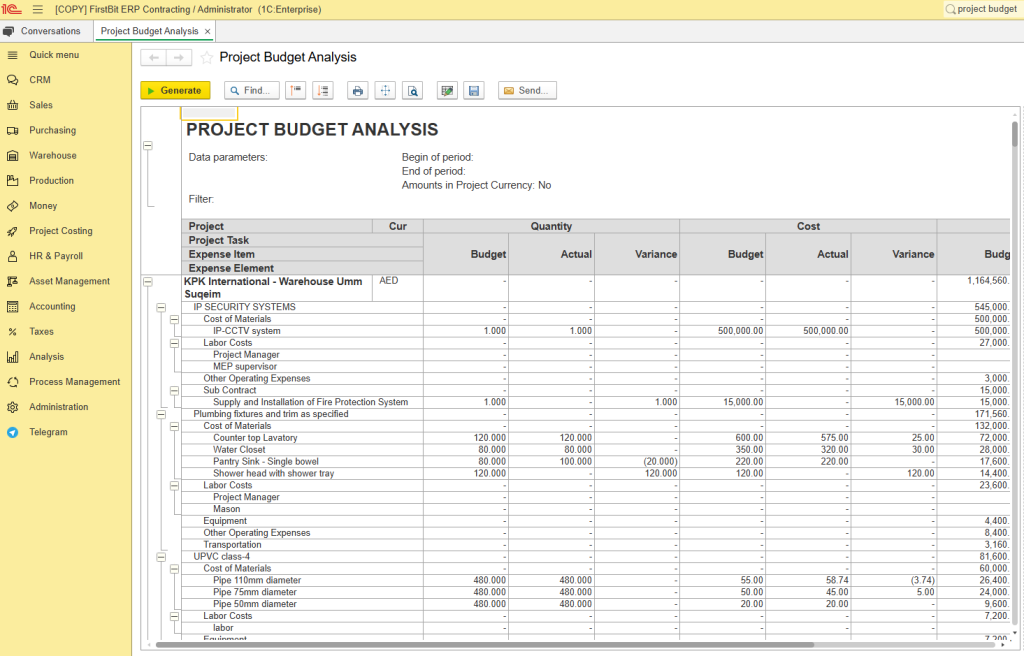
During the engineering phase, accurate planning and estimation are critical for project success. FirstBit ERP enables engineering teams to organize project data, prepare budgets, and establish a strong foundation for execution.
-
Create and manage project estimates and BOQs
-
Track project budgets from the earliest planning stages
-
Maintain centralized project documentation
-
Monitor cost forecasts and planned resource allocation
-
Improve collaboration between engineering, finance, and project management teams
Project budget analysis in FirstBit ERP Contracting
Procurement Phase
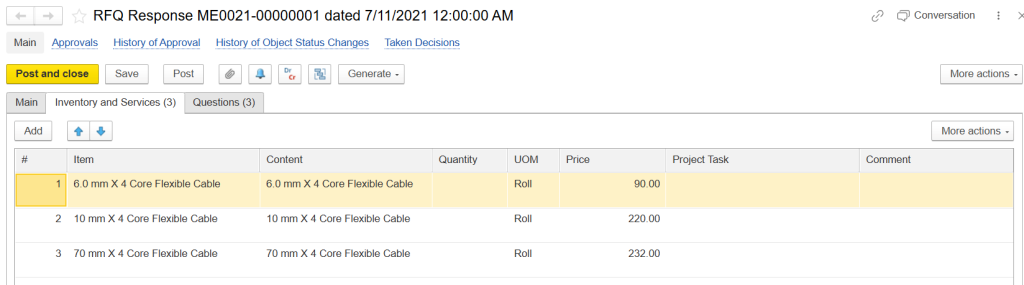
Procurement is one of the most critical phases of an EPC project, directly affecting project timelines and costs. FirstBit ERP streamlines procurement processes by connecting requisitions, purchasing, inventory, and financial controls within a single
platform.
FirstBit ERP helps procurement teams:
-
Generate requisitions and RFQs quickly
-
Compare supplier quotations and vendor performance
-
Track purchase orders and delivery status
-
Align purchasing decisions with project budgets
-
Monitor supplier price history and procurement costs in real time
RFQ response in FirstBit ERP Contracting
Construction Stage
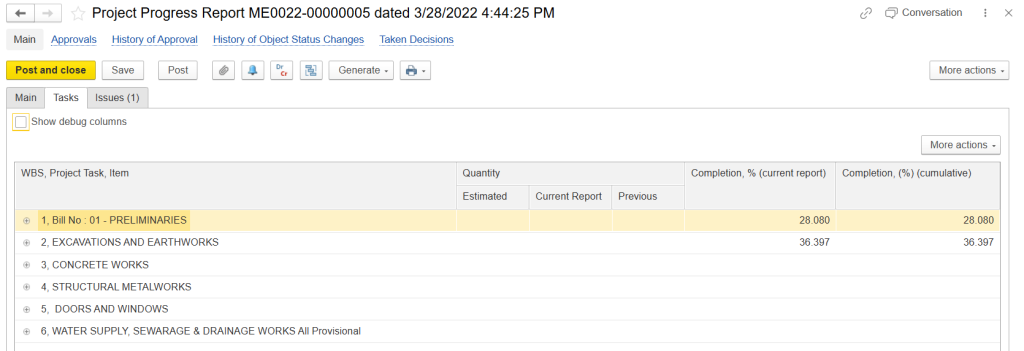
During construction, project managers need continuous visibility into progress, resources, costs, and site operations. FirstBit ERP provides real-time project monitoring and integrated reporting to keep execution on track.
FirstBit ERP Contracting supports construction teams by:
-
Tracking project progress against schedules and milestones
-
Managing labor allocation and workforce productivity
-
Monitoring equipment utilization and maintenance
-
Comparing actual costs against project budgets
-
Improving communication between site and office teams
Project progress report in FirstBit ERP Contracting
Conclusion
The success of modern infrastructure projects depends on careful decision-making, resource planning, and strong collaboration between all project stakeholders. EPC frameworks help organizations maintain consistency throughout complex developments while
improving oversight across technical, financial, and operational activities.
Understanding EPC meaning in construction provides a clearer view of how large-scale projects are organized and delivered in competitive markets like the UAE. By aligning multiple project functions under one management structure, companies can improve
coordination, strengthen accountability, and respond more effectively to changing project requirements.
As construction demands continue to evolve, EPC strategies remain essential for delivering high-performance infrastructure with greater reliability. Their ability to support innovation, quality assurance, and efficient project management makes them a
valuable solution for industries seeking long-term growth, operational excellence, and sustainable development outcomes.
Ensure timely and profitable project completion with FirstBit ERP
Request a demo
FAQ
What is the full meaning of EPC?
Meaning of EPC in construction is Engineering, Procurement, and Construction — a turnkey project delivery method widely used in the UAE for large-scale industrial, energy, and infrastructure developments.
EPC stands for Engineering, Procurement, and Construction — a project delivery model where one contractor manages all three phases. MEP refers to Mechanical, Electrical, and Plumbing systems within a building. While EPC covers the entire project
lifecycle, MEP is a specialized subcontracting discipline often integrated into EPC workflows.
What does EPC mean in a project?
In a construction project, EPC means a single-point responsibility contract where one entity handles design (Engineering), material/equipment sourcing (Procurement), and on-site execution (Construction). This model is common in UAE infrastructure
and industrial projects (e.g., ADNOC, DEWA) for faster delivery and clearer accountability.
How to manage an EPC project?
Successful EPC project management requires integrated control of all three phases: accurate engineering estimates, procurement aligned with budget and schedule, and real-time construction progress tracking. Using a unified ERP system (like FirstBit)
ensures data flows seamlessly between estimation, purchasing, invoicing, and cost allocation — preventing costly gaps between departments.
What is an EPC construction contract?
Meaning of construction contract EPC: an EPC (Engineering, Procurement, and Construction) contract is a type of construction agreement in which a single contractor is responsible for designing, procuring materials and equipment, and constructing
the entire project.












'%3e%3cg%20clip-path='url(%23clip1_6548_6055)'%3e%3cpath%20d='M13.974%2015.6195C14.2724%2016.0185%2014.6532%2016.3487%2015.0905%2016.5876C15.5278%2016.8265%2016.0114%2016.9686%2016.5084%2017.0042C17.0055%2017.0398%2017.5043%2016.9681%2017.9712%2016.7939C18.4381%2016.6198%2018.8621%2016.3472%2019.2143%2015.9948L21.2994%2013.9098C21.9324%2013.2544%2022.2827%2012.3766%2022.2747%2011.4654C22.2668%2010.5543%2021.9014%209.68269%2021.257%209.03839C20.6127%208.39408%2019.7412%208.02862%2018.83%208.0207C17.9189%208.01278%2017.0411%208.36305%2016.3857%208.99606L15.1902%2010.1845M16.754%2014.2295C16.4555%2013.8305%2016.0747%2013.5003%2015.6374%2013.2614C15.2002%2013.0225%2014.7166%2012.8804%2014.2196%2012.8448C13.7225%2012.8092%2013.2237%2012.8809%2012.7568%2013.0551C12.2899%2013.2292%2011.8659%2013.5018%2011.5136%2013.8542L9.42861%2015.9392C8.7956%2016.5946%208.44534%2017.4724%208.45326%2018.3836C8.46117%2019.2947%208.82664%2020.1663%209.47094%2020.8106C10.1152%2021.4549%2010.9868%2021.8204%2011.898%2021.8283C12.8091%2021.8362%2013.6869%2021.4859%2014.3423%2020.8529L15.5308%2019.6645'%20stroke='%235F7896'%20stroke-width='1.39002'%20stroke-linecap='round'%20stroke-linejoin='round'/%3e%3c/g%3e%3c/g%3e%3crect%20x='0.438953'%20y='0.438953'%20width='28.9709'%20height='28.9709'%20rx='14.4855'%20stroke='%235F7896'%20stroke-width='0.877907'/%3e%3cdefs%3e%3cclipPath%20id='clip0_6548_6055'%3e%3crect%20width='29.8488'%20height='29.8488'%20rx='14.9244'%20fill='white'/%3e%3c/clipPath%3e%3cclipPath%20id='clip1_6548_6055'%3e%3crect%20width='16.6802'%20height='16.6802'%20fill='white'%20transform='translate(7.02344%206.58435)'/%3e%3c/clipPath%3e%3c/defs%3e%3c/svg%3e)