





E-Invoicing in the UAE: The Ultimate Guide to Key 2026 Requirements for Construction Companies
09 Mar 2026 • 14 min read

Umme Aimon Shabbir
Editor at First Bit


E-invoicing in the UAE is moving from policy discussion to operational reality. With the 2026 implementation phase approaching, construction companies must understand how digital invoicing will change billing, tax reporting, and compliance workflows.
The shift toward structured e-invoicing is not limited to large enterprises. Contractors, subcontractors, suppliers, and project finance teams will all be affected under the upcoming UAE e-invoicing requirements. Manual PDFs and basic accounting exports will no longer be sufficient.
This guide explains what the new e-invoicing UAE framework means for construction companies, how the system will work, and what the UAE e-invoicing timeline requires from businesses before 2026. The focus is practical: what changes, who is involved, and how to prepare without disrupting cash flow.
What is E-Invoicing in the UAE?
E-invoicing in the UAE refers to the structured, electronic generation and exchange of invoices in a machine-readable format. Instead of sending PDFs or paper documents, businesses transmit invoice data through approved digital channels.
Unlike traditional billing methods, an einvoice contains standardized data fields that service providers and authorities can automatically validate. This reduces manual entry errors and improves reporting accuracy across supply chains.
The upcoming UAE e-invoicing requirements will require businesses to adopt this structured format as part of the national digital tax framework. Under the UAE e-invoicing timeline, companies must transition from simple electronic invoices to compliant, system-integrated e-invoicing processes.
Goals of E-Invoicing in the UAE
The primary objective of e-invoicing in the UAE is to enhance tax transparency and digital integration across businesses. The Ministry of Finance has positioned e-invoicing as part of the country’s broader digital transformation and fiscal modernization strategy.
A key goal is to reduce tax leakage and improve reporting accuracy under the VAT framework. Structured invoice data enables automated validation and real-time reporting to authorities, strengthening compliance under the upcoming UAE e-invoicing requirements.
Another objective is operational efficiency. By standardizing invoice formats and transmission methods, the system aims to reduce manual reconciliation, invoice disputes, and delayed approvals, which are common in construction billing cycles.
For contractors and suppliers, the shift supports faster processing and more reliable audit trails. Within the UAE e-invoicing timeline, businesses are expected to align internal systems to meet these structured data standards before mandatory rollout.
5-Corner Model of E-Invoicing in the UAE

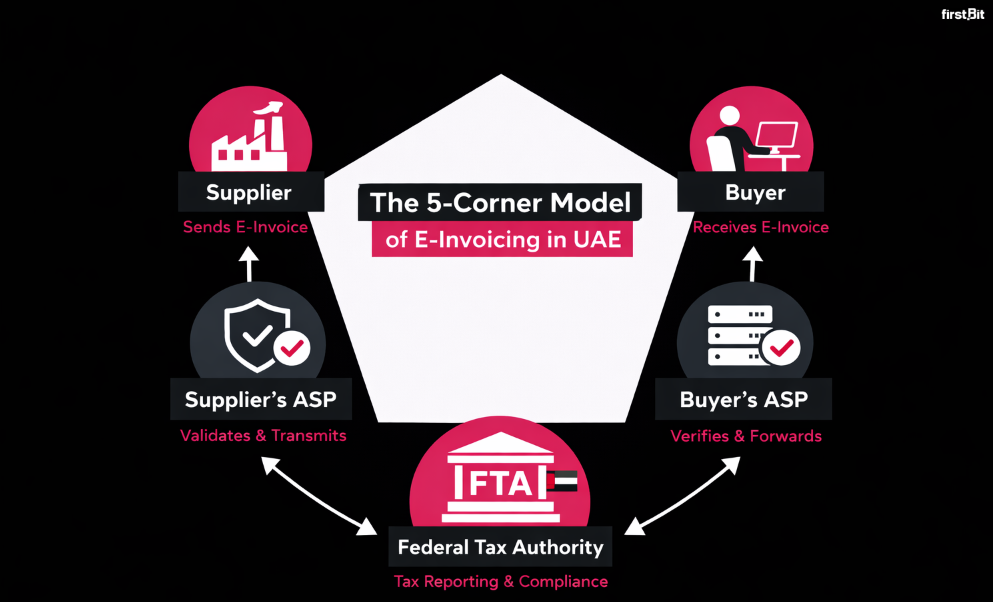
5 corner model of e-invoicing in the UAE
The UAE has adopted a structured 5-Corner Model to implement e-invoicing in the UAE, aligning with global digital tax frameworks. This model defines how invoice data moves securely between businesses and the Federal Tax Authority.
Instead of direct exchange between supplier and buyer, both parties connect through Accredited Service Providers (ASPs). These providers validate and transmit structured invoice data in line with UAE e-invoicing requirements, ensuring compliance before final delivery.
The Federal Tax Authority forms the fifth corner of the model. It receives invoice data for reporting and monitoring purposes, strengthening transparency within the national e-invoicing framework.
| Corner | Role in the E-Invoicing process |
| Supplier | Creates and sends a structured e-invoice through its Accredited Service Provider (ASP). |
| Supplier’s ASP | Validates the invoice format, ensures compliance with UAE e-invoicing requirements, and transmits the data securely. |
| Buyer’s ASP | Receives the invoice, verifies technical compliance, and forwards it to the buyer’s system. |
| Buyer | Receives and processes the compliant e-invoice within internal accounting systems. |
| Federal Tax Authority (FTA) | Receives invoice data for tax reporting and compliance monitoring purposes. |
For construction companies, this structure means invoice data must be system-generated and transmitted through compliant channels. Understanding the 5-Corner Model early helps businesses align systems and processes before the UAE e-invoicing timeline reaches mandatory enforcement.
What Is the Difference Between Invoice and E-Invoice?
A traditional invoice is typically issued as a paper document or PDF file. While it may be created digitally, it is not structured in a machine-readable format. Under e-invoicing in the UAE, this format is no longer sufficient for compliance.
An e-invoice is generated in a standardized digital format that systems can automatically validate. It contains structured data fields that comply with official e-invoicing requirements. These invoices are transmitted through accredited service providers rather than a simple email exchange.
| Aspect | Traditional Invoice | E-Invoice |
| Format | Paper or PDF | Structured digital format |
| Validation | Manual review | Automated system validation |
| Transmission | Email or physical delivery | Through Accredited Service Providers |
| Compliance | Not automatically compliant | Meets UAE e-invoicing requirements |
| Tax Reporting | Separate reporting process | Integrated into the reporting framework |
The difference lies in automation, validation, and regulatory alignment. Under the UAE e-invoicing timeline, businesses must shift from document-based invoicing to structured data exchange. For construction companies, this change directly affects billing workflows and ERP integration.
How Does the E-Invoicing System Work in the UAE?
The e-invoicing in the UAE system operates through structured data exchange rather than document sharing. Businesses generate invoices in a standardized format that complies with official UAE e-invoicing requirements. These invoices are transmitted through accredited service providers before reaching the buyer.
Instead of sending invoices directly, suppliers connect through an Accredited Service Provider (ASP). The ASP validates invoice data, checks format compliance, and securely transmits it to the buyer’s ASP and, where required, to authorities.
This structured workflow ensures invoice authenticity, data integrity, and tax transparency. Under the UAE e-invoicing timeline, businesses must adapt internal accounting systems to support automated e-invoicing rather than manual billing methods.
Main Steps of the E-Invoicing in the UAE
The e-invoicing process in the UAE follows a structured workflow defined by the Ministry of Finance. It ensures that invoice data is validated, transmitted securely, and reported in compliance with official standards.
The main steps include:
- Invoice creation. The supplier generates a structured e-invoice within its accounting or ERP system. The invoice must follow approved data standards under the UAE e-invoicing requirements.
- Validation by the supplier’s ASP. The Accredited Service Provider checks the invoice format, required fields, and technical compliance. If errors are detected, the invoice is rejected for correction before transmission.
- Transmission to the buyer’s ASP. Once validated, the invoice is transmitted securely to the buyer’s ASP. This ensures standardized delivery and prevents unauthorized modification.
- Reporting to the Federal Tax Authority (FTA). Relevant invoice data is shared with authorities as part of compliance monitoring. This step supports VAT transparency within the UAE e-invoicing timeline.
This structured approach replaces informal invoice exchange with regulated digital transmission. For construction companies, aligning billing systems to these steps will be essential before full implementation.
Roles in the Process of E-Invoicing in the UAE
The e-invoicing in the UAE framework assigns defined responsibilities to each participant in the transaction chain. Clear role allocation ensures structured data exchange and compliance with UAE e-invoicing requirements.
| Role | Responsibility in the e-invoicing process |
| Supplier | Generates the structured e-invoice and submits it through its Accredited Service Provider. |
| Supplier’s ASP | Validates invoice format and ensures compliance before secure transmission. |
| Buyer’s ASP | Receives the invoice, verifies technical standards, and forwards it to the buyer’s system. |
| Buyer | Processes the compliant invoice within internal accounting systems. |
| Federal Tax Authority (FTA) | Receives invoice data for reporting, compliance monitoring, and VAT oversight. |
Each role supports data integrity and regulatory transparency. Under the UAE e-invoicing timeline, businesses must coordinate with accredited service providers to ensure their systems align with the official e-invoicing structure.
For construction companies, this means reviewing ERP capabilities, vendor onboarding processes, and internal approval workflows. Preparing early reduces operational disruption once the mandatory phase of e-invoicing UAE begins.
UAE E-Invoicing Requirements
The e-invoicing UAE framework sets specific technical and compliance requirements that businesses must meet for structured invoice generation. These cover data formats, validation rules, and transmission protocols under the national tax system.
At its core, a compliant einvoice must include structured data elements such as supplier and buyer information, invoice date, line items, tax details, and unique invoice identifiers. The format must be machine-readable and conform to standards defined by the Federal Tax Authority.
Businesses must also ensure that invoice generation systems can integrate with Accredited Service Providers. This means validating invoices, transmitting data securely, and maintaining audit logs to support ongoing e-invoicing requirements and future tax reporting.
Meeting these requirements involves not only system updates but also process alignment across finance, billing, and compliance teams. Construction companies should treat this as a workflow change, not just a technical upgrade, ahead of the UAE e-invoicing timeline.
Who is Exempt from UAE E-Invoicing Requirements?
The scope of e-invoicing in the UAE primarily covers business-to-business (B2B) and business-to-government (B2G) transactions. Businesses involved in these transactions are expected to comply with structured e-invoice standards once the system becomes mandatory.
Business-to-consumer (B2C) transactions are currently outside the mandatory scope under the announced framework. This means companies issuing invoices only to end consumers may not initially fall under the full UAE e-invoicing requirements.
Specific exemptions may also apply to certain government transactions and regulated sectors, subject to ministerial decisions. However, most construction companies operating on commercial contracts will fall within the UAE e-invoicing timeline and should prepare accordingly.
Protect your rights under UAE law
Manage contracts efficiently with FirstBit
Request a demo
UAE E-Invoicing Timeline
The UAE e-invoicing timeline is being implemented in phased stages under the Ministry of Finance initiative. The system is scheduled for mandatory rollout beginning in July 2026, with preparatory stages already underway.
Implementation includes accrediting service providers, publishing technical standards, and enabling system onboarding before enforcement. This approach gives businesses time to align internal billing and tax workflows with the new e-invoicing requirements.
In a 2021 OECD survey used to assess global e-invoicing adoption, responses were collected from 71 tax administrations, showing how widely tax authorities are moving toward digital invoice data collection and reporting[?].
For construction companies, the timeline means preparation cannot be delayed until 2026. ERP readiness, ASP onboarding, and invoice workflow redesign should start early to avoid billing disruption once e-invoicing becomes mandatory.
Benefits of E-Invoicing in the UAE
The shift to e-invoicing in the UAE is designed to benefit both tax authorities and businesses. Beyond compliance, structured electronic invoicing reduces manual processing, strengthens audit trails, and improves the accuracy of VAT reporting[?].
For construction companies, automated invoice validation and transmission can shorten billing cycles. This helps reduce errors related to manual entry, speeds up approvals between suppliers and buyers, and supports better working capital management.
Analysis shows that e-invoicing can reduce invoice processing costs by about 60% compared with traditional manual or paper-based methods, thanks to automated workflows and data validation[?].
E-invoicing also promotes faster payments and improved cash flow. By reducing delays in invoice approvals and enabling quicker reconciliation, businesses can manage liquidity more effectively[?].
Enhanced compliance is another key benefit. Structured e-invoices provide real-time data visibility for VAT reporting, reducing the risk of audit issues and penalties under the UAE e-invoicing requirements.
Navigate UAE construction laws with an ERP built for the UAE market
Request a demo
How FirstBit ERP Supports UAE E-Invoice Standards
As e-invoicing in the UAE moves toward mandatory implementation, businesses must ensure their accounting systems can generate, validate, and store structured invoice data. For construction companies, this shift affects billing workflows, tax reporting, and vendor coordination across projects.
FirstBit ERP is an accounting and business management system used in the UAE. In the context of UAE e-invoicing requirements, it supports structured invoice generation, financial tracking, and system-level compliance preparation.
- Structured invoice generation. The system can generate invoices with defined data fields required for VAT reporting and digital compliance. This supports the transition toward compliant e-invoicing formats.
- VAT-compliant tax configuration. Tax rates, VAT calculations, and reporting structures can be configured according to UAE regulations. This reduces the risk of errors when aligning with e-invoicing requirements.
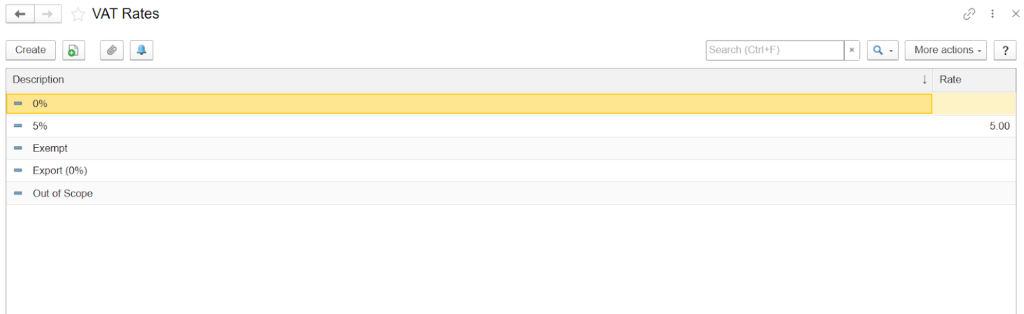
VAT rates applied in FirstBit ERP
- Audit trail and document storage. Invoice records and financial transactions are stored with traceable logs. This supports compliance and documentation readiness under the UAE e-invoicing timeline.
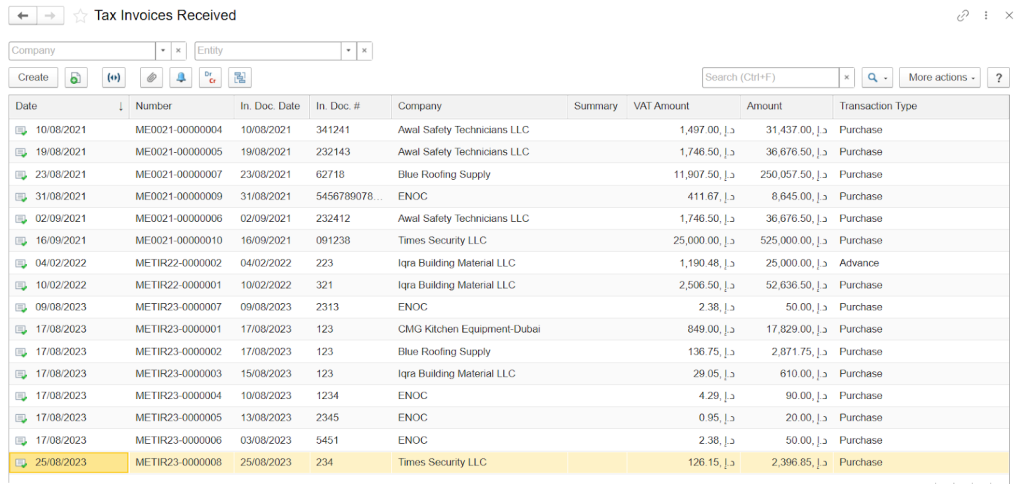
Tax invoices record in FirstBit ERP
- Integration readiness with service providers. ERP systems can integrate with third-party platforms or accredited service providers, enabling structured data exchange required for e-invoicing UAE compliance.
Full e-invoicing functionality will be available in line with the July 2026 regulatory rollout. In the meantime, the system’s existing financial and reporting controls support structured data management and process alignment ahead of mandatory compliance. This phased alignment reflects the broader transition toward structured e-invoicing under the evolving UAE e-invoicing requirements.
Conclusion
The transition to e-invoicing in the UAE marks a structural change in how financial data moves between businesses and authorities. For construction companies, this is not just a tax update but a workflow transformation that affects billing cycles, subcontractor coordination, and compliance oversight.
As the UAE e-invoicing timeline advances toward 2026, preparation becomes a strategic decision rather than a technical upgrade. Companies that review internal systems early, align with service providers, and adjust approval processes will face fewer operational disruptions.
The broader shift toward structured e-invoicing reflects a global move toward digital tax transparency. For contractors and project-based businesses, readiness will depend on how effectively finance, operations, and IT teams coordinate under evolving UAE e-invoicing requirements.
Stay compliant with UAE laws
Automate VAT, payroll, and documentation
Request a demo
FAQ
What is eInvoicing?
What are the requirements for e-invoicing in the UAE?
What are the new rules for invoices in the UAE?
Who all are exempted from e-invoicing?

Umme Aimon Shabbir
Editor at First Bit
Share this article
'%3e%3cg%20clip-path='url(%23clip1_6548_6055)'%3e%3cpath%20d='M13.974%2015.6195C14.2724%2016.0185%2014.6532%2016.3487%2015.0905%2016.5876C15.5278%2016.8265%2016.0114%2016.9686%2016.5084%2017.0042C17.0055%2017.0398%2017.5043%2016.9681%2017.9712%2016.7939C18.4381%2016.6198%2018.8621%2016.3472%2019.2143%2015.9948L21.2994%2013.9098C21.9324%2013.2544%2022.2827%2012.3766%2022.2747%2011.4654C22.2668%2010.5543%2021.9014%209.68269%2021.257%209.03839C20.6127%208.39408%2019.7412%208.02862%2018.83%208.0207C17.9189%208.01278%2017.0411%208.36305%2016.3857%208.99606L15.1902%2010.1845M16.754%2014.2295C16.4555%2013.8305%2016.0747%2013.5003%2015.6374%2013.2614C15.2002%2013.0225%2014.7166%2012.8804%2014.2196%2012.8448C13.7225%2012.8092%2013.2237%2012.8809%2012.7568%2013.0551C12.2899%2013.2292%2011.8659%2013.5018%2011.5136%2013.8542L9.42861%2015.9392C8.7956%2016.5946%208.44534%2017.4724%208.45326%2018.3836C8.46117%2019.2947%208.82664%2020.1663%209.47094%2020.8106C10.1152%2021.4549%2010.9868%2021.8204%2011.898%2021.8283C12.8091%2021.8362%2013.6869%2021.4859%2014.3423%2020.8529L15.5308%2019.6645'%20stroke='%235F7896'%20stroke-width='1.39002'%20stroke-linecap='round'%20stroke-linejoin='round'/%3e%3c/g%3e%3c/g%3e%3crect%20x='0.438953'%20y='0.438953'%20width='28.9709'%20height='28.9709'%20rx='14.4855'%20stroke='%235F7896'%20stroke-width='0.877907'/%3e%3cdefs%3e%3cclipPath%20id='clip0_6548_6055'%3e%3crect%20width='29.8488'%20height='29.8488'%20rx='14.9244'%20fill='white'/%3e%3c/clipPath%3e%3cclipPath%20id='clip1_6548_6055'%3e%3crect%20width='16.6802'%20height='16.6802'%20fill='white'%20transform='translate(7.02344%206.58435)'/%3e%3c/clipPath%3e%3c/defs%3e%3c/svg%3e)


Related articles


See all




Related articles

Regulatory Changes in the UAE in 2026 and How FirstBit ERP Helps Construction Companies Stay Compliant

How to Select the Best FTA-Approved E-Invoicing Service Provider (ASP) in the UAE?

Construction Law in the UAE: 2026 Legal Framework, The Essentials of Contracts, and Dispute Resolution
See all

See FirstBit ERP solutions in action
Discover how our system solves the unique challenges of contractors in a personalized demo.
After the demo you will get a quotation for your company.
After the demo you will get a quotation for your company.