Construction projects in the UAE are advancing at a relentless pace, but rising prices are making it increasingly difficult to maintain profitability. Contractors face tighter margins, unexpected price fluctuations, and greater financial pressure. In this environment, cost benchmarking in construction has become an essential tool for companies striving to stay competitive in 2026.
If you want to make smarter financial decisions from the start of a project’s lifecycle, compare costs more accurately, and identify financial risks before they escalate, it’s time to apply construction cost benchmarking in the UAE using reliable market data and historical project performance.
This approach helps contractors benchmark construction costs against comparable developments and published UAE market benchmarks, making bids more competitive and budgets more realistic.
What Is Construction Cost Benchmarking in the UAE
In 2026, cost benchmarking in construction is especially valuable for UAE contractors managing tighter margins, changing input costs, and competitive tendering.
Cost benchmarking in construction is the process of comparing costs against historical data, industry standards, and top-performing projects to assess whether the project provides good value for money and to identify inefficiencies and opportunities for improvement.
In simple terms, it answers questions like:
-
Are we spending more or less compared to similar developments?
-
How can we reduce unnecessary expenses?
-
Are our construction expenses reasonable, or are they too high?
-
What is the expected price per square meter?
-
Where do the major pricing differences come from?
In 2026, UAE contractors use cost benchmarking to manage rising material prices, labour expenses, and construction risks. By analysing market data and historical performance, companies can identify financial gaps and improve decision-making. This is especially important for large developments, infrastructure projects, and fast-moving construction sectors in Dubai and Abu Dhabi.
Construction cost benchmarking in the UAE also improves profitability and risk management. It helps contractors avoid underpricing, control unexpected expenses, and optimise resource allocation. When combined with digital tools and real-time data analysis, benchmarking gives construction teams better visibility into project expenditure and supports more accurate forecasting throughout the project lifecycle.
Studies indicate that benchmarking improves financial control and decision-making. It compares construction expenditure against historical data, industry standards, and top-performing developments to identify inefficiencies and improvement opportunities. This helps construction teams establish realistic targets, evaluate variances, and support data-driven decision-making[?].
Cost Benchmark vs Cost Estimate vs Budget
These terms are closely related, but each serves a distinct purpose in development financial management. Benchmarks provide a reference point based on comparable projects, estimates forecast the probable expenditure of a defined development, while budgets establish the approved financial limit against which expenditure is controlled.
|
Term
|
What it means
|
|
Cost benchmark
|
Reference cost from comparable developments or market data
|
|
Cost estimate
|
Forecast of expected costs for a specific development
|
|
Budget
|
Approved spending limit used to control execution
|
What is Benchmark in Construction?
A benchmark in construction is a standard or reference point used to measure and compare the financial performance, quality, productivity, or progress of a construction project against similar ones or industry standards.
Example: If the average price of building a residential tower in Dubai is AED 6,000/m², that value becomes a benchmark for comparing new developments.
Benchmarks help construction companies to:
-
Measure project performance
-
Identify inefficiencies
-
Control spending
-
Improve planning
-
Compare with industry standards
-
Achieve better value for money
In short, a benchmark in construction is used to evaluate whether a development is performing well in terms of financial performance, time, quality, or efficiency.
UAE Construction Cost Benchmarks 2026: Quick Reference
The following benchmarks provide a quick reference for indicative construction pricing across common asset types in the UAE for 2026. Expressed in AED per square meter, they support early-stage feasibility studies and financial planning.
|
Asset type
|
Indicative benchmark
|
|
3-Star Hotel
|
AED 7,000–9,450/m²
|
|
Low-rise Office
|
AED 4,900–6,000/m²
|
|
Low-rise Apartments
|
AED 4,200–6,000/m²
|
|
Standard Villa
|
AED 4,000–5,000/m²
|
|
Logistics Warehouse
|
AED 5,500–8,600/m²
|
Indicative UAE construction cost ranges. Actual costs vary by location, specification, procurement route, design complexity, and project scale.
Stay one step ahead of competitors
Monitor the UAE market dynamics and adapt fast
Request a demo
Common Construction Industry Benchmarks
Reliable construction industry benchmarks in the UAE are based on real project data from sources like RICS, MEED, and government tender portals. Using these standards, contractors can evaluate construction performance across asset classes and emirates.
Companies use construction industry benchmarks to measure construction performance, monitor productivity, improve financial management, and maintain safety standards. Such data-driven performance tracking has become essential in 2026 for construction firms seeking to improve operational efficiency, reduce delivery risks, and achieve better project outcomes across all stages of construction operations.
Most benchmarks are based on key performance indicators (KPIs) related to finance, time, quality, safety, productivity, and client satisfaction.
Construction industry benchmarks include:
- Completion rate measures the percentage of projects completed within the planned schedule and contractual deadlines.
- Budget adherence evaluates how effectively construction developments stay within estimated budgets and control overall spending.
- Cash flow stability assesses the company’s ability to manage incoming and outgoing finances effectively.
- Profitability margins measure the financial performance of projects by comparing revenues against total spending and expenses.
- Workplace safety performance tracks accident rates, injury frequency, and compliance with occupational health
and safety standards.
- Labour productivity levels measure the amount of completed work compared to labour hours used during project execution.
Benefits of Cost Benchmarking in Construction
Cost benchmarking in construction provides a structured approach for evaluating financial performance, improving budgeting accuracy, and identifying opportunities for cost savings. By using benchmarking practices, construction companies can make more informed decisions and improve overall operational efficiency.
Key benefits of cost benchmarking in construction include:
- Improved budget accuracy. Benchmarking helps companies develop more realistic project budgets based on historical data and industry cost standards.
- Better cost control. Comparing project expenses against benchmarks allows project managers to identify cost overruns early and take corrective action.
- Higher profitability. Better cost management and reduced inefficiencies contribute to improved financial performance and long-term business profitability.
- Enhanced planning. Cost benchmarking provides reliable financial insights that support more effective planning and resource allocation during development.
- Identification of inefficiencies. Benchmark comparisons help reveal areas where labour, materials, or operational processes may be underperforming or wasting resources.
- Improved decision-making. Construction managers can use benchmark data to make informed decisions regarding procurement, design changes, and project execution strategies.
UAE Construction Cost Benchmarks by Asset Type
Real-world examples of the UAE construction cost benchmarking provide valuable insight into how project expenditure varies across different asset classes, specifications, and procurement strategies. The benchmarks referenced in this section are based on verified market data and live project analysis published by Stonehaven, offering a practical guide for developers, consultants, and investors navigating the UAE construction market
[?].
All benchmark rates are measured using Gross Floor Area (GFA) unless otherwise stated, with price ranges reflecting both low-to-medium and medium-to-high specification standards. Actual construction expenditure can fluctuate depending on factors such as development location, contract structure, design complexity, structural systems, and economies of scale
[?].
Hospitality
Hospitality developments in the UAE are heavily influenced by brand positioning, guest experience expectations, and premium finishes. Luxury hotels, particularly 5-star developments, require extensive fit-outs, high-end MEP systems, and bespoke interior detailing, resulting in significantly higher construction expenditure compared to mid-scale hospitality assets.
| Project Type |
Low (AED/m²) |
High (AED/m²) |
| 3-Star Hotel |
7,000 |
9,450 |
| 4-Star Hotel |
8,850 |
12,180 |
| 5-Star Hotel |
12,000 |
17,500 |
Commercial
Commercial developments in the UAE include office towers, business parks, and premium workplace fit-outs. Project expenditure varies based on building height, structural systems, façade complexity, and tenant requirements. Premium office fit-outs in major business districts such as Dubai and Abu Dhabi, can significantly increase overall project expenditure.
| Project Type |
Low (AED/m²) |
High (AED/m²) |
| Low-rise Office |
4,900 |
6,000 |
| Mid-rise Office |
5,900 |
7,300 |
| High-rise Office |
7,100 |
9,500 |
Residential
Residential construction expenditure in the UAE depends on unit density, vertical transportation systems, façade specifications, and interior quality levels. Luxury villas and high-end residential towers command substantially higher expenditure due to premium materials, custom finishes, and smart home technologies.
| Project Type |
Low (AED/m²) |
High (AED/m²) |
| Low-rise Apartments (G+4) |
4,200 |
6,000 |
| Medium-rise Apartments (G+12) |
5,500 |
7,200 |
| High-rise Apartments (G+40) |
7,100 |
9,700 |
| Villas Standard |
4,000 |
5,000 |
| Villas Luxury |
8,400 |
18,200 |
Retail
Retail developments range from community shopping centres to large-scale regional malls with complex entertainment and leisure offerings. Construction expenditure is typically driven by atrium structures, MEP intensity, tenant coordination requirements, and the quality of retail fit-outs.
| Project Type |
Low (AED/m²) |
High (AED/m²) |
| Community Malls |
4,800 |
6,600 |
| Regional Mall |
5,300 |
7,100 |
| Large Regional Mall |
6,000 |
8,650 |
Industrial & Logistics
The UAE’s industrial and logistics sector continues to expand due to growing regional trade activity and e-commerce demand. Construction expenditure in this sector is generally lower than commercial or hospitality projects because of simpler structural systems and functional design requirements.
| Project Type |
Low (AED/m²) |
High (AED/m²) |
| Light Industrial Unit |
3,000 |
4,000 |
| Logistics Warehouses Facility |
5,500 |
8,600 |
Succeed in the UAE Market
Request a demo
6 Methods of Cost Benchmarking in Construction
Different methods of cost benchmarking in construction are used depending on business goals, available data, and the level of analysis required. Some approaches focus on comparing internal project performance, while others assess costs against industry standards or specific building elements.
These methods support better decision-making during planning, design, and construction execution. By analysing spending trends and comparing similar developments, companies can improve budgeting accuracy, reduce financial risks, and maintain greater control over overall project spending. This process contributes to stronger financial management and improved long-term project performance.
1. Internal Cost Benchmarking in Construction
Internal benchmarking compares costs across developments within the same organisation. Construction firms use this method to identify inconsistencies in procurement, labour productivity, or subcontractor pricing between different projects or business units.
For example, a general contractor may compare:
-
Subcontractor rates between regional offices to determine whether procurement teams are securing competitive pricing.
-
Equipment utilisation expenses across construction sites to assess whether machinery is being used efficiently.
-
Project overhead expenses between business units to identify opportunities for spending reduction and standardisation.
Internal benchmarking is valuable because organisations usually have access to detailed and reliable historical construction data.
Construction ERP software strengthens this process by generating and centralising valuable financial data — including budgets, BOQs, labour expenses, cash flow reports, and more — within a unified platform.
This enables organisations to build consistent historical databases, identify spending trends and variances, and improve the reliability of future benchmarking and forecasting activities.
2. External Cost Benchmarking in Construction
External benchmarking compares project financial performance against industry averages, market databases, or competitor data. This method is commonly used during early project planning and feasibility studies. This approach helps determine whether project spending is competitive within the market. However, adjustments are often required for location, inflation, procurement route, and project complexity.
External benchmark data may come from:
Pro tip: Combine external benchmarking with internal project data to create more accurate financial models. Reviewing both market trends and past construction performance helps teams build realistic budgets, improve bidding strategies, and identify opportunities to reduce spending earlier in the development lifecycle.
3. Elemental Benchmarking
Elemental benchmarking helps construction teams compare the costs of individual building elements such as foundations, roofing, structural systems, and finishes. This method provides detailed financial visibility, making it easier to identify areas where spending can be optimised without affecting overall project quality or performance.
By analysing costs at the element level, contractors and estimators can make more accurate comparisons between developments of similar size and scope. Elemental benchmarking improves budgeting consistency and supports better forecasting during early-stage planning and design development.
Pro tip: Create standardised elemental financial categories across all developments to improve benchmarking accuracy. Consistent data collection makes it easier to compare performance, identify recurring financial issues, and build more reliable estimates for future construction projects.
4. Unit Rate Benchmarking
Unit rate benchmarking compares the cost price per unit of work across similar developments. Contractors and estimators use benchmarked rates to evaluate pricing accuracy, improve budgeting, and identify opportunities to reduce spending.
Unit rates can be compared against industry standards and regional market conditions. Common benchmarks include price per square meter, labour productivity rates, and material installation costs. These comparisons help teams maintain realistic estimates and reduce the risk of budget overruns during construction.
Pro tip: Always normalize benchmark data before comparing unit rates. Factors such as location, labour availability, inflation, design complexity, and material quality can significantly impact construction costs. Adjusting for these variables ensures more accurate benchmarking results and helps avoid misleading financial comparisons.
5. Market-Based Benchmarking
Market-based benchmarking compares project expenditure with current market conditions, supplier prices, and regional construction indices. Market benchmarking ensures that financial estimates remain realistic and aligned with current economic conditions.
This method helps account for:
6. Real-Time Digital Benchmarking
Modern construction firms increasingly use digital platforms and financial databases for real-time benchmarking. These systems automatically compare live project data against historical and industry benchmarks. The use of standardised financial coding and digital benchmarking platforms have improved the speed and accuracy of construction cost analysis.
Digital benchmarking tools can:
-
Track spending trends
-
Detect budget deviations early
-
Improve estimate consistency
-
Support data-driven decision-making
For example,
ERP software for contractors enables companies to monitor construction expenditures, compare actual expenses against budgets, analyse profitability, and generate real-time dashboards and variance reports.
How to Conduct UAE Construction Cost Benchmarking
Construction cost benchmarking in the UAE usually begins by collecting reliable financial data from similar projects across the UAE construction market. Companies compare labour rates, material prices, equipment expenses, and tender pricing to identify performance gaps and establish realistic financial expectations. Sector-specific benchmarks are especially important for residential, commercial, and infrastructure developments.
Modern UAE construction benchmarking also relies on digital tools, AI analytics, and real-time reporting systems. These technologies help project teams track pricing fluctuations, monitor inflation, and forecast future spending more accurately.
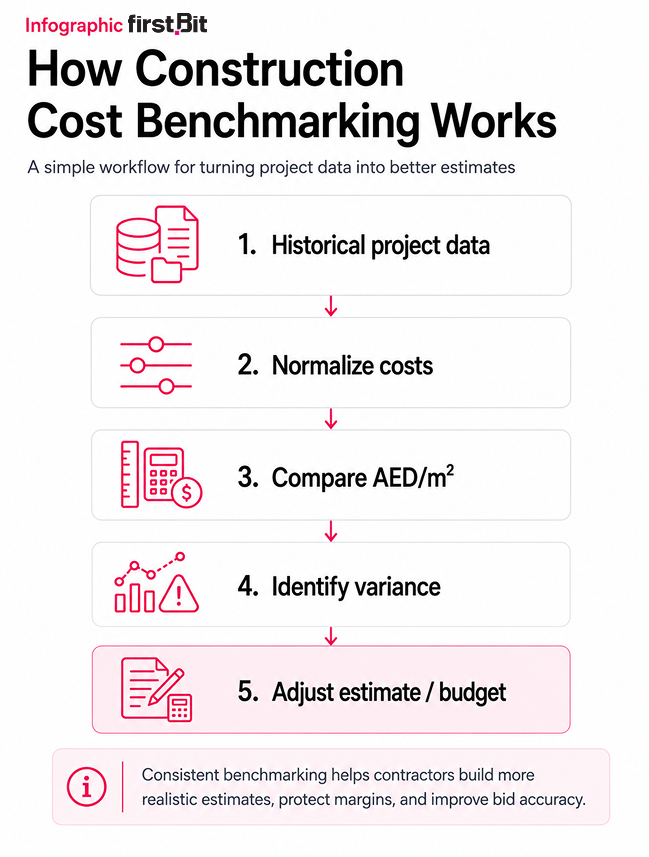
How construction cost benchmarking works
Step 1: Define Benchmarking Objectives and KPIs
The first step in the UAE construction cost benchmarking is identifying clear project goals and performance indicators. Companies should define what they want to measure, such as cost per square meter, labour productivity, procurement efficiency, or
project delivery timelines. Clear KPIs make benchmarking more accurate and actionable.
Construction firms in the UAE often benchmark against similar development types, locations, and specification levels to ensure fair comparisons. Aligning KPIs with business objectives helps teams focus on areas that directly impact profitability and operational performance.
Pro tip: Focus on measurable KPIs that can be tracked consistently across multiple developments for more reliable benchmarking results.
Step 2: Collect Historical and Market Cost Data
Accurate benchmarking depends on collecting reliable historical and market financial data. This includes material prices, labour expenses, subcontractor rates, equipment expenses, and project overheads from previous UAE construction developments.
Market reports and regional construction price indexes also help companies understand current pricing trends. In the UAE, factors like supply chain conditions, inflation, and project demand can significantly influence construction prices across sectors.
Pro tip: Use both internal construction data and external market reports to build a more accurate and balanced benchmarking database.
Step 3: Normalise Construction Cost Data
Construction financial data must be normalised before comparisons are made. This process adjusts costs based on development size, location, inflation, design specifications, and contract types to ensure fair analysis between projects.
For UAE projects, normalisation is especially important because costs can vary between emirates and building categories. Adjusting for variables such as façade complexity, MEP requirements, and sustainability standards improves benchmarking accuracy.
Pro tip: Standardise financial units, such as AED per square meter, to simplify project comparisons and reporting.
Step 4: Compare Costs Against Benchmarks
Once data is normalised, construction teams can compare a project's financial performance against industry benchmarks and historical data. This helps identify areas where spending exceeds market averages or where operational efficiencies can be improved.
Benchmark comparisons also support better decision-making during procurement, budgeting, and construction planning. UAE contractors often use benchmarking to evaluate supplier pricing, labour utilisation, and design alternatives before finalising project budgets.
budgets.
Pro tip: Compare projects within the same sector and specification category to avoid misleading benchmark results.
Step 5: Apply Insights for Continuous Improvement
The final step is using benchmarking insights to improve future construction performance. Companies can adjust procurement strategies, optimise resource allocation, and improve financial forecasting based on benchmark findings.
Continuous benchmarking also helps UAE construction firms stay competitive in a fast-changing market. Regular updates to benchmark databases allow businesses to respond quickly to material price fluctuations, labour shortages, and evolving project
requirements.
Pro tip: Review and update benchmark data regularly to reflect current market conditions and improve forecasting accuracy.
Deliver work that exceeds expectations
Control quality in FirstBit ERP
Request a demo
How FirstBit ERP Improves UAE Construction Cost Benchmarking
FirstBit ERP provides real-time operational visibility, enabling construction companies to monitor expenses across materials, labour, equipment, subcontractors, and overheads throughout every stage of construction. By using live project data and automated reporting, businesses can identify inefficiencies early and maintain tighter control over budgets and resources.
FirstBit ERP is particularly valuable for UAE construction firms handling multiple developments simultaneously. The software enables organisations to standardise financial analysis, compare project performance across sites, and establish reliable benchmarks for future tenders, budgeting, and project planning.
Key ways Firstbit ERP supports cost benchmarking:
-
Tracks costs in real time
-
Standardizes BOQ and estimation data
-
Analyzes profitability across multiple developments
-
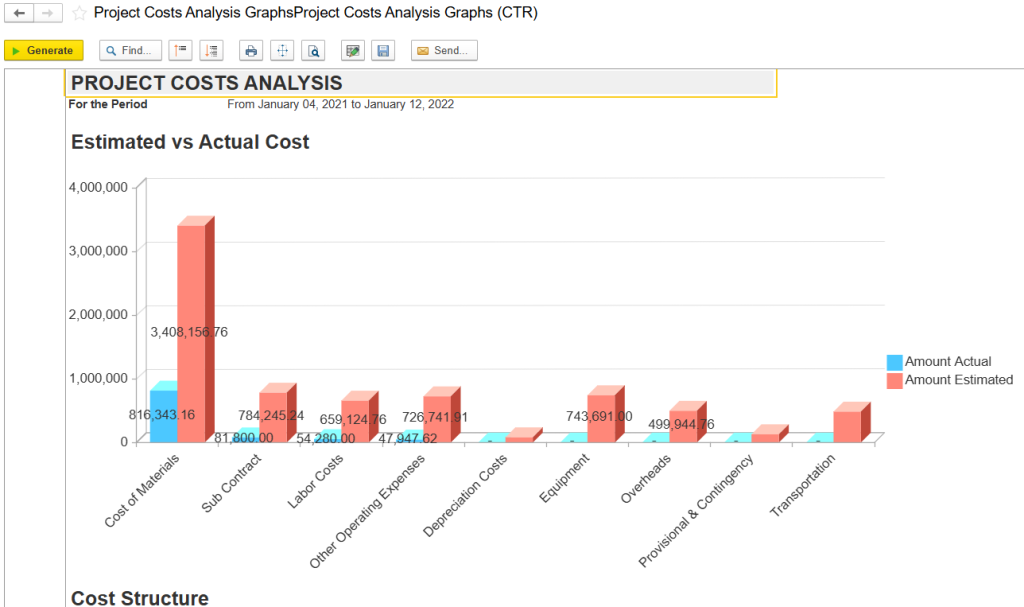
Compares estimated cost vs actual expenses
Cost analysis in Firstbit ERP Contracting
-
Generates project P&L and variance reports
-
Supports project budget analysis
-
Stores historical construction data for future benchmarking
-
Monitors labour, material, and equipment expense
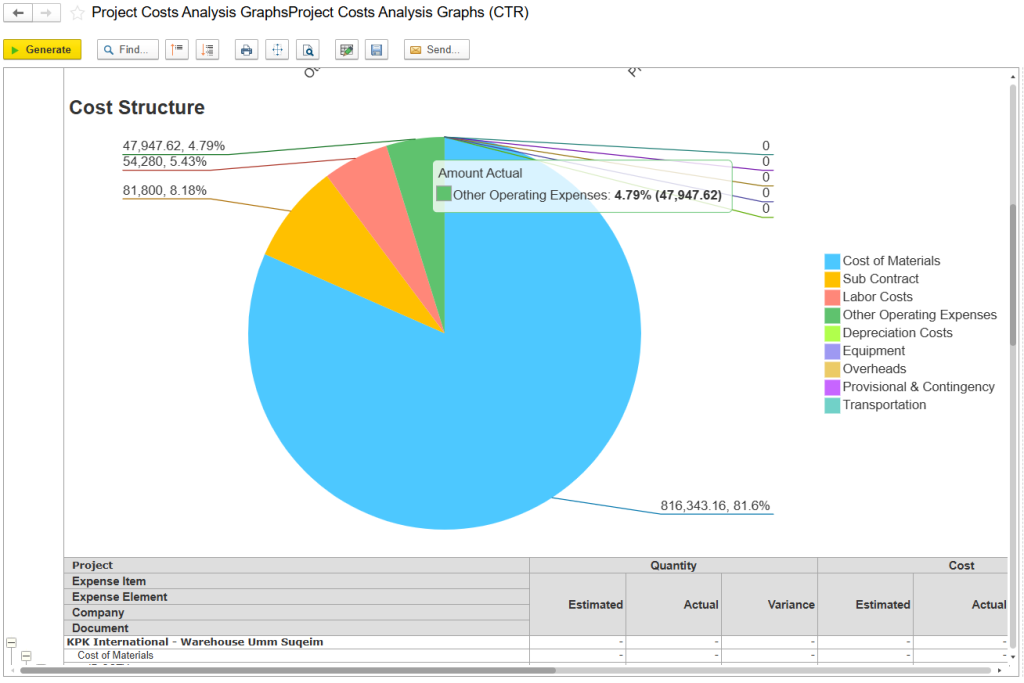
Cost structure in Firstbit ERP Contracting
Conclusion
The UAE construction cost benchmarking has become a strategic advantage for construction companies operating in the UAE. As projects grow in complexity and market conditions continue to shift, businesses that rely on accurate financial intelligence will be better positioned to control spending, improve forecasting, and maintain long-term financial stability.
Looking ahead, the UAE construction sector will continue to experience growth driven by infrastructure expansion, real estate development, and large-scale investment initiatives. In such a fast-moving market, companies that prioritize cost transparency
and data-driven planning will gain a stronger competitive edge while building greater resilience against inflation, supply chain disruptions, and future market uncertainty.
Spot emerging trends and adapt fast
Request a demo
FAQ
What is construction cost benchmarking in the UAE?
Construction cost benchmarking in the UAE is the process of comparing your project expenditure (labour, materials, equipment, subcontractors) against industry averages or competitor data within the UAE market. This helps you understand if you’re overpaying, underbidding, or pricing competitively — so you can adjust strategies and protect your margins.
What costs should I benchmark in my construction projects?
Focus on these key categories:
Labour: Hourly rates by trade (carpenters, electricians, etc.)
Materials: Unit prices for concrete, steel, MEP, finishes
Equipment: Rental vs. ownership expenses per hour/day
Subcontractors: Rates for specialised work (pile driving, façade, etc.)
Overheads: Site supervision, utilities, permits per sqm or per construction phase
FirstBit ERP lets you break down expenses by custom codes — making benchmarking granular and actionable.
Does benchmarking mean I should always choose the cheapest option?
No. Benchmarking reveals value, not just price. Sometimes paying 10% more for a reliable subcontractor saves 20% in rework. FirstBit ERP helps you benchmark the total financial impact of ownership — including delays, defects, and safety incidents — not just the invoice amount.
Where can I find reliable UAE construction cost benchmarks?
Sources such as RICS, MEED Projects, BNC Network, and government tender databases like Dubai Municipality are widely used for UAE construction cost benchmarking. RICS provides cost analysis standards, while MEED and BNC track project awards, tender values, and market trends. Government tender portals offer actual procurement data that helps validate market rates and benchmark estimates against real project expenditure.
FirstBit ERP helps you build your own private benchmark database — continuously updated with real project data.
How often should construction cost benchmarks be updated?
Construction cost benchmarks should generally be updated quarterly, since labour, material prices, inflation, and market conditions can change quickly. Major benchmark methodologies or weighting structures can be reviewed less frequently, such as every 3–5 years. Quarterly updating aligns with common construction cost indices and industry practice.
What is the difference between construction cost benchmarking and cost estimating?
Construction cost benchmarking compares a project’s costs with historical or similar projects to assess performance, value, and whether costs are reasonable. Cost estimating, by contrast, predicts the probable cost of a specific future project based on its scope, quantities, resources, risks, and available information.












'%3e%3cg%20clip-path='url(%23clip1_6548_6055)'%3e%3cpath%20d='M13.974%2015.6195C14.2724%2016.0185%2014.6532%2016.3487%2015.0905%2016.5876C15.5278%2016.8265%2016.0114%2016.9686%2016.5084%2017.0042C17.0055%2017.0398%2017.5043%2016.9681%2017.9712%2016.7939C18.4381%2016.6198%2018.8621%2016.3472%2019.2143%2015.9948L21.2994%2013.9098C21.9324%2013.2544%2022.2827%2012.3766%2022.2747%2011.4654C22.2668%2010.5543%2021.9014%209.68269%2021.257%209.03839C20.6127%208.39408%2019.7412%208.02862%2018.83%208.0207C17.9189%208.01278%2017.0411%208.36305%2016.3857%208.99606L15.1902%2010.1845M16.754%2014.2295C16.4555%2013.8305%2016.0747%2013.5003%2015.6374%2013.2614C15.2002%2013.0225%2014.7166%2012.8804%2014.2196%2012.8448C13.7225%2012.8092%2013.2237%2012.8809%2012.7568%2013.0551C12.2899%2013.2292%2011.8659%2013.5018%2011.5136%2013.8542L9.42861%2015.9392C8.7956%2016.5946%208.44534%2017.4724%208.45326%2018.3836C8.46117%2019.2947%208.82664%2020.1663%209.47094%2020.8106C10.1152%2021.4549%2010.9868%2021.8204%2011.898%2021.8283C12.8091%2021.8362%2013.6869%2021.4859%2014.3423%2020.8529L15.5308%2019.6645'%20stroke='%235F7896'%20stroke-width='1.39002'%20stroke-linecap='round'%20stroke-linejoin='round'/%3e%3c/g%3e%3c/g%3e%3crect%20x='0.438953'%20y='0.438953'%20width='28.9709'%20height='28.9709'%20rx='14.4855'%20stroke='%235F7896'%20stroke-width='0.877907'/%3e%3cdefs%3e%3cclipPath%20id='clip0_6548_6055'%3e%3crect%20width='29.8488'%20height='29.8488'%20rx='14.9244'%20fill='white'/%3e%3c/clipPath%3e%3cclipPath%20id='clip1_6548_6055'%3e%3crect%20width='16.6802'%20height='16.6802'%20fill='white'%20transform='translate(7.02344%206.58435)'/%3e%3c/clipPath%3e%3c/defs%3e%3c/svg%3e)