





Beyond the Hype: What AI Agents Actually Do on UAE Construction Sites in 2026
Publication date 20 Apr 2026 •
Updated 15 Jun 2026 •
9 min read

Anna Fischer
Construction Content Writer


In 2026, UAE contractors are moving from AI curiosity to practical use cases: faster documentation, better project coordination, site monitoring, cost control, and reporting. Generative AI in construction, AI agents in construction, and construction AI assistants can help teams process drawings, RFIs, site reports, schedules, procurement updates, and compliance documents faster.
The value is not in replacing engineers or project managers, but in reducing routine work and surfacing project information sooner.
Research reports that projects using AI monitoring solutions saw a 47.8% reduction in quality-related issues and a 39.5% improvement in schedule adherence across 1,234 construction sites. It also notes that AI-powered monitoring reduced workplace incidents by 58.7% and improved regulatory compliance by 76.2% across 823 active sites[?].
Generative AI in Construction: Definition & Use Cases
Generative AI in construction means AI systems that create or summarize project content from existing data: text, drawings, schedules, reports, images, and documents. In practice, it helps construction teams turn scattered project information into draft reports, risk summaries, document comments, design options, and faster answers to routine project questions.
Research on generative AI in construction project management shows that AI is already improving planning accuracy, real-time monitoring, resource allocation, cost control, safety compliance, and project predictability.
Research on generative AI in construction project management shows that AI is already improving planning accuracy, real-time monitoring, resource allocation, cost control, safety compliance, and project predictability.
What is Generative AI in Construction
Generative AI in construction is AI that helps create, summarize, or organize project information based on existing data. It can work with documents, drawings, schedules, reports, photos, cost records, and site updates to produce drafts, summaries, checklists, comments, or recommendations for human review.
Research on AI in construction project management notes that modern large-scale projects generate around 88,500 document sheets and process more than 130,000 data points across the project lifecycle, which makes manual review slow and error-prone.
For contractors, the main value is faster processing of project information. Generative AI helps teams work with this volume of information faster, but final decisions should still remain with engineers, project managers, and finance teams.
Transform your business
Embrace innovation with FirstBit ERP
Request a demo
Generative AI in Construction: Use Cases
Generative AI in construction is most useful in daily workflows where teams lose time preparing, checking, and searching project information. Instead of manually going through scattered files, teams can use AI to create first drafts, extract key points, and organize updates for review.
Common use cases include:
-
Drafting RFIs, reports, meeting summaries, and client updates
-
Summarizing site reports, inspection notes, and progress records
-
Checking drawings, schedules, and project documents for possible inconsistencies
-
Preparing quality, safety, and compliance checklists
-
Finding answers across project files and communication history
For UAE contractors, these use cases can improve coordination between office teams, site teams, consultants, and subcontractors. The main benefit is faster and more consistent handling of project information across daily workflows.
AI Agents in Construction: Why & How They Are Used
AI agents in construction are software systems that can process project information, make decisions within set rules, and perform specific actions to support a construction workflow.
Unlike a general chatbot, an AI agent for construction is usually built for a specific task, such as checking project data, routing information, sending alerts, or triggering the next step in a process.
Unlike a general chatbot, an AI agent for construction is usually built for a specific task, such as checking project data, routing information, sending alerts, or triggering the next step in a process.
Choose the right technology for your construction business
Request a demo
Why Do UAE Companies Use AI Agents in Construction
UAE construction companies use AI agents in construction to reduce manual coordination across office and site teams. Projects often involve many subcontractors, documents, approvals, schedules, deliveries, and compliance checks, so small delays in information flow can affect cost, timelines, and quality.
AI agents can help teams manage:
-
Cost and budget checks
-
Schedule conflicts and inspection delays
-
Safety, insurance, and compliance documents
-
Procurement updates and material deliveries
-
Equipment maintenance alerts
-
Internal tasks and approvals
This helps contractors spot issues earlier, reduce routine follow-ups, and keep project information moving between departments without waiting for manual checks at every step.
How To Implement AI Agents in Construction
To implement a construction AI assistant in construction, companies should start with one narrow workflow instead of trying to automate the whole project environment at once. A practical first step is to choose a repetitive process, define the rules for how the agent should act, and connect it to the systems where project data already lives.
A simple implementation plan can include:
-
Choose one workflow, such as RFI routing, invoice checks, compliance alerts, or schedule updates
-
Define what the agent can do independently and when it must ask for human approval
-
Connect the agent to relevant project systems, documents, ERP, schedules, or communication tools
-
Test the agent on one project or department before wider rollout
-
Review results, errors, and user feedback before adding more workflows
This approach helps contractors reduce risk and keep control over decisions. AI agents and chat GPT for construction workflows should first support monitoring, flagging, routing, drafting, and routine coordination, while engineers, project managers, and finance teams remain responsible for final approvals.
OpenAI states that ChatGPT can produce incorrect or misleading outputs and may sound confident even when it is wrong. This is why RFIs, client updates, technical notes, and summaries should be reviewed before they are sent or used in project workflows[?].
ERP that saves your money
Adopt FirstBit ERP to cut costs, boost ROI, and effectively plan future cash flows
Request a demo
How AI Assistant from First Bit Is Transforming UAE Construction Workflows
A construction AI assistant can bring the most value when it works with real project data, not disconnected chat prompts. In FirstBit ERP, this means using information from ERP workflows such as budgets, BOQs, procurement, subcontractors, warehouse, payroll, project progress, invoices, approvals, and financial reports.
For UAE contractors, the construction AI assistant can help teams work faster across daily processes:
-
Find project information without searching through multiple modules
-
Summarize project status, costs, procurement updates, and pending approvals
-
Help finance teams review budget vs actuals and cash flow indicators
-
Support faster preparation of reports for management
-
Highlight missing data, overdue tasks, or potential project risks

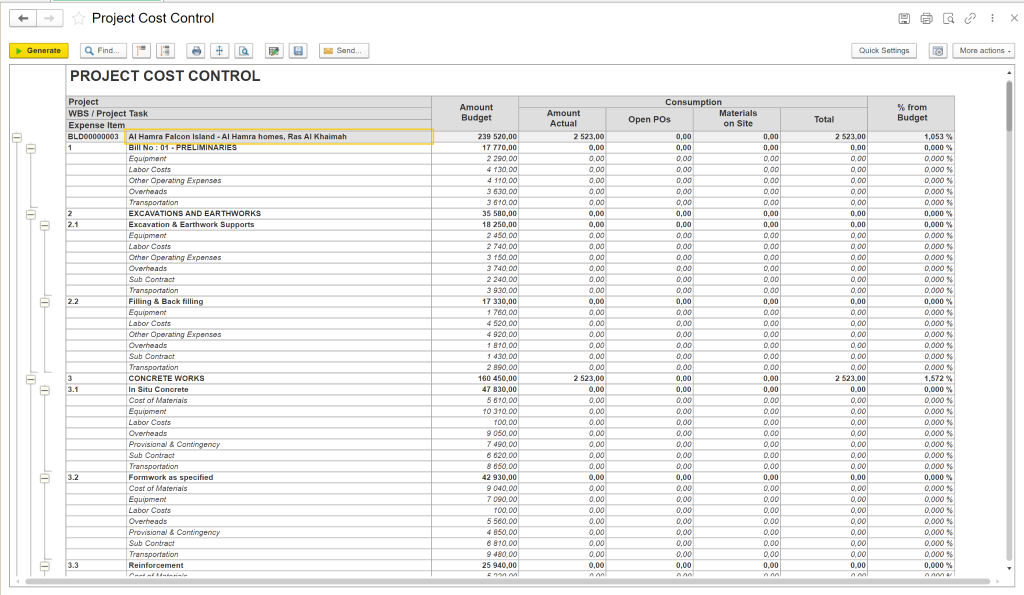
AI-ready project cost data in FirstBit ERP
This helps construction companies reduce manual coordination between departments and get answers faster from the data they already manage in the system. The result is more visibility across projects, fewer delays in reporting, and better support for managers who need to make decisions quickly.
Conclusion
Generative AI in construction, ChatGPT for construction, and AI agents in construction are not replacing foremen, engineers, or project managers. Their real value is in practical support: faster documentation, progress tracking, contract review, procurement drafts, and early risk signals.
For UAE contractors, an AI agent for construction becomes useful when it works inside real project workflows. For example, tools like OpenSpace can analyze site photos and update progress reports, AI can scan contracts for potential variations, and a construction AI assistant can draft supplier requests based on material data. Final decisions still stay with project teams, while AI helps them work faster and spot issues earlier.
Deliver projects on time, every time
Request a demo
F.A.Q.
What are the 5 types of AI agents?
What can AI be used for in construction?
Can ChatGPT do construction takeoffs?
How to use AI in building construction?

Anna Fischer
Construction Content Writer
Share this article
'%3e%3cg%20clip-path='url(%23clip1_6548_6055)'%3e%3cpath%20d='M13.974%2015.6195C14.2724%2016.0185%2014.6532%2016.3487%2015.0905%2016.5876C15.5278%2016.8265%2016.0114%2016.9686%2016.5084%2017.0042C17.0055%2017.0398%2017.5043%2016.9681%2017.9712%2016.7939C18.4381%2016.6198%2018.8621%2016.3472%2019.2143%2015.9948L21.2994%2013.9098C21.9324%2013.2544%2022.2827%2012.3766%2022.2747%2011.4654C22.2668%2010.5543%2021.9014%209.68269%2021.257%209.03839C20.6127%208.39408%2019.7412%208.02862%2018.83%208.0207C17.9189%208.01278%2017.0411%208.36305%2016.3857%208.99606L15.1902%2010.1845M16.754%2014.2295C16.4555%2013.8305%2016.0747%2013.5003%2015.6374%2013.2614C15.2002%2013.0225%2014.7166%2012.8804%2014.2196%2012.8448C13.7225%2012.8092%2013.2237%2012.8809%2012.7568%2013.0551C12.2899%2013.2292%2011.8659%2013.5018%2011.5136%2013.8542L9.42861%2015.9392C8.7956%2016.5946%208.44534%2017.4724%208.45326%2018.3836C8.46117%2019.2947%208.82664%2020.1663%209.47094%2020.8106C10.1152%2021.4549%2010.9868%2021.8204%2011.898%2021.8283C12.8091%2021.8362%2013.6869%2021.4859%2014.3423%2020.8529L15.5308%2019.6645'%20stroke='%235F7896'%20stroke-width='1.39002'%20stroke-linecap='round'%20stroke-linejoin='round'/%3e%3c/g%3e%3c/g%3e%3crect%20x='0.438953'%20y='0.438953'%20width='28.9709'%20height='28.9709'%20rx='14.4855'%20stroke='%235F7896'%20stroke-width='0.877907'/%3e%3cdefs%3e%3cclipPath%20id='clip0_6548_6055'%3e%3crect%20width='29.8488'%20height='29.8488'%20rx='14.9244'%20fill='white'/%3e%3c/clipPath%3e%3cclipPath%20id='clip1_6548_6055'%3e%3crect%20width='16.6802'%20height='16.6802'%20fill='white'%20transform='translate(7.02344%206.58435)'/%3e%3c/clipPath%3e%3c/defs%3e%3c/svg%3e)


Related articles


See all








See FirstBit ERP solutions in action
Discover how our system solves the unique challenges of contractors in a personalized demo.
After the demo you will get a quotation for your company.
After the demo you will get a quotation for your company.