The UAE construction sector is entering a more practical phase of digital transformation in 2026. Contractors are looking for measurable results in cost control, scheduling, and safety. As a result, AI and construction are becoming increasingly connected, with intelligent tools helping project teams solve daily operational challenges across the UAE.
For many contractors in the UAE, the discussion about AI has shifted from experimentation to implementation. However, artificial intelligence in construction still requires realistic planning, skilled teams, and proper integration with existing workflows to deliver long-term value.
This overview examines how AI is realistically shaping the construction industry in the UAE in 2026. It highlights practical applications, current limitations, and opportunities available to contractors.
What Is Artificial Intelligence in Construction
Artificial intelligence in construction refers to the use of smart technologies and machine learning systems to improve how buildings and infrastructure are designed, planned, and managed. AI helps construction companies analyze data, automate tasks, and make faster decisions that improve efficiency and reduce costly mistakes.
According to the research, over the next five years, AI and construction will become increasingly interconnected through autonomous drones, digital twins, and advanced robotics. AI will support smarter buildings, better energy management, and safer job sites. [?]
AI does not replace construction professionals. It supports engineers, project managers, and site teams with faster insights and automation. Combined with technologies like BIM, drones, and digital twins, AI helps UAE contractors deliver smarter, safer, and more efficient projects while meeting growing demands for sustainability and compliance.
Key Technologies in Construction AI in 2026
Construction AI in 2026 is powered by a combination of intelligent technologies that help firms improve safety, reduce delays, and make better project decisions in real time. From predictive analytics to autonomous equipment, AI is transforming how construction sites are planned, monitored, and managed across every phase of a project.
These innovations rely on connected systems that continuously collect and analyze data from cameras, drones, sensors, machinery, and digital models. Machine learning, computer vision, IoT networks, and robotics now work together to create smarter, more efficient jobsites with greater visibility and automation than ever before.
Machine Learning and Predictive Analytics
Machine learning helps construction companies analyze large amounts of project data to improve planning and decision-making. By studying past schedules, labor performance, and material usage, AI systems can predict delays, budget overruns, and safety risks before they happen.
Predictive analytics also improves resource management on construction sites. Contractors can forecast
equipment maintenance, optimize workforce scheduling, and reduce downtime with real-time insights. These tools help teams complete projects faster while controlling costs and minimizing disruptions.
Pro tip: Start small when implementing predictive analytics in construction. Focus first on one key area such as scheduling, cost forecasting, or equipment maintenance. A targeted approach makes adoption easier, improves data quality, and delivers measurable results faster.
Computer Vision and Site Intelligence
Computer vision technology uses cameras, drones, and AI software to monitor construction sites automatically. These systems can track project progress, detect missing materials, and identify safety hazards without constant manual inspections.
Site intelligence platforms provide managers with real-time visual data that improves accuracy and communication. AI-powered image analysis can compare live site conditions with BIM models to ensure work is completed correctly and on schedule. This reduces rework and improves project transparency.
Pro tip: Use drone-based site monitoring weekly to capture progress updates and identify problems before they delay construction activities.
IoT and Connected Construction Sites
IoT devices connect equipment, tools, and workers through sensors that collect live jobsite data. These connected systems monitor temperature, equipment usage, worker location, and environmental conditions to improve safety and efficiency.
Connected construction sites allow project managers to make faster decisions using real-time information. Smart wearables and sensors can send alerts about unsafe conditions, equipment failures, or productivity issues, helping teams respond immediately and avoid costly downtime.
Robotics and Autonomous Equipment
Robotics is transforming construction by automating repetitive and dangerous tasks. Autonomous machines can handle excavation, material transport, bricklaying, and site inspections with greater consistency and speed than manual processes.
Research indicates that robotics improves safety. Autonomous machinery, drones, and robotic arms automate hazardous and repetitive construction activities. These innovations reduce worker exposure to dangerous environments while enabling continuous, high-efficiency operations on construction sites. [?]
Autonomous equipment also helps address labor shortages in the construction industry. AI-powered machines reduce worker fatigue, improve productivity, and allow skilled employees to focus on higher-value tasks that require human expertise and decision-making.
Pro tip: Begin automation with semi-autonomous equipment that supports workers rather than replacing entire workflows immediately.
Make fast, data-driven decisions with real-time dashboards
Request a demo
AI in Construction Industry of the UAE: Why It’s Gaining Popularity
Artificial intelligence in construction is becoming a major force in the UAE as companies look for faster, safer, and more cost-effective ways to complete projects. With the country investing heavily in smart cities, mega infrastructure developments, and sustainable construction, AI-powered technologies are helping firms improve efficiency and reduce delays.
Several factors are driving the popularity of AI in the UAE construction sector:
-
Strong government support for digital transformation and smart infrastructure
-
Rising demand for sustainable and energy-efficient buildings
-
Increased adoption of BIM and digital twin technologies
-
Need to reduce construction waste and project delays
-
Improved site safety through automation and predictive monitoring
As the UAE continues to position itself as a global leader in innovation, adoption of AI in construction is expected to accelerate further. The combination of advanced technologies, government initiatives, and ambitious urban development projects is making AI an essential part of the future of construction in the region.
Practical Applications of AI in Construction for 2026
Construction AI is transforming the entire industry by improving efficiency, increasing safety, reducing costs, and enabling smarter decision-making throughout all project phases. AI technologies are widely adopted by construction companies to automate workflows, optimize resource allocation, and improve project outcomes in real time.
AI in construction is no longer considered an experimental technology. In 2026, it is becoming a core operational tool that helps companies improve productivity, reduce risks, and deliver projects more efficiently. As AI adoption continues to grow, construction firms that integrate intelligent technologies into their workflows will gain a significant competitive advantage.
AI-Driven Project Planning
Construction teams are using AI to analyze schedules, budgets, labor availability, weather conditions, and procurement timelines. Predictive construction AI can identify delays and cost risks before they affect project delivery. It can also help reduce manual planning work and improve project accuracy across large-scale developments.
Key applications include:
However, the effectiveness of AI depends heavily on the quality and accuracy of the data provided. AI systems require reliable, real-time project information to generate accurate forecasts and recommendations.
This data can be sourced directly from the project management module of
FirstBit ERP, ensuring that schedules and project updates are continuously synchronized for better predictive analysis and decision-making.
Smart Site Monitoring and Safety
AI-powered cameras, drones, and sensors are increasingly used to monitor construction sites in real time. Computer vision systems can automatically identify unsafe conditions and alert site managers immediately. Wearable technologies with AI are also being used to track worker fatigue, movement patterns, and environmental risks on-site.
AI in construction safety monitoring can detect:
AI in BIM and Digital Workflows
AI in construction industry is improving Building Information Modeling (BIM) by automating design reviews and enhancing coordination between engineering teams. AI can compare models, identify conflicts, and support faster decision-making. AI-enhanced BIM workflows reduce rework and improve communication between architects, engineers, and contractors.
Practical BIM applications include:
-
Automated clash detection
-
Real-time progress tracking
-
Design optimization
-
Material quantity analysis
-
Digital twin management
Research warns that despite its benefits, AI-BIM integration faces technical and organizational challenges. Among them are interoperability issues between BIM platforms, cybersecurity risks, data privacy concerns, and evolving regulations complicate implementation. Traditional BIM systems also suffer from manual data entry limitations. [?]
Predictive Maintenance for Equipment
Heavy construction machinery now uses sensors and AI analytics to predict failures before breakdowns happen. These systems monitor equipment performance continuously and recommend maintenance at the right time. Predictive maintenance is becoming especially important for large fleets and infrastructure projects operating under tight deadlines.
Benefits of AI in the construction industry for predictive maintenance include:
AI for Construction Inspections
AI-based inspection systems are helping teams perform faster and more accurate quality control checks. Drones and computer vision software compare construction progress against approved plans and identify defects automatically. These technologies also improve project accuracy while reducing manual inspection time.
Common inspection uses of construction AI for inspections include:
-
Crack detection
-
Structural monitoring
-
Surface defect analysis
-
Concrete quality checks
-
Automated reporting
Deliver projects on time, every time
Request a demo
What are Limitations of AI in Construction
Although artificial intelligence in construction offers many benefits to the companies, it also presents several challenges and limitations that can affect implementation, efficiency, and long-term adoption. In 2026, many construction companies still face technical, financial, and operational barriers when integrating AI technologies into their projects and workflows.
Research proves that AI systems are only effective when supported by reliable, structured, and centralized data. Centralized cloud-based project data enables AI tools to generate accurate insights and improve project outcomes throughout the construction lifecycle[?].
Some common limitations of AI in construction include:
-
Dependence on high-quality data. AI technologies rely heavily on accurate and well-organized project data. Poor data quality, incomplete records, or inconsistent reporting can reduce the accuracy and effectiveness of AI-driven decisions and predictions.
-
High implementation costs. AI systems require significant investment in software, hardware, sensors, cloud infrastructure, and employee training. Small and medium-sized construction companies may struggle to afford the upfront costs associated with AI adoption.
-
Limited workforce expertise. Many construction professionals lack the technical knowledge required to operate and manage construction AI effectively. Companies often need additional training programs or specialized staff to support AI integration.
-
Resistance to technological change. Some organizations and workers may resist AI adoption due to concerns about job displacement, workflow disruption, or lack of trust in automated systems. This can slow implementation and reduce operational efficiency.
-
Cybersecurity and data privacy risks. AI systems connected to cloud platforms and digital infrastructure can become targets for cyberattacks. Construction companies must invest in cybersecurity measures to protect sensitive project data and operational systems.
AI in the construction industry comes with important limitations. Companies must address financial, technical, and operational challenges before fully benefiting from AI technologies. Human expertise remains essential. Successful AI adoption requires balance, planning, and continuous improvement.
How FirstBit ERP Collects the Data AI Needs to Generate Construction Insights
AI in the construction industry can generate accurate construction forecasts and project recommendations only when it has access to reliable operational data. FirstBit ERP captures this information at every stage of the construction lifecycle — from tendering and procurement to project execution. This creates a dependable data foundation that AI systems can analyze effectively.
FirstBit ERP continuously gathers real-time updates from construction sites, procurement teams, warehouses, subcontractors, and accounting departments. This constant stream of structured data allows AI-powered analytics to generate more accurate project forecasts, automate reporting, and provide early warnings for budget overruns or scheduling risks.
Key data FirstBit ERP collects for AI in construction:
-
Project estimation and BOQ data for accurate forecasting and cost prediction
-
Real-time project progress updates from construction sites
-
Labor attendance, timesheets, and payroll records for workforce analytics
-
Procurement requests, purchase orders, and supplier performance data
-
Equipment usage, maintenance schedules, and operational costs
-
Financial transactions, invoices, VAT, and accounting records
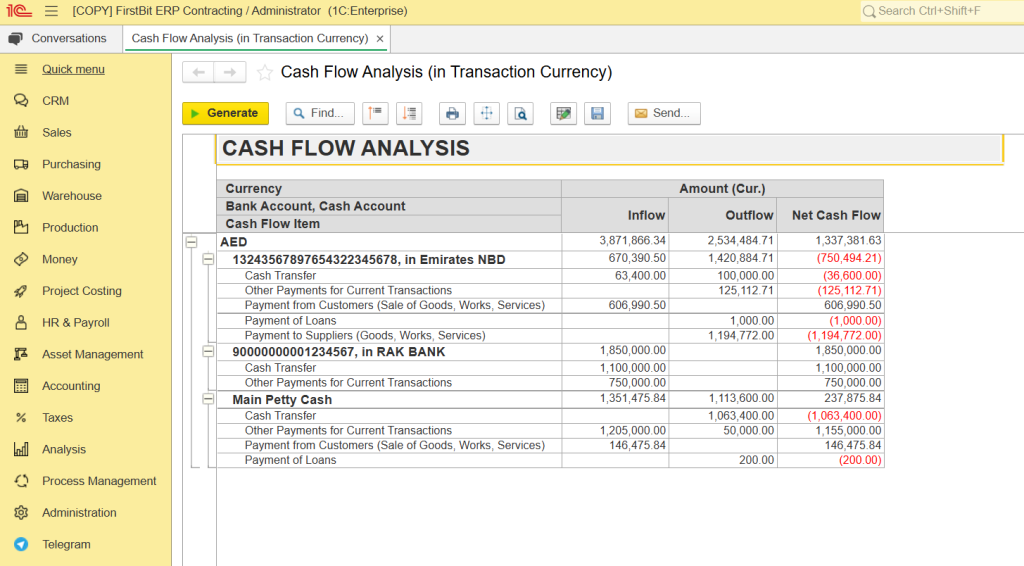
Cash flow analysis in FirstBit ERP provides data for AI-driven forecasting
ERP that saves your money
Adopt FirstBit ERP to cut costs, boost ROI, and effectively plan future cash flows
Request a demo
Conclusion
AI in construction industry is becoming a practical business tool for contractors across the UAE. Companies are increasingly using AI to improve project planning, reduce delays, strengthen cost management, and more. However, to achieve the best results you need to focus on realistic implementation and measurable operational improvements rather than rapid technology adoption alone.
At the same time, AI adoption in construction still comes with challenges. That's why contractors must balance innovation with practical execution to ensure AI solutions support existing project delivery processes instead of creating additional complexity.
As the UAE continues investing heavily in artificial intelligence and smart infrastructure, the construction sector is expected to become increasingly technology-driven over the coming years. Contractors that adopt AI strategically will be better positioned to improve efficiency, competitiveness, and long-term project performance in a rapidly evolving market.
FAQ
How is AI used in construction?
AI in construction industry is presently being used to prepare cost estimates, develop bids and project proposals, compare as-built and as-planned conditions, monitor schedule progress, perform inspections, identify design conflicts, and track material prices, among other things.
Can ChatGPT do construction estimates?
ChatGPT can assist with construction estimates, but it should be used cautiously. It can help produce rough preliminary estimates, especially when you provide detailed drawings and specifications. However, it is not dependable enough to replace a qualified estimator because construction pricing depends on local labor rates, material volatility, site conditions and code requirements.
Artificial intelligence in construction when used for estimation can miss critical details or make inaccurate assumptions. For real projects, AI outputs should always be reviewed and verified by an experienced professional before being used for contracts or bids.
Is AI taking over the construction industry?
AI is transforming the construction industry, but it is not fully “taking over.” Instead, it is automating repetitive tasks like scheduling, cost estimation, safety monitoring, and site inspections.
Industry reports show growing investment in AI and robotics because construction faces labor shortages and efficiency challenges. However, most experts believe human workers will still be essential for skilled trades, supervision, and complex decision-making. In practice, AI in construction industry is acting more as a powerful assistant than a replacement for builders and engineers.
Can AI and construction jobs work together to solve labor shortages and improve productivity?
Yes. AI and construction jobs can work together to address labor shortages while improving productivity. Rather than replacing workers, AI helps companies recruit talent faster, improve training, optimize workforce planning, automate repetitive tasks, and enhance scheduling. This allows skilled workers to focus on higher-value activities, increasing efficiency, safety, and project delivery performance across construction projects.
What challenges do AI and construction companies face when collaborating?
AI and construction companies face several challenges when integrating new technologies into projects. The most common issues include poor data quality, difficulty connecting AI tools with existing systems, high implementation costs, and a shortage of workers with AI-related skills. Construction firms also encounter resistance to change, cybersecurity risks, privacy concerns, and uncertainty about return on investment.
Choose the right technology for your construction business
Request a demo












'%3e%3cg%20clip-path='url(%23clip1_6548_6055)'%3e%3cpath%20d='M13.974%2015.6195C14.2724%2016.0185%2014.6532%2016.3487%2015.0905%2016.5876C15.5278%2016.8265%2016.0114%2016.9686%2016.5084%2017.0042C17.0055%2017.0398%2017.5043%2016.9681%2017.9712%2016.7939C18.4381%2016.6198%2018.8621%2016.3472%2019.2143%2015.9948L21.2994%2013.9098C21.9324%2013.2544%2022.2827%2012.3766%2022.2747%2011.4654C22.2668%2010.5543%2021.9014%209.68269%2021.257%209.03839C20.6127%208.39408%2019.7412%208.02862%2018.83%208.0207C17.9189%208.01278%2017.0411%208.36305%2016.3857%208.99606L15.1902%2010.1845M16.754%2014.2295C16.4555%2013.8305%2016.0747%2013.5003%2015.6374%2013.2614C15.2002%2013.0225%2014.7166%2012.8804%2014.2196%2012.8448C13.7225%2012.8092%2013.2237%2012.8809%2012.7568%2013.0551C12.2899%2013.2292%2011.8659%2013.5018%2011.5136%2013.8542L9.42861%2015.9392C8.7956%2016.5946%208.44534%2017.4724%208.45326%2018.3836C8.46117%2019.2947%208.82664%2020.1663%209.47094%2020.8106C10.1152%2021.4549%2010.9868%2021.8204%2011.898%2021.8283C12.8091%2021.8362%2013.6869%2021.4859%2014.3423%2020.8529L15.5308%2019.6645'%20stroke='%235F7896'%20stroke-width='1.39002'%20stroke-linecap='round'%20stroke-linejoin='round'/%3e%3c/g%3e%3c/g%3e%3crect%20x='0.438953'%20y='0.438953'%20width='28.9709'%20height='28.9709'%20rx='14.4855'%20stroke='%235F7896'%20stroke-width='0.877907'/%3e%3cdefs%3e%3cclipPath%20id='clip0_6548_6055'%3e%3crect%20width='29.8488'%20height='29.8488'%20rx='14.9244'%20fill='white'/%3e%3c/clipPath%3e%3cclipPath%20id='clip1_6548_6055'%3e%3crect%20width='16.6802'%20height='16.6802'%20fill='white'%20transform='translate(7.02344%206.58435)'/%3e%3c/clipPath%3e%3c/defs%3e%3c/svg%3e)