Many UAE contractors still manage project profitability with delayed reports and scattered data. By the time a cost overrun or schedule risk becomes clear, it may already affect margins, cash flow, or delivery dates.
This is why AI in construction management is becoming relevant. It helps turn project data into earlier warnings, clearer forecasts, and faster management decisions.
One cited analysis found that 98% of large construction projects faced cost overruns or delays, with average budget overruns of 32% and schedule extensions of 66%[?].
This article explains how AI can support construction planning, site monitoring, resource allocation, and risk control in the UAE — and why reliable ERP data is essential for practical AI insights.
What Is AI in Construction Management?
AI in construction management is the use of data-driven tools to support project planning, cost control, scheduling, site monitoring, resource allocation, and risk management. Instead of relying only on manual updates, managers can use AI to identify patterns, forecast issues, and make faster decisions.
In practice, AI can analyze data from budgets, BOQs, procurement, labor, equipment, invoices, and site progress reports. This helps contractors understand what is happening across projects and where action is needed.
For UAE construction companies, the main value is better control. AI helps project teams move from reactive problem-solving to earlier, more informed decision-making across the full project lifecycle.
Benefits of AI in Construction Project Management
The main benefit of AI for construction project management is stronger financial visibility. Contractors can compare planned and actual performance earlier, track cost movement across projects, and see which activities are putting margins at risk.
AI also improves schedule and resource control. It can show where labor, equipment, or materials are not aligned with the project plan, helping managers reduce idle time and avoid unnecessary pressure on the budget.
One cited analysis of 1,443 construction projects found that companies using AI-powered project management platforms achieved a 41% reduction in change orders, a 37% improvement in labor productivity, and kept budget variations within 7.3% of initial estimates[?].
For UAE contractors, these benefits matter because profitability depends on more than winning projects. It depends on controlling execution, cash flow, procurement, and resources after the contract is signed.
Keep your project on track
Manage every phase efficiently with ERP tools
Request a demo
How To Use AI for Construction Management?
To use AI for construction management effectively, contractors should start with the areas where delays, cost changes, and resource issues already create measurable pressure. These are usually planning, site monitoring, resource allocation, and risk management.
AI can turn existing project data into practical outputs: updated forecasts, priority alerts, schedule risks, resource gaps, and performance comparisons. This gives managers a clearer view of what needs attention before issues affect delivery or margins.
For UAE construction companies, the strongest results come when AI is connected to daily project control. It should support the way teams plan, track, and adjust work across active projects.
AI in Construction Planning
AI in construction planning helps contractors build more realistic schedules by analyzing project history, dependencies, labor availability, procurement timelines, and site constraints. For UAE projects, this can be especially useful when teams need to plan around material lead times, subcontractor availability, and seasonal productivity risks.
Instead of waiting for delays to appear during execution, AI can highlight weak points in the plan earlier. It can show which activities are likely to slip, where resources may be insufficient, and how schedule changes may affect cost or delivery.
Boost project performance
Request a demo
AI for Construction Site Monitoring
AI for construction site monitoring helps project teams compare actual site progress with the approved plan using data from cameras, drones, sensors, and daily reports. This gives managers clearer visibility into completed work, quality issues, safety risks, and delays across active sites.
For UAE contractors, this is important because site problems often become expensive when they are reported too late. If progress updates, quality checks, or safety observations are delayed, managers lose time to correct the issue before it affects the schedule.
This is why AI monitoring has strong practical value: research across 1,234 construction sites found that AI monitoring solutions reduced quality-related issues by 47.8% and improved schedule adherence by 39.5%.
AI for Resource Allocation
AI for resource allocation helps contractors understand how labor, equipment, materials, and subcontractors are being used across projects. This is especially useful when one site has idle equipment while another is short on machinery, or when labor plans no longer match actual site progress.
For UAE contractors, better resource allocation can directly protect project margins. When managers can see underused or overstretched resources earlier, they can adjust schedules, reduce downtime, and avoid unnecessary cost pressure.
Useful tips for contractors:
Review resource dashboards weekly to spot idle equipment or overloaded teams early
Use AI forecasts to adjust labor schedules before delays affect productivity
Connect project data from multiple sites to improve company-wide resource visibility
Track equipment usage trends to reduce downtime and avoid unnecessary rentals
Keep projects running like clockwork
Schedule tasks in FirstBit
Request a demo
AI in Construction Risk Management
AI in construction risk management helps teams track early signals of cost overruns, schedule slippage, safety issues, procurement delays, and cash flow pressure. These risks often start small, then become expensive when they reach site execution or client reporting.
For UAE contractors, this is useful because project risks are rarely isolated. A delayed material order can affect labor productivity, equipment use, subcontractor sequencing, and payment milestones. AI helps connect these signals earlier, so managers can act before one issue spreads across the project.
How to use AI for construction project management to reduce risks:
Start with one high-impact area, such as procurement tracking or schedule forecasting
Use live project data from ERP, site reports, and procurement systems to improve AI accuracy
Set automated alerts for delays, budget variance, and subcontractor performance
Review AI insights weekly with project and commercial teams to catch issues early
Combine AI recommendations with site-level human judgment before making major decisions
Streamlined billing payment processing. Automate invoicing, subcontractor payments, and financial reporting to improve cash flow and minimize errors.
Why Data from FirstBit ERP Is Critical for AI in Construction Management
AI can only produce useful insights when project data is accurate, structured, and updated. In construction, this data usually sits across budgets, BOQs, procurement, invoices, payroll, equipment records, subcontractor costs, inventory, accounting, and cash flow reports.
FirstBit ERP helps bring this operational data into one system. This gives AI a stronger base for analyzing project performance, detecting cost movement, comparing planned and actual figures, and showing where profitability may be affected.
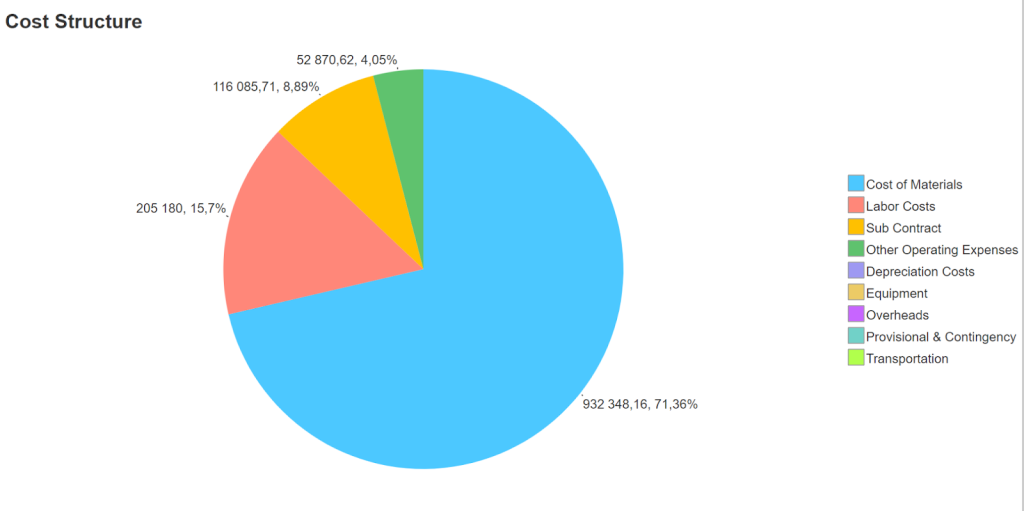
Cost structure data in FirstBit ERP
For UAE contractors, this makes ERP data central to practical AI use. When project, financial, procurement, and site information is connected, AI insights become more relevant for daily management and long-term profitability.
Ensure timely and profitable project completion with FirstBit
Request a demo
Conclusion
AI in construction management matters because profitability is often lost through small delays, weak visibility, and decisions made too late. For UAE contractors, the value of AI is in seeing these risks earlier and linking them to their financial impact.
Planning, site monitoring, resource allocation, and risk management become stronger when AI works with reliable project data. This helps teams understand how today’s changes can affect tomorrow’s schedule, cash flow, and margin.
The real shift is from managing projects by reports after the fact to managing them through connected, data-based insight. With a strong ERP data foundation, UAE contractors can use construction management AI to improve execution, protect profitability, and make project control more predictable.
F.A.Q.
How does AI help improve profitability at the company level?
AI helps contractors see how project-level issues affect company-wide profitability. It can connect cost movement, procurement delays, labor productivity, equipment use, and cash flow into one clearer picture. This gives management earlier visibility into margin risks across active projects, rather than only reviewing losses after reports are closed.
What ERP data is needed to make AI useful in construction management?
AI in construction project management needs structured operational data from across the business. This includes project budgets, BOQs, purchase orders, invoices, inventory, subcontractor costs, labor records, payroll, equipment usage, accounting entries, cash flow, and project profitability reports. The more complete and consistent this data is, the more useful AI insights become.
How does AI handle UAE-specific challenges like summer heat or payment delays?
AI can help contractors plan around UAE-specific risks by connecting site, workforce, schedule, and financial data. For example, it can support productivity planning during extreme heat, show how delayed approvals may affect timelines, or forecast how late payments could pressure cash flow. It does not remove these risks, but it helps managers see their impact earlier.
How does this integrate with our FirstBit ERP system in Dubai?
AI works best when it can use reliable data already stored in FirstBit ERP. Project, procurement, finance, payroll, equipment, and cash flow data can become the foundation for AI-based reporting, forecasting, and risk alerts. For Dubai contractors, this means AI insights can be connected to daily operations instead of sitting separately from core project and financial workflows.
How to choose the right AI tools for construction management?
You can select construction management AI tools by carefully evaluating your project needs, ease of use, integration with existing software, scalability, data security, reporting features, and customer support. Prioritize tools that improve scheduling, budgeting, safety, and collaboration, while providing measurable ROI and encouraging strong user adoption throughout your construction team.
How to use AI as a construction manager?
If you want to use AI for construction project management, leverage it to automate scheduling, track site progress, predict delays, manage budgets, improve safety, and generate reports. AI also helps analyze project data for faster decision-making, better resource planning, and improved team collaboration, allowing construction managers to save time and reduce costly project risks.
Keep your project on track
Manage every phase efficiently with ERP tools
Request a demo
Anna Fischer
Construction Content Writer
Anna has background in IT companies and has written numerous articles on technology topics.












'%3e%3cg%20clip-path='url(%23clip1_6548_6055)'%3e%3cpath%20d='M13.974%2015.6195C14.2724%2016.0185%2014.6532%2016.3487%2015.0905%2016.5876C15.5278%2016.8265%2016.0114%2016.9686%2016.5084%2017.0042C17.0055%2017.0398%2017.5043%2016.9681%2017.9712%2016.7939C18.4381%2016.6198%2018.8621%2016.3472%2019.2143%2015.9948L21.2994%2013.9098C21.9324%2013.2544%2022.2827%2012.3766%2022.2747%2011.4654C22.2668%2010.5543%2021.9014%209.68269%2021.257%209.03839C20.6127%208.39408%2019.7412%208.02862%2018.83%208.0207C17.9189%208.01278%2017.0411%208.36305%2016.3857%208.99606L15.1902%2010.1845M16.754%2014.2295C16.4555%2013.8305%2016.0747%2013.5003%2015.6374%2013.2614C15.2002%2013.0225%2014.7166%2012.8804%2014.2196%2012.8448C13.7225%2012.8092%2013.2237%2012.8809%2012.7568%2013.0551C12.2899%2013.2292%2011.8659%2013.5018%2011.5136%2013.8542L9.42861%2015.9392C8.7956%2016.5946%208.44534%2017.4724%208.45326%2018.3836C8.46117%2019.2947%208.82664%2020.1663%209.47094%2020.8106C10.1152%2021.4549%2010.9868%2021.8204%2011.898%2021.8283C12.8091%2021.8362%2013.6869%2021.4859%2014.3423%2020.8529L15.5308%2019.6645'%20stroke='%235F7896'%20stroke-width='1.39002'%20stroke-linecap='round'%20stroke-linejoin='round'/%3e%3c/g%3e%3c/g%3e%3crect%20x='0.438953'%20y='0.438953'%20width='28.9709'%20height='28.9709'%20rx='14.4855'%20stroke='%235F7896'%20stroke-width='0.877907'/%3e%3cdefs%3e%3cclipPath%20id='clip0_6548_6055'%3e%3crect%20width='29.8488'%20height='29.8488'%20rx='14.9244'%20fill='white'/%3e%3c/clipPath%3e%3cclipPath%20id='clip1_6548_6055'%3e%3crect%20width='16.6802'%20height='16.6802'%20fill='white'%20transform='translate(7.02344%206.58435)'/%3e%3c/clipPath%3e%3c/defs%3e%3c/svg%3e)