





Why Construction Accountants Make Mistakes — and How ERP Fixes Them
Publication date 22 Jun 2026 •
Updated 21 Jul 2026 •
12 min read

Anna Fischer
Construction Content Writer


In UAE construction companies, accounting errors are often identified during month-end close, but their root causes usually occur much earlier in the project cycle. Invoices, purchase orders, payroll data, material issues, subcontractor certificates, equipment costs and site approvals are captured across different departments, site teams, systems and spreadsheets. As a result, construction accountants often need to reconcile versions, verify cost codes and manually reconstruct the financial position of each project.
This is the type of process gap that the construction ERP is designed to address. By connecting accounting, procurement, project management, inventory, payroll and reporting in one workflow, ERP helps link financial data to the correct project before it reaches the ledger. In this article we explain where construction accounting errors usually begin, why they often become visible only during month-end close, and how construction ERP helps reduce these risks before they reach the ledger.
How does ERP Reduce Errors in Construction Accounting?
Scattered spreadsheets and manual approvals create gaps in construction accounting. When cost data, purchase requests, invoices, payroll, VAT details and approvals are handled in separate files or disconnected workflows, the project record becomes fragmented. In some cases, these gaps affect not only reporting accuracy but also cash flow, budget control and project profitability.
Construction ERP is designed to bring these processes into a controlled structure. It connects project accounting, procurement, site approvals, inventory, payroll and reporting so that each transaction is tied to the correct project, BOQ or WBS line and cost code.
Most construction accounting errors occur when the same transaction passes through several teams and systems. For example, one site requisition may move through the following stages:
- Purchase order
- Delivery note
- Supplier invoice
- Approval
- Ledger posting
If each stage uses a different file, naming rule or approval path, finance may face duplicate invoices, incorrect cost allocation, missing commitments or VAT errors.
ERP changes this flow by keeping these steps connected:
- Purchases are checked against the approved budget
- Invoices are matched with purchase orders and receipts
- Labor costs are allocated from timesheets
- Required fields are reviewed before reporting
This creates a clearer accounting trail from the first site request to the final ledger entry.
Which Construction Accounting Mistakes are Most Common?
The most common construction accounting mistakes are not always simple data-entry errors. In many cases, they are the result of incomplete, late or incorrectly classified project data. These mistakes can affect margin, cash flow, WIP, reporting and project profitability.
Common construction accounting mistakes include:
- Wrong project allocation or incorrect cost codes
- Missing committed costs from open purchase orders
- Unapproved purchases outside budget control
- Late subcontractor invoices and payment certificates
- Inconsistent timesheets for labor and payroll
- Inventory write-offs without a clear project allocation trail
- VAT, FTA or e-invoicing gaps in invoice data
These errors affect the numbers behind project decisions. Wrong allocation distorts project margin, missing commitments hide future cash needs, late subcontractor invoices weaken month-end close, and poor inventory or timesheet control makes job costing less reliable.
Prevent cost overruns
Register expenses in FirstBit ERP
Request a demo
How can Construction Finance Teams Close Monthly Accounts Faster with Project-wise Cost Data?
Finance teams can close monthly accounts faster when project-wise cost data is classified before month-end close begins. Each cost has a clear project, BOQ or WBS line, cost code and approval status. This reduces late reconciliation and gives accountants a clearer base for accruals, WIP, project P&L and management reporting.
A slow close usually means finance is still verifying project data after the period ends, including:
- Open purchase orders
- Certified subcontractor work
- Warehouse receipts
- Equipment usage
- Labor hours
- Invoices waiting for approval
ERP moves much of this verification into daily operations. Costs are recorded with project details at the point of purchase, receipt, timesheet or approval. By month end, accountants can focus on exceptions, missing approvals and unusual variances instead of clarifying the basic allocation of each cost.

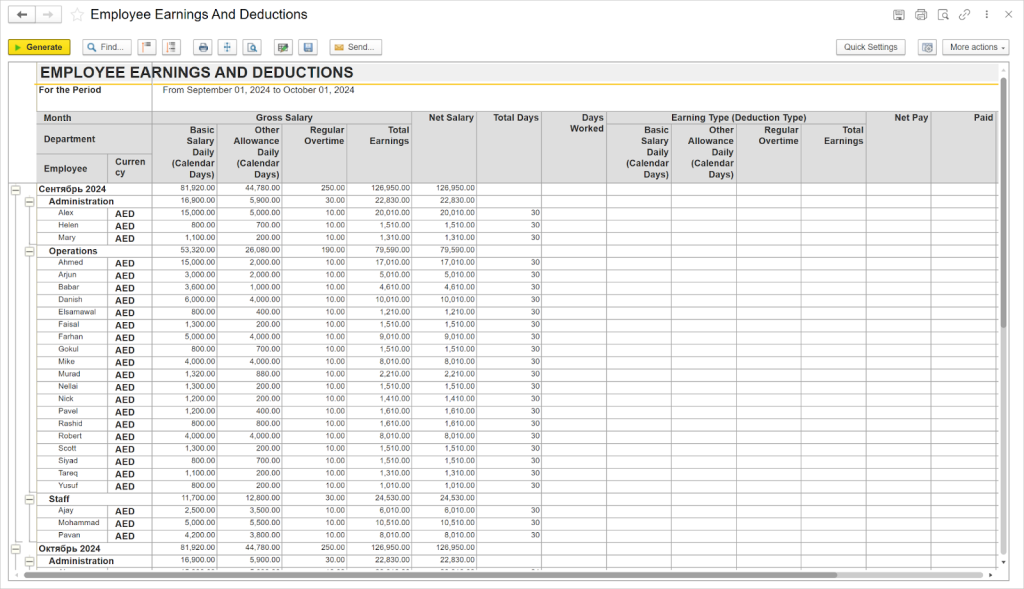
Employee Earnings and Deductions report in FirstBit ERP showing salary, allowances, overtime, days worked
Employee Earnings and Deductions in FirstBit ERP helps finance teams review salary, allowances, overtime, days worked, and net pay before payroll amounts are allocated to projects. Use this report to reduce the risk of incorrect labor allocation, missing overtime costs, or late payroll adjustments during month-end close.
For construction companies, this is important because labor costs often move between site teams, HR, payroll, and accounting. When payroll data is checked before posting, accountants can reduce the risk of incorrect labor allocation, missing overtime costs, or late payroll adjustments during month-end close.
How can ERP Track Actual vs Budgeted Costs on a UAE Construction Project?
ERP tracks actual vs budgeted costs by using the approved project budget as the baseline. For each BOQ or WBS line, the system shows how planned costs compare with real project spending.
A typical ERP cost view includes:
| Cost area | What ERP shows |
| Approved budget | The planned cost for each BOQ or WBS line |
| Committed costs | Purchase orders, subcontractor agreements, approved variations, and other commitments |
| Actual costs | Invoices, timesheets, warehouse issues, equipment usage, and subcontractor payment certificates |
| Forecast cost | The expected final cost based on current project data |
| Variance | The difference between the budget and current or forecasted cost |
| Margin impact | How the variance may affect project profitability |
For UAE construction projects, this control is especially important because costs may include subcontractor payment certificates, retention, advance payments, variations, imported materials, equipment usage, and multi-currency purchases. ERP keeps these costs connected to the right project, cost code, and AED budget baseline.
In 2026, this visibility becomes even more important as construction material prices in the UAE continue to rise, putting extra pressure on project budgets and margins. The system can also support UAE finance controls by keeping VAT details, supplier invoice data, tax invoice references, and e-invoicing-ready fields linked to the same project cost record where relevant.
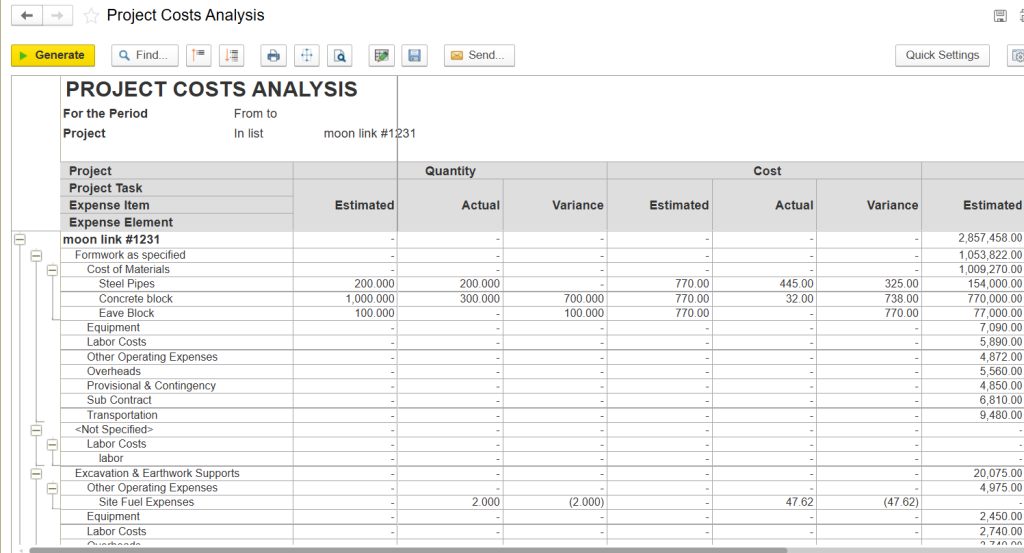
Project Costs Analysis in FirstBit ERP shows estimated costs, actual costs, and variances
Project Costs Analysis in FirstBit ERP shows estimated costs, actual costs, and variances by project task, expense item, and expense element. Use this report to compare estimated and actual quantities and costs for each project cost category. Review the variance column to find materials, labor, equipment, or subcontractor costs that are moving above the approved estimate.
For UAE contractors, this view is useful when material prices change during the project. Project teams can check cost pressure early, update forecasts, and take action before the variance affects the final project margin.
Automate all financial operations within one ERP software
Request a demo
What Should be Centralized Before Accounting Becomes Reliable?
Reliable construction accounting needs one controlled project record. This record should bring together the data that affects cost, cash flow, approvals, and reporting. Without it, project managers, procurement teams, and finance teams may work with different versions of the same project numbers.
The key data to centralize includes:
- Project budget
- BOQ/WBS structure
- Cost codes
- Purchase orders
- Warehouse movements
- Subcontractor certificates
- Labor hours
- Equipment usage
- Supplier invoices
- Approval status
- Cash flow forecasts
- Reports
These records describe the same project from different angles. For example, procurement records the purchase order, the warehouse confirms receipt, the site records material use, and finance sees the cost when the invoice arrives.
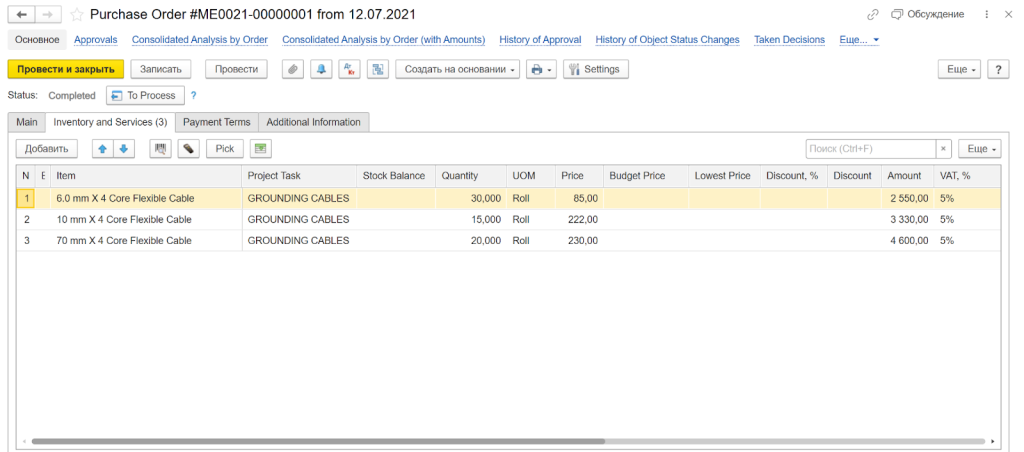
A purchase order in FirstBit ERP links materials, quantities, prices, VAT, and project tasks
ERP connects these statuses from request to payment. This helps accountants trace who requested a cost, who approved it, which purchase order it relates to, and how it affects budget control.
A purchase order in FirstBit ERP links materials, quantities, prices, VAT, and project tasks before the cost reaches accounting. Use this view to check the project task, item quantity, price, amount, and VAT rate before approval. This helps procurement and finance confirm that the cost is linked to the correct project record before it becomes an invoice or ledger entry.
How Does FirstBit ERP Help UAE Contractors Improve Accounting Accuracy?
FirstBit ERP helps UAE construction and contracting companies connect accounting, project management, cost control, procurement, inventory, payroll, reporting, and UAE finance requirements in one workflow.
The system helps teams standardize project data, reduce manual work, and improve visibility across finance and operations. It does not remove every accounting risk automatically, but it gives accountants, CFOs, project managers, and procurement teams a clearer view of the same project numbers.
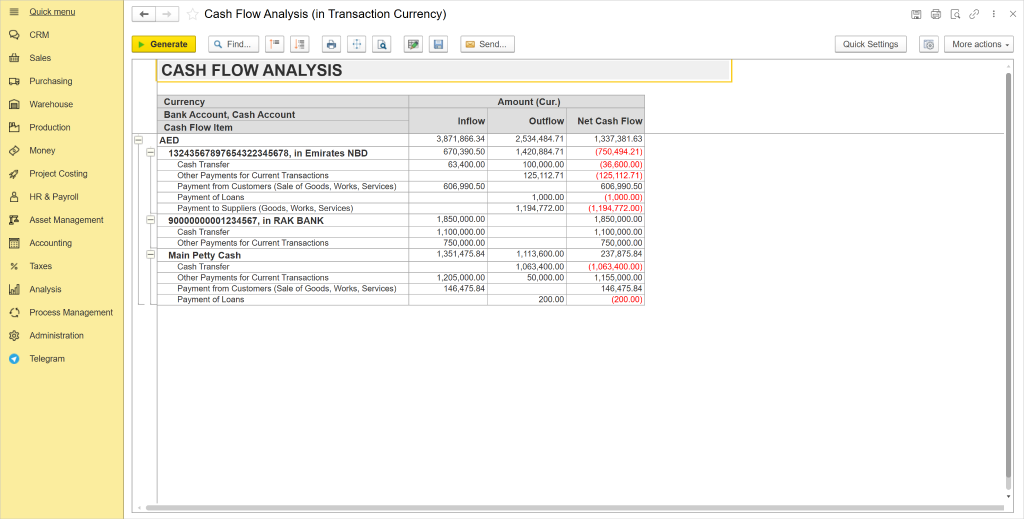
Cash Flow Analysis report in FirstBit ERP showing inflow, outflow, and net cash flow
Cash Flow Analysis in FirstBit ERP helps finance teams review inflows, outflows, and net cash flow by account and cash flow item. Use this report to check whether supplier payments, customer receipts, loan payments, or project-related cash movements may affect liquidity before management reporting.
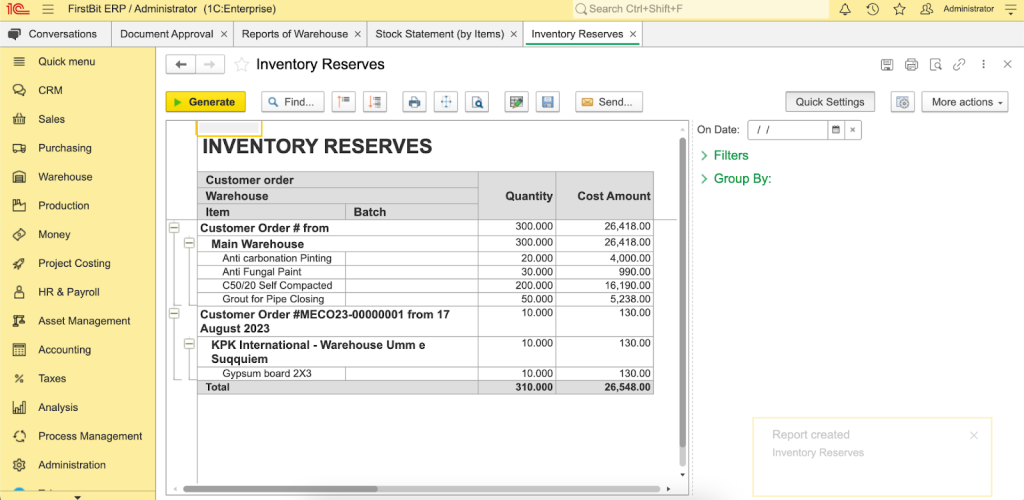
Inventory Reserves in FirstBit ERP show reserved materials, quantities, and cost amounts
Request a demo to see how reserved materials, quantities, and costs can be reviewed before they are issued to a project, invoiced, or included in cost reports. This helps teams understand the expected inventory cost impact before material movements are posted to accounting.
Protect your profit margins
Use FirstBit ERP to compare planned vs. actual costs
Request a demo
Accounting Accuracy Starts Before Data Reaches Finance
Construction accounting errors rarely begin in the accounting department. More often, they start earlier, when project costs, approvals, material movements, labor hours, subcontractor certificates or invoices are recorded late, classified incorrectly or kept outside a shared system.
For UAE contractors, improving accounting accuracy means improving the quality of project data before it reaches finance. When site teams, procurement, warehouse, HR, equipment managers and subcontractors work in connected ERP workflows, finance teams have a clearer basis for cost control, VAT and FTA reporting, WIP, project P&L and month-end close.
Construction ERP helps create this structure by linking daily project transactions to budgets, BOQ or WBS lines, cost codes and approval trails. FirstBit ERP supports this process with ERP tools for accounting, project cost control, procurement, reporting and project management, helping contractors reduce avoidable errors and make project financial data easier to control.
FAQ
How can ERP reduce accounting errors in construction businesses?
How can construction finance teams close monthly accounts faster with project-wise cost data?
How can an ERP system help me track actual vs budgeted costs on a construction project in the UAE?
What should I check when evaluating the best construction ERP for my business?
Manage your cash flow with confidence
Request a demo

Anna Fischer
Construction Content Writer
Share this article
'%3e%3cg%20clip-path='url(%23clip1_6548_6055)'%3e%3cpath%20d='M13.974%2015.6195C14.2724%2016.0185%2014.6532%2016.3487%2015.0905%2016.5876C15.5278%2016.8265%2016.0114%2016.9686%2016.5084%2017.0042C17.0055%2017.0398%2017.5043%2016.9681%2017.9712%2016.7939C18.4381%2016.6198%2018.8621%2016.3472%2019.2143%2015.9948L21.2994%2013.9098C21.9324%2013.2544%2022.2827%2012.3766%2022.2747%2011.4654C22.2668%2010.5543%2021.9014%209.68269%2021.257%209.03839C20.6127%208.39408%2019.7412%208.02862%2018.83%208.0207C17.9189%208.01278%2017.0411%208.36305%2016.3857%208.99606L15.1902%2010.1845M16.754%2014.2295C16.4555%2013.8305%2016.0747%2013.5003%2015.6374%2013.2614C15.2002%2013.0225%2014.7166%2012.8804%2014.2196%2012.8448C13.7225%2012.8092%2013.2237%2012.8809%2012.7568%2013.0551C12.2899%2013.2292%2011.8659%2013.5018%2011.5136%2013.8542L9.42861%2015.9392C8.7956%2016.5946%208.44534%2017.4724%208.45326%2018.3836C8.46117%2019.2947%208.82664%2020.1663%209.47094%2020.8106C10.1152%2021.4549%2010.9868%2021.8204%2011.898%2021.8283C12.8091%2021.8362%2013.6869%2021.4859%2014.3423%2020.8529L15.5308%2019.6645'%20stroke='%235F7896'%20stroke-width='1.39002'%20stroke-linecap='round'%20stroke-linejoin='round'/%3e%3c/g%3e%3c/g%3e%3crect%20x='0.438953'%20y='0.438953'%20width='28.9709'%20height='28.9709'%20rx='14.4855'%20stroke='%235F7896'%20stroke-width='0.877907'/%3e%3cdefs%3e%3cclipPath%20id='clip0_6548_6055'%3e%3crect%20width='29.8488'%20height='29.8488'%20rx='14.9244'%20fill='white'/%3e%3c/clipPath%3e%3cclipPath%20id='clip1_6548_6055'%3e%3crect%20width='16.6802'%20height='16.6802'%20fill='white'%20transform='translate(7.02344%206.58435)'/%3e%3c/clipPath%3e%3c/defs%3e%3c/svg%3e)


Related articles


See all








See FirstBit ERP solutions in action
Discover how our system solves the unique challenges of contractors in a personalized demo.
After the demo you will get a quotation for your company.
After the demo you will get a quotation for your company.