A snag list is one of the most important quality control tools in construction. It helps contractors identify defects, unfinished work, and compliance issues before project handover, ensuring the final result meets client expectations and contractual standards. In the UAE’s fast-paced construction sector, a well-managed snag list can prevent delays, disputes, and costly rework.
Rather than waiting until the end of a project to discover problems, contractors use snagging inspections to detect issues early and efficiently track corrective actions. A detailed snag report creates clear accountability among project teams, subcontractors, and clients, making it easier to verify that every item has been resolved before project completion.
If you're looking for the snag list meaning or want to understand how snagging works in practice, this guide covers everything — from examples of snag lists to proven snagging best practices. You'll also learn about the unique aspects of snagging inspections in the UAE, helping you achieve smoother handovers, better quality control, and greater client satisfaction.
Snag List Meaning in Construction: How Is Snag Different from a Defect?
A snag list or snagging list is a document used during the final stages of a construction project to record items that require correction before handover. Also known as a punch list in some regions, it typically includes unfinished work, installation issues, cosmetic imperfections, and quality concerns that do not meet the project specifications.
A snag is not always the same as a defect. Although the terms are often used interchangeably, there are key differences between a construction snag and a construction defect, including their severity, impact, and typical resolution process.
|
Aspect
|
Snag
|
Defect
|
|
Definition
|
A minor issue, omission, or finishing flaw identified during the final inspection process.
|
A broader construction problem that affects quality, performance, compliance, or safety.
|
|
Severity
|
Usually cosmetic or non-critical.
|
Can range from minor to major, including serious structural or functional issues.
|
|
Examples
|
Paint blemishes, scratched surfaces, misaligned fixtures, incomplete fittings.
|
Water ingress, faulty electrical systems, structural cracks, inadequate insulation.
|
|
Impact on building performance
|
Typically does not affect the building's core function or safety.
|
May compromise usability, durability, safety, or regulatory compliance.
|
|
When identified
|
Usually during pre-handover inspections and snagging reviews.
|
Can be identified during construction, handover, or the defects liability period.
|
|
Resolution
|
Generally quick and straightforward to rectify.
|
May require extensive investigation, repair work, or specialist intervention.
|
While all snags require correction before project completion, defects are generally more significant issues that can affect a building's performance, safety, or long-term durability. Knowing the difference between the two helps project teams prioritize repairs, manage quality standards, and gain a clearer understanding of the true meaning of snag in construction.
Snagging Meaning in Construction
Snagging in construction is the process of inspecting a completed building or project to identify issues that need to be corrected before final handover. It serves as a quality-control measure, helping contractors and clients ensure that all work meets the required standards. The process typically takes place near project completion and results in a documented list of items requiring attention
[?].
During a snagging inspection, professionals look for unfinished work, poor workmanship, installation errors, and cosmetic imperfections. Common examples include cracked tiles, paint defects, leaking fixtures, misaligned doors, or missing fittings. Once identified, these issues are recorded and assigned for rectification before the project is officially signed off and handed over.
Research found that mobile technologies can transform traditional snagging processes. Smartphones can replace paper-based procedures by capturing defects digitally, recording locations automatically, attaching photographs, and synchronizing information with centralized databases[?].
Common Types of Snags
During a snagging inspection, a variety of defects and unfinished items may be identified. These issues can range from minor cosmetic imperfections to more significant functional problems that require immediate attention.
Identifying and addressing these snags before project handover helps ensure quality, safety, and compliance with project specifications. Early correction reduces future maintenance issues and improves client satisfaction.
Pro tip: Take clear photos of every snag and record its exact location. Well-documented issues are easier to track and resolve. Construction ERP software can help site teams to upload photos directly from the job site through a mobile app and instantly share them with office staff, helping ensure nothing is missed before handover.
Common types of snags you’ll need to add to a snag list include:
-
Cosmetic defects. Scratched surfaces, chipped paint, uneven finishes, and damaged fixtures.
-
Poor workmanship. Misaligned doors, uneven tiling, gaps in sealant, and incorrectly fitted components.
-
Plumbing issues. Leaking pipes, faulty taps, poor drainage, and inadequate water pressure.
-
Electrical faults. Non-functioning outlets, faulty switches, damaged light fittings, and wiring defects.
-
Structural concerns. Minor wall cracks, uneven floors, loose roof tiles, and signs of settlement.
-
Incomplete work. Missing fixtures, unfinished installations, absent fittings, and outstanding construction tasks.
-
Insulation and ventilation problems. Inadequate insulation, poor airflow, and improperly installed ventilation systems.
-
Window and door defects. Poorly fitted frames, damaged glazing, faulty locks, and draught issues.
Use a checklist to cover all important areas and thoroughly complete your snagging list.
You can check out one of the following examples:
Keep your project on track
Manage every phase efficiently with ERP tools
Request a demo
UAE & Dubai Snagging Inspection: Buyer Protection & Liability Period
In the UAE, the snagging process begins once a project has received the necessary approvals from the relevant authorities, including Civil Defense and the local municipality. After the Building Completion Certificate is issued, the developer notifies the buyer that the property is ready for handover.
Before accepting the property, the buyer conducts a snagging inspection to identify defects, unfinished works, or items that do not meet the agreed specifications. The findings are documented in a snag list and submitted to the developer, who is responsible for carrying out the necessary rectifications. Once the corrective works have been completed, a re-inspection may be conducted.
Snagging Inspection and Handover Process in Dubai
This process helps ensure that developers deliver properties in accordance with approved plans, contractual specifications, and applicable construction standards.
Snagging inspection and handover process in Dubai:
- Dubai Civil Defense (DCD) approves fire and life-safety systems and issues the required clearances for the completed building.
- The relevant authority issues the Building Completion Certificate, confirming that the project meets regulatory requirements.
- The developer issues a Completion Notice to the buyer, confirming that the property is ready for handover.
- The buyer conducts a snagging inspection to identify defects and unfinished work before accepting the property.
- The developer rectifies the reported defects and completes any outstanding items.
- A re-inspection is carried out to verify that all defects have been resolved.
- The property is handed over, and ownership registration proceeds through the Dubai Land Department (DLD).
- The title deed is issued by DLD, officially confirming ownership.
If defects are not rectified, the buyer may escalate the matter through:
-
The developer's formal complaint process
-
The Real Estate Regulatory Agency (RERA)
-
DLD dispute resolution channels
-
The Dubai Courts as a final legal remedy
Developer Liability Under Dubai Law
-
10 years for structural defects affecting the stability or safety of the building.
-
1 year for mechanical, electrical, plumbing, and other installation-related defects.
These protections apply from the date of the building completion certificate and cannot be reduced through contractual agreements.
How to Snag a Building: A Step-by-Step Snagging Process
A successful snagging inspection requires a systematic approach to identify defects, incomplete work, and quality issues before project handover. Following a structured process helps ensure that no areas are overlooked:
- Prepare for the inspection. Gather project drawings, specifications, checklists, and any relevant handover documents before starting the inspection.
- Inspect the exterior first. Examine roofs, walls, windows, doors, drainage systems, pathways, and landscaping for visible defects or unfinished work.
- Conduct a room-by-room walkthrough. Check each internal space carefully, including walls, ceilings, floors, fixtures, fittings, and finishes.
- Test building systems. Verify that electrical outlets, lighting, plumbing fixtures, heating, ventilation, and other installed systems operate correctly.
- Document all defects. Record each issue with a clear description, precise location, and photographic evidence in a snag list to support corrective actions.
- Assign responsibility. Identify the contractor, subcontractor, or supplier responsible for resolving each issue and establish completion deadlines.
- Track progress and repairs. Monitor the status of all snag items and maintain an up-to-date snag list throughout the rectification process.
- Reinspect and verify completion. Revisit corrected items to confirm that repairs have been completed to the required standard before signing them off.
A thorough snagging process improves construction quality and reduces the risk of disputes after handover. It helps ensure that all defects are resolved before project completion. This results in a smoother and more successful handover.
Ensure timely and profitable project completion with FirstBit ERP
Request a demo
What Is Included in a Construction Snag List or Snag Report?
A construction snag list or snag report serves as a central record that helps contractors,
project managers, and clients track outstanding items and ensure they are resolved before the project is signed off.
A well-prepared snag report provides clear information about each issue, who is responsible for fixing it, and when the corrective work should be completed. This improves accountability and helps maintain construction quality standards. Below you’ll find the essential information that should be included in a snagging list to streamline issue resolution.
Project Information
Every snag report starts with essential project details. This information ensures that all stakeholders can quickly identify the project, inspection date, and specific areas being reviewed. Accurate project information creates a clear audit trail and helps teams manage multiple inspections efficiently.
Typical project information in the snag list includes:
-
Project name and reference number
-
Site address or building location
-
Inspection date and time
-
Inspector's name and contact details
-
Contractor and subcontractor information
-
Building, floor, unit, or room identification
-
Project stage or handover status
Pro tip: Use consistent project naming and reference numbers across all inspection reports to make records easier to track throughout the project lifecycle.
Specific Line-Item Details
The most important part of a snag report is the individual defect record. Each issue should be documented clearly so that the responsible party can locate and correct it without additional clarification. Detailed line-item information helps construction teams prioritize repairs, monitor progress, and ensure that no defects are overlooked.
A comprehensive snag list typically includes the following information about the issue:
-
Issue reference number. A unique identifier that allows each defect to be tracked throughout the remediation process.
-
Exact location. The building area, floor, room, or asset where the issue was identified.
-
Detailed defect description. A clear explanation of the problem, including the nature and extent of the defect.
-
Photographic evidence. Supporting images that visually document the issue and provide proof of its condition.
-
Priority or severity level. A classification that helps teams determine which defects require immediate attention.
-
Responsible trade or contractor. The individual, subcontractor, or team assigned to complete the corrective work.
-
Status and completion deadline. The current progress of the item, target resolution date, and verification of completion.
Pro tip: The more specific the description and location of a defect, the more quickly and accurately it can be repaired.
Common Areas Inspected
Construction snagging inspections typically cover all major building components and systems. The goal is to identify any defects, omissions, or workmanship issues before occupancy or final handover.
Commonly inspected areas include:
-
Interior walls, ceilings, and decorative finishes
-
Doors, windows, and hardware
-
Flooring, tiling, and surface finishes
-
Kitchens, bathrooms, and installed fixtures
-
Electrical systems, outlets, and lighting
-
Plumbing systems, drainage, and pipework
-
Exterior facades, roofs, and common areas
Inspectors may also review mechanical, electrical, and plumbing (MEP) systems, safety installations, and shared building spaces to verify compliance with project specifications and quality standards.
Pro tip: Follow a consistent inspection route to ensure no areas or systems are accidentally missed, and all are included in the snag list. Don't focus only on visible finishes — check the functionality of building systems as well.
Examples of Snag Lists
We reviewed three examples of snagging reports. These examples represent different property types, including a detached house, a semi-detached house, and an apartment, and illustrate how snagging issues can vary from minor cosmetic defects to more significant workmanship, waterproofing, drainage, and compliance concerns.
The comparison highlights that not every snag list is the same. Some reports primarily identify decoration and finishing issues that are relatively straightforward to rectify, while others reveal deficiencies in construction quality that may require more extensive remedial work.
|
Property type
|
Main snag types
|
Workmanship
|
Severity
|
Links
|
|
New-build 2-bed apartment/flat with balcony
|
Cosmetic defects, flooring damage, shrinkage cracks, paint marks, sealant, scratches, cleaning issues
|
Generally good with poor finishing in places
|
2–3/10
|
Click the link
|
|
New-build 3-bed semi-detached house
|
Finishing defects, paintwork, doors, windows, flooring transitions, drainage details, external paving, minor compliance items
|
Average to below average
|
4/10
|
Click the link
|
|
New-build luxury 3-bed detached house with multiple ensuites and balconies
|
Waterproofing, roof drainage, damp, stormwater management, balcony detailing, gas compliance, plus cosmetic defects
|
Poor
|
7–8/10
|
Click the link
|
Keep projects running like clockwork
Schedule tasks in FirstBit ERP
Request a demo
Snagging Checklist
This checklist serves as a practical guide for construction teams, site engineers, and quality inspectors during the pre-handover stage. It identifies the key building elements that should be reviewed to detect defects, incomplete works, and installation issues before the property is delivered to the client.
Any deficiencies identified during the inspection should be recorded on a snag list. By systematically reviewing each category and addressing all items, project teams can improve quality control, reduce post-handover disputes, and ensure the property meets the required standards and specifications.
|
Category
|
What to check
|
|
Walls & ceilings
|
Surface cracks, paint quality, signs of moisture, uneven finishes, and overall workmanship.
|
|
Floor finishes
|
Proper installation of tiles or flooring, consistent levels, damaged surfaces, and quality of joints and grouting.
|
|
Doors & glazing
|
Smooth operation of doors and windows, secure locking systems, frame positioning, and glass condition.
|
|
Bathrooms
|
Waterproofing, drainage performance, sanitary fixture installation, water flow, and finishing quality.
|
|
Water systems
|
Adequate water pressure, leak-free pipework, drainage efficiency, and correct hot and cold water supply.
|
|
Electrical installations
|
Performance of switches and outlets, lighting functionality, distribution boards, and electrical safety measures.
|
|
Air conditioning & ventilation
|
Cooling effectiveness, airflow distribution, thermostat accuracy, unusual sounds, and signs of condensation.
|
How FirstBit ERP Helps Contractors Manage Snag Reports & Snag Work
Managing snag lists and snag work efficiently is essential for delivering construction projects on time and meeting quality standards.
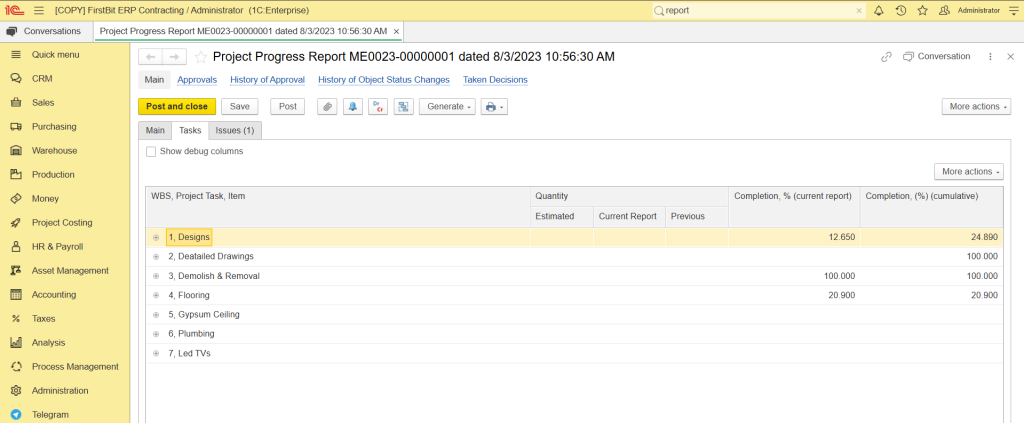
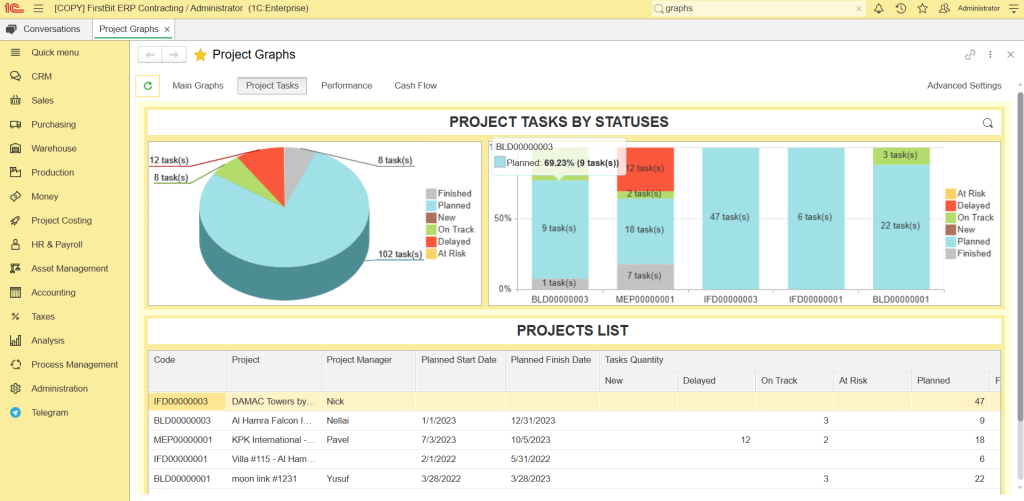
FirstBit ERP helps contractors record, track, and resolve snag items through a centralized project management system. It gives teams real-time visibility into project issues and corrective actions.
Contractors can create detailed reports, assign tasks to responsible team members, and monitor progress from a single platform. Site engineers can also attach photos and updates directly from the field, ensuring accurate documentation and faster issue resolution.
Benefits of using FirstBit ERP for snag list management:
-
Attach site photos and supporting documents to reports
-
Store all snag reports in a centralized cloud-based ERP system
-
Monitor progress and task completion status in real time
Tasks & project progress in FirstBit ERP Contracting
-
Assign snag work to responsible teams or subcontractors
-
Maintain full visibility of project costs due to the corrective work
-
Manage multiple projects and their reports from one dashboard
Project tasks by statuses in FirstBit ERP Contracting
By digitizing snag reporting and follow-up processes, FirstBit ERP helps contractors improve quality control, close issues faster, and deliver projects with greater efficiency and client satisfaction.
Stay ahead of delays
Request a demo
Conclusion
Effective snag reports are essential for delivering construction projects that meet quality expectations, contractual requirements, and client standards. By identifying and resolving issues before handover, contractors can reduce costly rework, improve project efficiency, and maintain stronger relationships with stakeholders throughout the construction process.
Understanding snag list meaning allows UAE contractors to implement more structured quality control procedures and ensure greater transparency across project teams. Consistent inspections and accurate reporting help create accountability, making it easier to track progress and verify that corrective actions have been completed.
As construction projects become increasingly complex, a proactive approach to creation of each snag list supports smoother handovers and higher client satisfaction. Integrating snagging into daily project workflows helps contractors maintain quality standards, protect project timelines, and strengthen their reputation in the competitive UAE construction industry.
FAQ
What does snag mean in construction?
The meaning of snag in construction is any minor defect, unfinished item, or deviation from specifications found during the final walkthrough — such as a leaking tap, misaligned door, or missing fixture. Snags are not structural issues but must be corrected before project closeout.
What is the purpose of a snag list?
A snag list documents all minor defects, omissions, or incomplete work items identified during the final inspection of a construction project. Its purpose is to ensure the contractor rectifies these issues before formal handover, protecting the owner’s interests and ensuring compliance with contractual and regulatory standards.
What is snagging in Dubai real estate?
In Dubai real estate, snagging is the mandatory final inspection process before property handover, where buyers or their representatives identify finishing defects (e.g., paint flaws, tile gaps, electrical faults). The developer must resolve all snags listed to meet RERA and Dubai Municipality requirements before issuing the completion certificate.
What is a snag in construction terms?
In construction, a “snag” refers to any minor defect, unfinished item, or deviation from specifications found during the final walkthrough — such as a leaking tap, misaligned door, or missing fixture. Snags are not structural issues but must be corrected before project closeout.
To snag a building, conduct a systematic room-by-room inspection before handover, documenting all defects with photos and clear descriptions. Use a standardized snag list template, categorize items by trade (e.g., electrical, plumbing, finishes), and submit the report to the contractor. Track rectification progress through follow-up inspections — ideally using digital tools integrated with your project management system for efficient workflow control.
How do I close out a punch list properly on a construction project?
Closing out a punch list — called a “snag list” in the UAE and UK — means documenting every outstanding item with its location and photo evidence, assigning each to the responsible trade with a completion deadline, and re-inspecting each item before signing it off; nothing should be marked closed without verification. Using a digital system to track status keeps the final handful of stubborn items visible instead of getting lost as the project winds down.
Keep your project on track
Manage every phase efficiently with ERP tools
Request a demo












'%3e%3cg%20clip-path='url(%23clip1_6548_6055)'%3e%3cpath%20d='M13.974%2015.6195C14.2724%2016.0185%2014.6532%2016.3487%2015.0905%2016.5876C15.5278%2016.8265%2016.0114%2016.9686%2016.5084%2017.0042C17.0055%2017.0398%2017.5043%2016.9681%2017.9712%2016.7939C18.4381%2016.6198%2018.8621%2016.3472%2019.2143%2015.9948L21.2994%2013.9098C21.9324%2013.2544%2022.2827%2012.3766%2022.2747%2011.4654C22.2668%2010.5543%2021.9014%209.68269%2021.257%209.03839C20.6127%208.39408%2019.7412%208.02862%2018.83%208.0207C17.9189%208.01278%2017.0411%208.36305%2016.3857%208.99606L15.1902%2010.1845M16.754%2014.2295C16.4555%2013.8305%2016.0747%2013.5003%2015.6374%2013.2614C15.2002%2013.0225%2014.7166%2012.8804%2014.2196%2012.8448C13.7225%2012.8092%2013.2237%2012.8809%2012.7568%2013.0551C12.2899%2013.2292%2011.8659%2013.5018%2011.5136%2013.8542L9.42861%2015.9392C8.7956%2016.5946%208.44534%2017.4724%208.45326%2018.3836C8.46117%2019.2947%208.82664%2020.1663%209.47094%2020.8106C10.1152%2021.4549%2010.9868%2021.8204%2011.898%2021.8283C12.8091%2021.8362%2013.6869%2021.4859%2014.3423%2020.8529L15.5308%2019.6645'%20stroke='%235F7896'%20stroke-width='1.39002'%20stroke-linecap='round'%20stroke-linejoin='round'/%3e%3c/g%3e%3c/g%3e%3crect%20x='0.438953'%20y='0.438953'%20width='28.9709'%20height='28.9709'%20rx='14.4855'%20stroke='%235F7896'%20stroke-width='0.877907'/%3e%3cdefs%3e%3cclipPath%20id='clip0_6548_6055'%3e%3crect%20width='29.8488'%20height='29.8488'%20rx='14.9244'%20fill='white'/%3e%3c/clipPath%3e%3cclipPath%20id='clip1_6548_6055'%3e%3crect%20width='16.6802'%20height='16.6802'%20fill='white'%20transform='translate(7.02344%206.58435)'/%3e%3c/clipPath%3e%3c/defs%3e%3c/svg%3e)