Construction delays rarely start as one large failure. More often, they begin as a planning gap and then move through the job as a domino effect: one missed assumption delays one activity, which pushes the next trade, the next delivery, and the next decision with it.
In fact, AGC’s 2025 workforce survey found that 78% of firms had at least one delayed project in the previous year, and 34% reported delays tied to approvals and inspections [?] .
Construction planning has become critical in today’s unstable operating environment. Whether preparing a small residential building construction plan or a large commercial development schedule, the same core principles apply. In this article, we explain how to build a construction plan, manage it during execution, and control the risks along the way.
What Is Construction Planning?
To answer the question, what is construction planning, it is the foundational process of defining how a construction project will be executed, in what sequence, with what resources, and within what timeframe. It establishes the strategic framework that guides every phase of a project from early design coordination to final delivery.
At the core of the construction plan is the construction schedule, a document that outlines all project activities, their durations, dependencies, required resources, and expected milestones. Once construction begins, this schedule becomes a living document, continuously updated to reflect real-world conditions such as weather, supply chain delays, site constraints, and labor availability.
Key Components of Construction Planning
Effective construction planning relies on several essential scheduling concepts:
Project milestones. Important checkpoints marking major stages of progress.
Duration. Estimated time needed to complete each task.
Dependencies. Logical relationships define which tasks must precede or follow others.
Lead time. The time when one activity begins ahead of another.
Lag time. Required waiting periods, such as curing or drying times.
Float (Slack). With extra time, a task can be delayed without affecting the project’s overall completion date.
Resource allocation. Assigning labor, materials, equipment, and other assets to each activity.
Baseline schedule. The approved schedule is used as the benchmark for tracking progress.
Construction planners typically start by breaking the project down into manageable activities. They estimate how long each activity will take, identify their dependencies, and sequence them in the most efficient order. They also consider lead and lag times to allow for realistic overlap and buffers where needed.
Achieve peak productivity on site
Manage teams, equipment, and materials in FirstBit
Request a demo
Who Is Involved in Construction Planning?
Construction planning is a collaborative, multidisciplinary effort involving:
Construction schedulers develop and maintain schedules, ensuring accurate sequencing and realistic durations.
Project managers oversee the entire process, aligning scheduling with project objectives.
Site supervisors provide insights from the field so that the schedule matches on-site realities.
Architects and designers ensure that the planned sequence supports the design intent.
Engineers address structural and technical requirements within the schedule.
Subcontractors provide trade-specific timelines and constraints.
Clients and owners review and approve the plan to ensure it aligns with their expectations.
The level of involvement varies by project size. Smaller residential projects may rely solely on a project manager, while large commercial developments typically require experienced schedulers and broader technical teams.
Core Principles of Construction Planning and Scheduling
Strong construction planning starts with a few core principles. These principles form the foundation for the detailed planning process. A reliable schedule depends on clear scope, sound task logic, visibility of the critical path, and active risk management.
1. Comprehensive Scope Definition
A schedule cannot be reliable if the project scope is vague. The team needs a shared understanding of what will be delivered, what is outside the project, and how completed work will be accepted.
A Work Breakdown Structure (WBS) helps convert that scope into manageable parts. It breaks the project into a hierarchy of deliverables and work packages, which makes the schedule easier to build and control. The
100% rule means that each lower level must fully cover the work of the level above it. WBS elements should also be mutually exclusive, so work is not counted twice and responsibilities do not overlap.
2. Logical Sequencing and Dependencies
Once the scope is defined, activities need to be arranged in the order that work can actually happen on site. This requires identifying dependencies between tasks, such as finish-to-start or start-to-start relationships. These links show whether one activity must finish before another begins or whether activities can proceed in parallel.
This logic is usually shown in a schedule network diagram. Methods such as the Precedence Diagram Method (PDM) are used to map activity relationships and build a realistic sequence. A clear network makes the workflow easier to review, test, and explain before execution begins.
3. Critical Path Awareness
Every construction schedule should identify
the critical path. The critical path is the longest chain of dependent activities in the schedule network. It determines the shortest possible project duration. If a critical activity is delayed, the project completion date will also move unless time is recovered on that same path.
Critical path awareness helps the team focus on the activities that have the greatest effect on project duration. It also supports faster decision-making when delays occur, because schedule compression efforts need to target the work that controls the finish date.
4. Risk Identification and Mitigation
A construction plan should reflect real project uncertainty, not just the intended sequence of work. Schedule risks can come from bad weather, supply delays, labor shortages, permit issues, utility conflicts, or late design information. These factors can affect productivity, float, and milestone dates.
Risk management should be built into the planning process from the start. The team needs to identify key risks, assess their likely impact, define mitigation actions, and prepare contingencies where needed. Continuous risk monitoring improves schedule reliability and gives the project team more time to respond before an issue turns into a major delay.
Stay ahead of delays
Request a demo
Step-by-Step Guide to Construction Planning and Scheduling
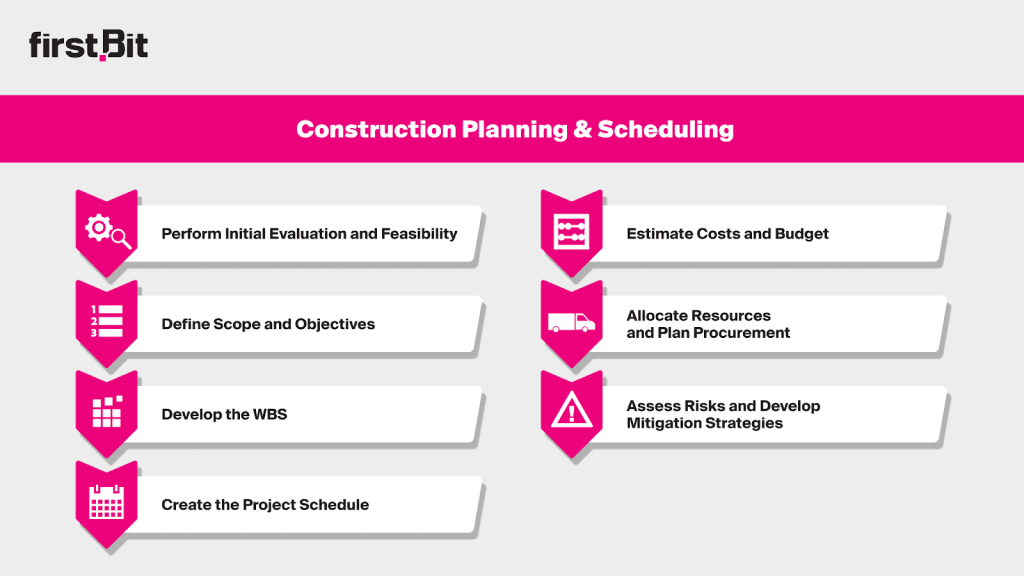
Construction planning converts project requirements into a defined sequence of work, with time and cost assigned to each step.
Construction Planning and Scheduling
Step 1 — Perform Initial Evaluation and Feasibility
Early evaluation determines whether the project is feasible before detailed planning begins. It addresses the following:
This step matters because weak early assumptions lead to rework. If site access, approvals, or external dependencies are not defined early, the project may require scope, schedule, or procurement changes during execution. Early feasibility review is, therefore, a core part of construction planning and
management.
What to do
Set up a feasibility register before detailed planning begins. For each item, record the issue, its impact on scope, schedule, or cost, the person responsible, and the action or decision required to close it.
Step 2 — Define Scope and Objectives
Scope definition establishes what the project must deliver. It identifies the deliverables, exclusions, acceptance criteria, and the project targets for time, cost, and performance.
It also aligns the assumptions used by the owner, designer, contractor, and key trades. If those assumptions differ, the schedule may look complete while still missing required work, interfaces, or approval steps.
What to do
Write a one-page scope statement. List the deliverables, define the exclusions, state the acceptance criteria, and record the planning assumptions approved by the key decision-makers.
Step 3 — Develop the Work Breakdown Structure (WBS)
The WBS provides the structure for a detailed construction plan by breaking the full scope into manageable parts. In a building construction plan, it typically aligns with structural systems, architectural components, MEP works, and site development. For construction project planning and scheduling, it must cover all approved work and use a structure that can be carried through execution.
In practice, the WBS can be organized in several ways, depending on project needs:
Some teams also connect it to responsibility assignments so ownership is clear. The key is to keep the structure consistent across the estimate, schedule, reporting, and control processes.
A defined WBS also improves cost planning by supporting more complete estimates and time-phased budgeting.
What to do
Develop the WBS to the work-package level. Check it against the full project scope, and use the same WBS codes in the estimate, schedule, and progress reporting.
Step 4 — Create the Project Schedule
Once the WBS is in place, the team can develop the project schedule. This step defines the activities, durations, dependencies, and milestones that will control the work. In construction planning and scheduling, those elements determine whether the schedule can be used for execution, reporting, and control.
The sequence should reflect how the work will actually be built in the field. It needs to account for:
Long-lead materials and equipment, permits, utility relocations, and approvals should be built into the schedule logic rather than tracked separately.
AGC’s 2025 workforce survey reinforces that point: 35% of firms reported project delays tied to electrical-equipment lead times, and 34% reported delays tied to governmental actions such as approvals, inspections, and utility-related issues[?].
The scheduling method should match the job. CPM is the standard approach for identifying the longest path and showing which delays affect the completion date. PERT may be useful when activity durations are less certain and need a wider planning range.
What to do
Convert each work package into activities. Assign realistic durations and dependencies, include procurement and approval tasks, set major milestones, and baseline the schedule only after field and management review.
Step 5 — Estimate Costs and Budget
Once the schedule is defined, the cost estimate should be tied to it. A reliable estimate depends on a clear technical baseline, defined scope, schedule, WBS, assumptions, and estimating method. That is what allows the team to build a cost baseline that reflects both total cost and the timing of the work.
For construction projects, the estimate often combines:
When cost data is aligned with the schedule, the team can build a time-phased budget and produce a more accurate cash flow forecast.
This step also makes the construction plan more useful during the delivery process. It shows what work is coming next and when labor demand, material commitments, and project spending will increase.
What to do
Prepare the estimate from the WBS, document the assumptions and pricing sources, and spread the approved costs across the schedule to create a time-phased cost baseline.
Step 6 — Allocate Resources and Plan Procurement
A schedule is workable only when labor, equipment, and materials are aligned with actual activity dates. In construction planning and scheduling, resource planning needs to account for:
Crew availability
Equipment access
Workface congestion
Material lead times
Procurement planning also needs to be built in early, especially for long-lead items and for packages that must be bid, reviewed, approved, fabricated, and delivered before installation begins. In construction planning and management, this is where the schedule starts to operate as a real construction plan rather than a sequencing document.
What to do
Create a resource and procurement matrix for the major activities. For each one, record the required crew, equipment, material, procurement lead time, approval points, and needed-on-site date.
Step 7 — Assess Risks and Develop Mitigation Strategies
Risk review starts before construction and continues after the baseline is approved. In construction planning and management, the team needs to identify risks tied to scope gaps, design maturity, procurement, schedule assumptions, external approvals, and site conditions, then assign response actions and track them over time.
For contractors, the question is direct: which events could delay the work, increase cost, or prevent access to the next activity? Typical risks include:
Bad weather
Labor shortages
Late submittal approvals
Supply delays
Utility conflicts
Regulatory hold points
A usable risk response assigns an owner, defines the trigger for action, and shows the required mitigation or contingency in the schedule or budget.
What to do
Create a risk register that records probability, impact, owner, mitigation action, contingency allowance, and review date. Link the major risk responses to the live schedule and budget. This structured approach turns the construction plan into a practical action plan for construction project delivery.
Managing the Plan During Execution
Once construction starts, the construction plan moves into project control. The team uses schedule updates, look-ahead planning, and formal change procedures to keep execution aligned with the approved scope, schedule, and cost baselines.
Monitoring Progress and Updating Plans
Progress monitoring compares actual performance to the baseline and keeps the schedule current by capturing actual starts, actual finishes, percent complete, and variance against planned dates. This quickly shows whether the project is still on track for key milestones and the final completion date.
Regular variance analysis should flag delays and negative trends early and link them to measurable downstream impacts. If an activity like a concrete pour slips, the update must show the effect on successor tasks, inspections, site access, procurement deadlines, and labor loading—so the team can make informed corrective decisions, not just record delay.
Pro tip
Update the live schedule on a fixed cycle. Record actual starts, actual finishes, and percent complete, compare them with the baseline, explain major variances, and assign follow-up actions for any activity affecting key milestones or the critical path.
Look-Ahead and Short-Term Planning
The baseline schedule isn’t detailed enough for day-to-day control, so look-ahead planning converts it into near-term, field-executable work. A rolling look-ahead plan typically covers the next three to six weeks and highlights what’s coming up and whether it can realistically start.
It confirms that constraints are cleared and that labor, materials, equipment, permits, and handoffs will be ready before each activity begins, while weekly work planning filters tasks to only those truly ready to start and finish. At this level, the team should be able to answer:
Pro tip
Maintain a rolling look-ahead plan for the next three to six weeks. Review constraints every week, confirm labor, materials, equipment, permits, and handoffs before assigning work, and issue a weekly work plan that includes only ready tasks.
Change and Risk Management
Construction execution naturally brings changes from design evolution, owner decisions, site conditions, procurement issues, and risk events. Each change should follow a formal process that records what changed, why it changed, and the impact on time, cost, and scope—so the plan stays measurable and controlled.
Uncontrolled changes weaken the baseline and distort schedule performance, so updates should only happen through the approved change workflow with impacts logged in the same control system. Risk events should be handled the same way: when a risk triggers, the schedule, budget, and mitigation actions are updated together as one process. Every significant change must answer:
Pro tip
Record every significant change through the formal change process. Document the scope effect, time impact, cost impact, approval, and required schedule update, then link the change to the active risk, cost, and schedule controls.
Keep your project on track
Manage every phase efficiently with ERP tools
Request a demo
How FirstBit ERP Transforms Construction Planning and Management
In construction, planning often breaks down because scope, schedule, procurement, costs, and site updates are managed in different places. That slows decisions and makes control harder. An ERP helps by connecting these processes in one system.
For construction planning and management,
FirstBit ERP supports the workflow in three practical ways:
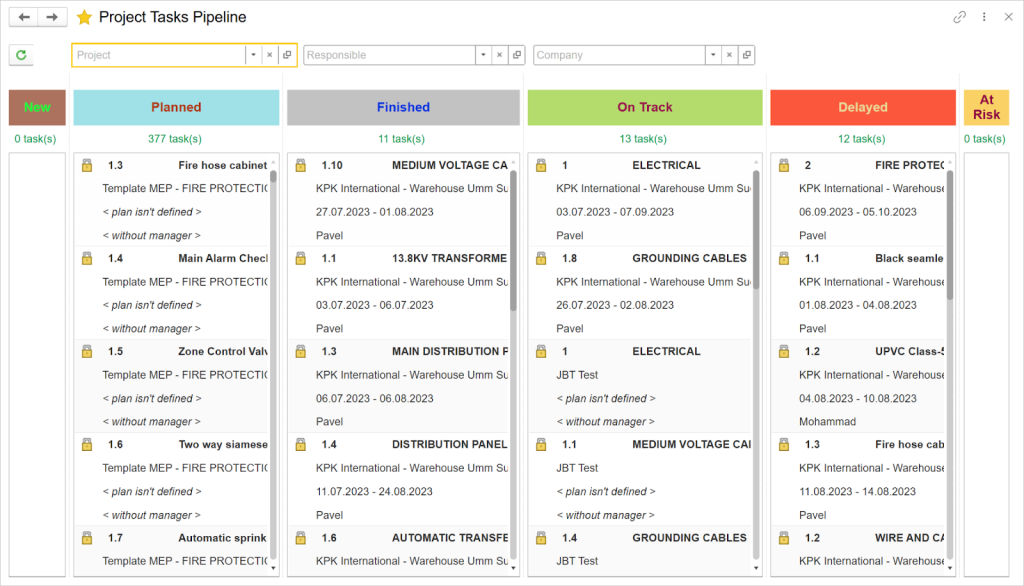
First, it helps keep project data in one place, so teams can track tasks, milestones, budgets, procurement, and progress without relying on disconnected files.
Task Planning & Status Board in FirstBit ERP
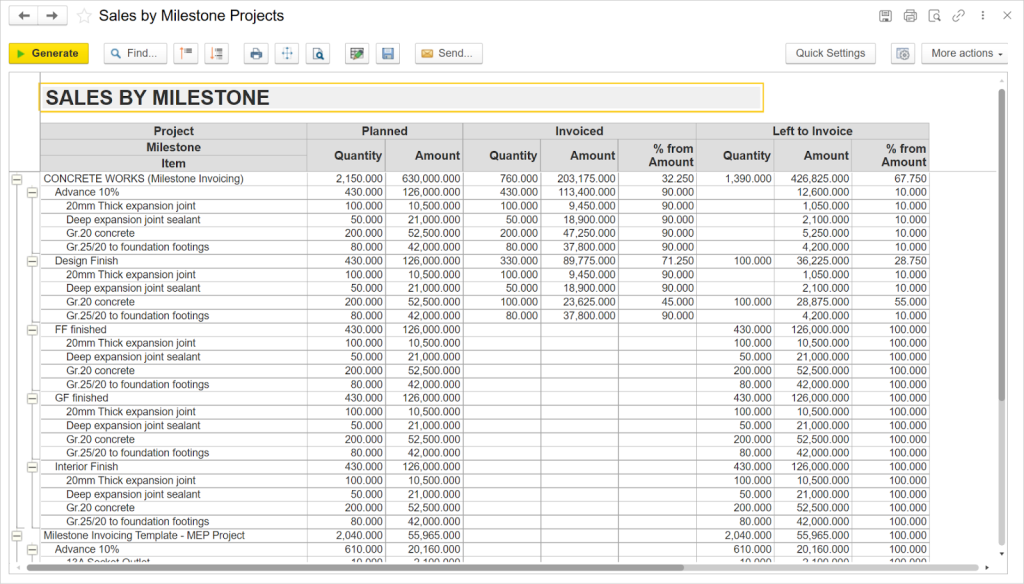
Second, it improves control by linking schedule-related activity with cost, resource, and purchasing data.
Sales by Milestone report in FirstBit ERP
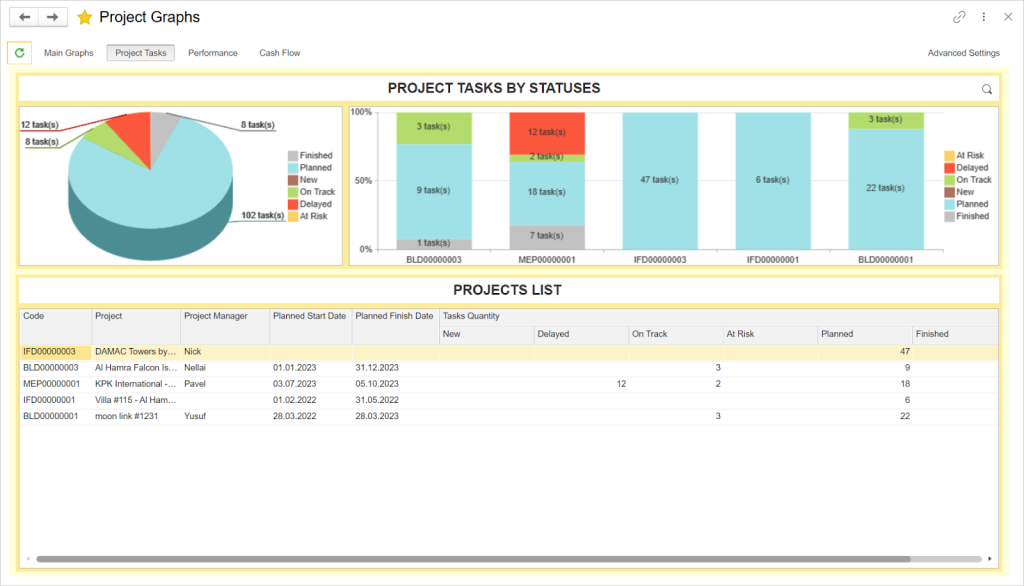
Third, it supports execution through dashboards, approvals, field reporting, and clearer visibility across office and site teams.
Project Execution Dashboard in FirstBit ERP
ERP helps teams apply construction planning and management principles more consistently. In that sense,
FirstBit ERP supports construction planning and scheduling by making the construction plan easier to track, update, and manage during execution.
Conclusion
Effective construction planning is crucial for staying on schedule and within budget. It requires constant monitoring and the flexibility to adjust the plan as conditions change. Identifying risks early and implementing mitigation strategies helps prevent delays and minimizes the impact of unforeseen challenges.
Collaboration among all stakeholders is essential to ensure smooth execution. Project managers, designers, and subcontractors must work together to allocate resources efficiently and address potential issues promptly. This coordinated effort improves decision-making and keeps the project on track.
Boost project performance
Request a demo
F.A.Q.
What is construction planning in simple terms?
Construction planning is creating a practical roadmap for the project—what work will be done, in what order, with which people and materials, so the job finishes on time, within budget, and to the required quality.
What are the main steps in the construction planning process?
It starts by defining the scope from drawings and specs, then breaking the work into tasks (WBS), sequencing them, and building a schedule. After that, resources and procurement are planned, risks and constraints are checked, and the plan is monitored and updated as the project progresses.
What Key Performance Indicators (KPIs) are used to measure AWP success?
AWP is tracked through readiness and reliability KPIs (constraint-free work packages ready, constraint closure time, lookahead plan reliability) and outcome KPIs (productivity vs plan, SPI, CPI, rework rate, and safety incident rate).
Anna Fischer
Construction Content Writer
Anna has background in IT companies and has written numerous articles on technology topics.












'%3e%3cg%20clip-path='url(%23clip1_6548_6055)'%3e%3cpath%20d='M13.974%2015.6195C14.2724%2016.0185%2014.6532%2016.3487%2015.0905%2016.5876C15.5278%2016.8265%2016.0114%2016.9686%2016.5084%2017.0042C17.0055%2017.0398%2017.5043%2016.9681%2017.9712%2016.7939C18.4381%2016.6198%2018.8621%2016.3472%2019.2143%2015.9948L21.2994%2013.9098C21.9324%2013.2544%2022.2827%2012.3766%2022.2747%2011.4654C22.2668%2010.5543%2021.9014%209.68269%2021.257%209.03839C20.6127%208.39408%2019.7412%208.02862%2018.83%208.0207C17.9189%208.01278%2017.0411%208.36305%2016.3857%208.99606L15.1902%2010.1845M16.754%2014.2295C16.4555%2013.8305%2016.0747%2013.5003%2015.6374%2013.2614C15.2002%2013.0225%2014.7166%2012.8804%2014.2196%2012.8448C13.7225%2012.8092%2013.2237%2012.8809%2012.7568%2013.0551C12.2899%2013.2292%2011.8659%2013.5018%2011.5136%2013.8542L9.42861%2015.9392C8.7956%2016.5946%208.44534%2017.4724%208.45326%2018.3836C8.46117%2019.2947%208.82664%2020.1663%209.47094%2020.8106C10.1152%2021.4549%2010.9868%2021.8204%2011.898%2021.8283C12.8091%2021.8362%2013.6869%2021.4859%2014.3423%2020.8529L15.5308%2019.6645'%20stroke='%235F7896'%20stroke-width='1.39002'%20stroke-linecap='round'%20stroke-linejoin='round'/%3e%3c/g%3e%3c/g%3e%3crect%20x='0.438953'%20y='0.438953'%20width='28.9709'%20height='28.9709'%20rx='14.4855'%20stroke='%235F7896'%20stroke-width='0.877907'/%3e%3cdefs%3e%3cclipPath%20id='clip0_6548_6055'%3e%3crect%20width='29.8488'%20height='29.8488'%20rx='14.9244'%20fill='white'/%3e%3c/clipPath%3e%3cclipPath%20id='clip1_6548_6055'%3e%3crect%20width='16.6802'%20height='16.6802'%20fill='white'%20transform='translate(7.02344%206.58435)'/%3e%3c/clipPath%3e%3c/defs%3e%3c/svg%3e)