





AI for Construction Management: Control Beyond the Project Level
Publication date 04 May 2026 •
Updated 20 Aug 2026 •
8 min read

Anna Fischer
Construction Content Writer


Many UAE contractors still manage project profitability with delayed reports and scattered data. By the time a cost overrun or schedule risk becomes clear, it may already affect margins, cash flow, or delivery dates.
This is why artificial intelligence in construction management is becoming relevant. It helps turn project data into earlier warnings, clearer forecasts, and faster management decisions.
One cited analysis found that 98% of large construction projects faced cost overruns or delays, with average budget overruns of 32% and schedule extensions of 66%[?].
This article explains how AI in construction management supports planning, site monitoring, resource allocation, and risk control in the UAE — and why reliable ERP data is essential for practical AI insights.
Why Construction Management Needs AI
Managing a construction business in the UAE means overseeing more than one project. You’re balancing multiple teams, budgets, schedules, resources, and client expectations at the same time. Artificial intelligence in construction management gives leaders a broader view of how the entire business is performing.
The challenge is that project data is often scattered across different systems and teams. While one project may look profitable, overruns or delays across several jobs can quickly affect company-wide margins. Without a complete picture, it becomes difficult to spot risks early and make informed decisions.
AI for construction management brings project data together to identify cost risks, resource issues, and performance trends across the business. AI-powered insights help leaders see where profitability is being lost, prioritize the right actions, and make better company-level decisions instead of simply adjusting individual project schedules.
AI in construction management addresses broader challenges — such as portfolio-level resource allocation, cash flow forecasting, margin protection, and strategic risk control — while AI in construction project management focuses on scheduling and task tracking.
AI for Strategic Construction Management
To use AI for construction management effectively, contractors should start with the areas where delays, design changes, cost changes, and resource issues already create measurable pressure. These are usually planning, site monitoring, resource allocation, and risk management.
AI is a valuable tool that turns existing project data into practical outputs: updated forecasts, priority alerts, schedule risks, resource gaps, and performance comparisons. This gives managers a clearer view of what needs attention before issues affect delivery or margins.
For UAE construction companies, the strongest results come when AI is integrated with real-time, accurate data. This approach enables technology to better support the way teams plan, track, and adjust work across active projects.
Keep your project on track
Manage every phase efficiently with ERP tools
Request a demo
AI in Construction Planning
AI in construction planning can help construction firms plan how people, equipment, materials, and capital are allocated across multiple projects. It analyzes historical performance, current workloads, future projects, procurement requirements, and resource capacity. As a result, AI can give management a clearer view of what the business will need in the months ahead.
For UAE construction companies, this can support decisions across the project portfolio. AI is transforming project portfolio management by identifying where demand may overlap, where shortages are likely to emerge, and where resources can be reassigned to improve utilization and operational efficiency.
This allows construction companies to move from reactive project-by-project planning toward more coordinated, company-wide planning. AI in construction planning helps leadership anticipate capacity constraints, prioritize resources, and make better decisions about which projects the business is equipped to deliver.
AI for Resource Allocation
Another practical application of AI is resource allocation that helps contractors understand how labor, equipment, materials, and subcontractors are being used across projects. This is especially useful when one site has idle equipment while another is short on machinery, or when labor plans no longer match actual progress at the building site.
For UAE contractors, better resource allocation can directly protect project margins. When managers can see underused or overstretched resources earlier, they can adjust schedules, reduce downtime, and avoid unnecessary cost pressure.
Useful tips for contractors:
- Review resource dashboards weekly to spot idle equipment or overloaded teams early
- Use AI forecasts to adjust labor schedules before delays affect productivity
- Connect project data from multiple sites to improve company-wide resource visibility
- Track equipment usage trends to reduce downtime and avoid unnecessary rentals
Boost project performance
Request a demo
AI in Construction Risk Management
Construction management AI helps contractors identify early signs of cost overruns, schedule slippage, procurement delays, cash flow pressure, subcontractor underperformance, and contract-related risks. These issues often start small but can quickly affect margins, working capital, and overall business performance if they are not identified early.
For UAE contractors, these risks are closely connected. A delayed material order, for example, can disrupt schedules, increase labor and equipment costs, and delay payment milestones. AI can integrate data across projects and departments to identify patterns earlier, providing management with a clearer view of potential business risks.
How to use AI for construction management to reduce business risks:
- Start with a high-impact area such as procurement risk, cost forecasting, or cash flow management.
- Use live data from ERP, project management, accounting, and procurement systems to improve AI accuracy.
- Set automated alerts for schedule delays, budget variances, payment delays, and subcontractor performance.
- Track material prices, task completion, supplier performance, and long-lead procurement to identify potential cost and delivery risks.
- Use AI to forecast cash flow requirements and identify projects that may create liquidity pressure.
- Review AI insights weekly with project, commercial, procurement, and finance teams to identify risks early.
Financial Visibility and Profitability Control with AI
Strong profitability control requires financial visibility and confidence in the accuracy of the data used to manage the construction business. AI can strengthen the financial management process by reducing manual analysis and improving the consistency of financial information.
AI can also support stronger profitability discipline across the organization. It helps finance teams examine the relationships between income, expenditure, operational activity, and financial outcomes. Management can spend less time collecting data and more time making informed decisions that protect sustainable profit.
In the UAE, reliable financial information is particularly important because Corporate Tax calculations begin with the accounting net profit or loss reported by the business, followed by the applicable tax adjustments. This makes the quality and traceability of financial information relevant not only to internal control but also to tax compliance.
What to look for in an AI solution for better financial visibility:
- Unified financial data. Can AI integrate data from accounting, ERP, banking, sales, payroll, procurement, and operations?
- Real-time visibility. Can management see current revenue, costs, cash flow, margins, and profitability without relying only on month-end reporting?
- Profitability analysis. Can it calculate and explain profitability by company, business unit, branch?
- Variance detection. Can AI automatically identify significant budget, cost, revenue, and margin deviations?
- Forecasting and scenarios. Does this AI have predictive analytics to forecast cash flow and profitability?
- AI alerts. Can it proactively flag anomalies, unusual transactions, margin erosion, overspending, and emerging financial risks?
- Management-level KPIs. Does it translate detailed financial data into clear indicators for CFOs, CEOs, and business-unit leaders?
Keep projects running like clockwork
Schedule tasks in FirstBit ERP
Request a demo
Why Data from FirstBit ERP Is Critical for AI in Construction Management
AI software can only produce useful insights when project data is accurate, structured, and updated. In construction, this data usually sits across budgets, BOQs, procurement, invoices, payroll, equipment records, subcontractor costs, inventory, accounting, and cash flow reports.
FirstBit ERP helps bring this operational data into one system. This gives AI a stronger base for analyzing project performance, detecting cost movement, comparing planned and actual figures, and showing where profitability may be affected.

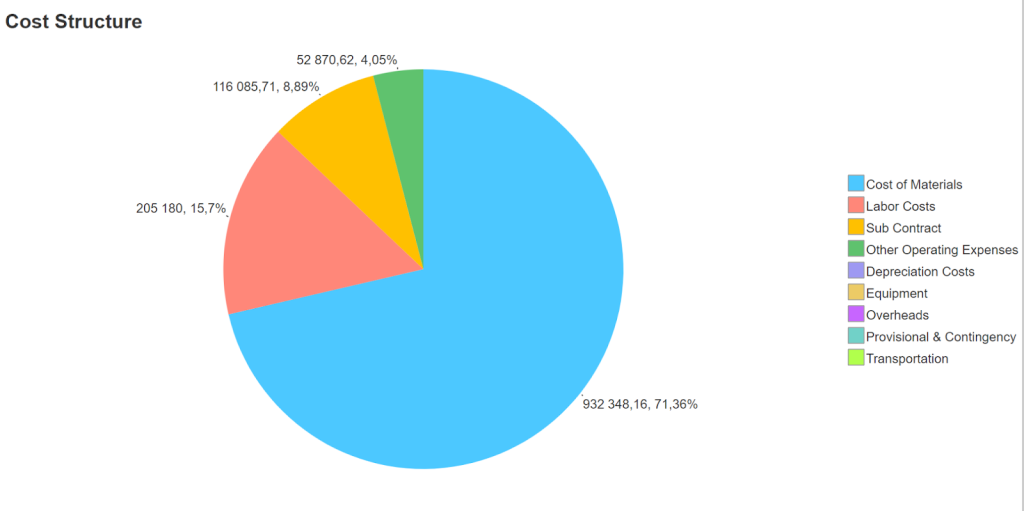
Cost structure data in FirstBit ERP
For UAE contractors, this makes ERP data central to practical AI use. When project, financial, procurement, and site information is connected, AI insights become more relevant for daily management and long-term profitability.
Conclusion
AI in construction management matters because profitability is often lost through small delays, weak visibility, and decisions made too late. For UAE contractors, the value of AI is in seeing these risks earlier and linking them to their financial impact.
Planning, site monitoring, resource allocation, and risk management become stronger when AI works with reliable project data. This helps teams understand how today’s changes can affect tomorrow’s schedule, cash flow, and margin.
The real shift across the construction industry is from managing projects by reports after the fact to managing them through connected, data-based insight. With a strong ERP data foundation, UAE contractors can use construction management AI to improve execution, protect profitability, and make project control more predictable.
Ensure timely and profitable project completion with FirstBit ERP
Request a demo
F.A.Q.
How does AI help improve profitability at the company level?
What ERP data is needed to make AI useful in construction management?
How does AI handle UAE-specific challenges like summer heat or payment delays?
How does this integrate with our FirstBit ERP system in Dubai?
Is AI in construction management suitable for mid-sized contractors in the UAE?
How quickly can a UAE contractor see results after implementing AI for construction management?

Anna Fischer
Construction Content Writer
Share this article
'%3e%3cg%20clip-path='url(%23clip1_6548_6055)'%3e%3cpath%20d='M13.974%2015.6195C14.2724%2016.0185%2014.6532%2016.3487%2015.0905%2016.5876C15.5278%2016.8265%2016.0114%2016.9686%2016.5084%2017.0042C17.0055%2017.0398%2017.5043%2016.9681%2017.9712%2016.7939C18.4381%2016.6198%2018.8621%2016.3472%2019.2143%2015.9948L21.2994%2013.9098C21.9324%2013.2544%2022.2827%2012.3766%2022.2747%2011.4654C22.2668%2010.5543%2021.9014%209.68269%2021.257%209.03839C20.6127%208.39408%2019.7412%208.02862%2018.83%208.0207C17.9189%208.01278%2017.0411%208.36305%2016.3857%208.99606L15.1902%2010.1845M16.754%2014.2295C16.4555%2013.8305%2016.0747%2013.5003%2015.6374%2013.2614C15.2002%2013.0225%2014.7166%2012.8804%2014.2196%2012.8448C13.7225%2012.8092%2013.2237%2012.8809%2012.7568%2013.0551C12.2899%2013.2292%2011.8659%2013.5018%2011.5136%2013.8542L9.42861%2015.9392C8.7956%2016.5946%208.44534%2017.4724%208.45326%2018.3836C8.46117%2019.2947%208.82664%2020.1663%209.47094%2020.8106C10.1152%2021.4549%2010.9868%2021.8204%2011.898%2021.8283C12.8091%2021.8362%2013.6869%2021.4859%2014.3423%2020.8529L15.5308%2019.6645'%20stroke='%235F7896'%20stroke-width='1.39002'%20stroke-linecap='round'%20stroke-linejoin='round'/%3e%3c/g%3e%3c/g%3e%3crect%20x='0.438953'%20y='0.438953'%20width='28.9709'%20height='28.9709'%20rx='14.4855'%20stroke='%235F7896'%20stroke-width='0.877907'/%3e%3cdefs%3e%3cclipPath%20id='clip0_6548_6055'%3e%3crect%20width='29.8488'%20height='29.8488'%20rx='14.9244'%20fill='white'/%3e%3c/clipPath%3e%3cclipPath%20id='clip1_6548_6055'%3e%3crect%20width='16.6802'%20height='16.6802'%20fill='white'%20transform='translate(7.02344%206.58435)'/%3e%3c/clipPath%3e%3c/defs%3e%3c/svg%3e)


Related articles


See all








See FirstBit ERP solutions in action
Discover how our system solves the unique challenges of contractors in a personalized demo.
After the demo you will get a quotation for your company.
After the demo you will get a quotation for your company.