





Digital document exchange is gradually becoming part of everyday business operations in the UAE. Companies can no longer simply send invoices to clients in whichever format is most convenient. Documents must be verifiable, transmitted securely, and processed with minimal manual effort.
If accounting processes are not prepared in advance, the transition to e-invoicing can result in delays, invoice errors, and additional workload for accounting teams.
In this article, we explain what Peppol is and how it helps companies, government organizations, and service providers exchange electronic business documents using a common standard.
What Is Peppol in Simple Terms
Peppol (Pan-European Public Procurement On-Line) is an international network for securely exchanging electronic invoices and other business documents. A company creates a document in its ERP or accounting system and sends it to the recipient through a certified provider.
The network uses Peppol IDs — unique electronic addresses that identify participants in the network. The system uses this ID to determine the recipient and route the document to the correct Access Point.
Why the Peppol Network Was Created: Goals and Objectives
Peppol was created to simplify e-procurement and the exchange of business documents between companies and government organizations. Originally developed in Europe, the network has since expanded to support cross-border document exchange and B2B transactions.
Peppol helps companies:
- Send electronic invoices internationally
- Use a unified document standard
- Connect with business partners through a single Access Point
- Participate in e-procurement processes
- Prepare for e-invoicing requirements
- Reduce manual data entry and processing
Together, these capabilities reflect Peppol’s core purpose: to provide a common standard, secure document delivery, and network-wide connectivity without the need to build separate integrations with each counterparty.
Without the right infrastructure in place, the transition to e-invoicing can become more complex and increase the risk of errors in invoice issuance.
Use an ERP compliant with UAE laws
Operate confidently in the UAE regulatory landscape
Request a demo
How Peppol Differs from Sending Invoices in the Usual Way
With traditional invoice exchange, invoices are often sent by email, uploaded to a customer portal, or shared as PDF files. The recipient then has to review the data and enter it into their accounting system manually.
With Peppol, invoices are exchanged as structured electronic documents. The recipient’s system can automatically read key details such as the invoice number, date, amount, tax information, party details, and line items.
The connection model is different as well. Instead of setting up a separate integration with each business partner, a company connects to a certified Access Point and uses it to exchange documents with other participants in the Peppol network.
In the standard Peppol model, four parties are involved:
- Sender
- Sender's access point
- Recipient's access point
- Recipient
Access points check documents, determine the route, and transmit the invoice to the addressee through a secure channel.
Advantages of the Peppol Network
Peppol makes electronic document exchange more manageable. Peppol offers several key benefits:
- Clear, structured data. Invoices are received not as files for review, but as structured data that can be processed directly in the accounting system.
- Reduced operational workload. Accounting teams no longer need to manually enter details from emails, scans, or PDFs. This shortens invoice processing time and reduces the risk of errors.
- A single connection to the network. A company connects through its provider and can then exchange documents with other Peppol participants without setting up a separate channel for each counterparty.
- Controlled document exchange. Documents are routed through certified Access Points, which validate the data, identify the recipient, and deliver the invoice through the required channel.
- Support for procurement workflows. Peppol is not limited to invoices. The network also supports the exchange of purchase orders, order confirmations, catalogues, and delivery documents.
Stay fully compliant with the latest UAE laws and regulations
Request a demo
How FirstBit ERP Supports E-Invoicing and Integration with Peppol
Companies use FirstBit ERP as an accounting system to generate data for electronic invoices, including information about customers, goods, services, taxes, sales, and purchases.
When working with Peppol, a company creates tax invoices in FirstBit ERP. It then transfers the invoice to an accredited ASP provider, which checks the document and sends it through the Peppol network.

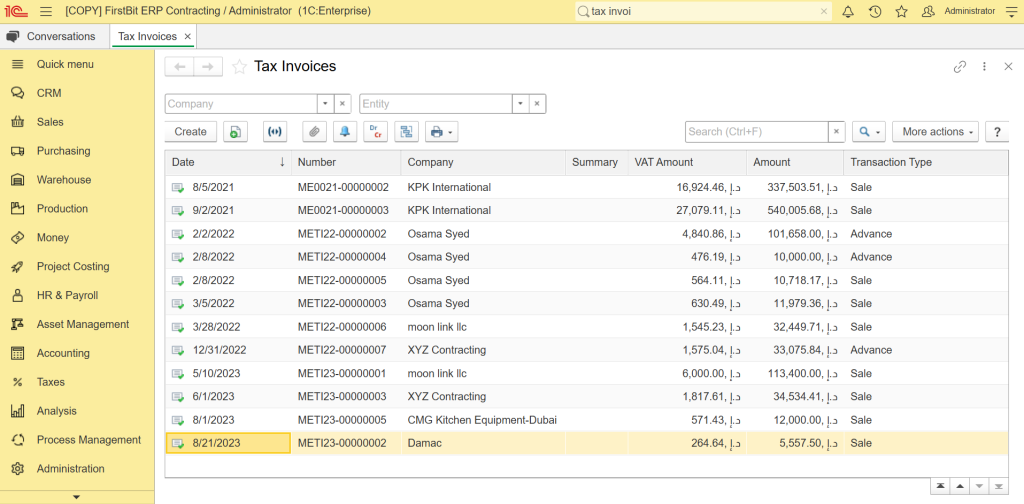
Tax Invoices in FirstBit ERP
FirstBit ERP does not act as an ASP provider. Instead, it prepares invoice data, generates tax invoices, records transactions, and integrates with e-invoicing providers.
This helps companies incorporate electronic invoicing into their broader accounting workflow and connect it with finance, tax, sales, and procurement processes.
Conclusion
For businesses in the UAE, Peppol is becoming an important part of the move toward electronic invoicing. It provides a clear exchange process: an invoice is created in the accounting system, sent through a provider, and delivered to the recipient in a structured format that can be processed automatically.
Preparation for e-invoicing starts within the ERP system. Incorrect company details, tax data, addresses, or invoice structures can affect the entire exchange process. The sooner a business reviews and standardizes this data, the smoother the transition to the new requirements will be, with fewer disruptions to day-to-day operations.
ERP tailored to UAE legislation
Navigate UAE construction laws effortlessly
Request a demo

Anna Fischer
Construction Content Writer
Share this term
'%3e%3cg%20clip-path='url(%23clip1_6548_6055)'%3e%3cpath%20d='M13.974%2015.6195C14.2724%2016.0185%2014.6532%2016.3487%2015.0905%2016.5876C15.5278%2016.8265%2016.0114%2016.9686%2016.5084%2017.0042C17.0055%2017.0398%2017.5043%2016.9681%2017.9712%2016.7939C18.4381%2016.6198%2018.8621%2016.3472%2019.2143%2015.9948L21.2994%2013.9098C21.9324%2013.2544%2022.2827%2012.3766%2022.2747%2011.4654C22.2668%2010.5543%2021.9014%209.68269%2021.257%209.03839C20.6127%208.39408%2019.7412%208.02862%2018.83%208.0207C17.9189%208.01278%2017.0411%208.36305%2016.3857%208.99606L15.1902%2010.1845M16.754%2014.2295C16.4555%2013.8305%2016.0747%2013.5003%2015.6374%2013.2614C15.2002%2013.0225%2014.7166%2012.8804%2014.2196%2012.8448C13.7225%2012.8092%2013.2237%2012.8809%2012.7568%2013.0551C12.2899%2013.2292%2011.8659%2013.5018%2011.5136%2013.8542L9.42861%2015.9392C8.7956%2016.5946%208.44534%2017.4724%208.45326%2018.3836C8.46117%2019.2947%208.82664%2020.1663%209.47094%2020.8106C10.1152%2021.4549%2010.9868%2021.8204%2011.898%2021.8283C12.8091%2021.8362%2013.6869%2021.4859%2014.3423%2020.8529L15.5308%2019.6645'%20stroke='%235F7896'%20stroke-width='1.39002'%20stroke-linecap='round'%20stroke-linejoin='round'/%3e%3c/g%3e%3c/g%3e%3crect%20x='0.438953'%20y='0.438953'%20width='28.9709'%20height='28.9709'%20rx='14.4855'%20stroke='%235F7896'%20stroke-width='0.877907'/%3e%3cdefs%3e%3cclipPath%20id='clip0_6548_6055'%3e%3crect%20width='29.8488'%20height='29.8488'%20rx='14.9244'%20fill='white'/%3e%3c/clipPath%3e%3cclipPath%20id='clip1_6548_6055'%3e%3crect%20width='16.6802'%20height='16.6802'%20fill='white'%20transform='translate(7.02344%206.58435)'/%3e%3c/clipPath%3e%3c/defs%3e%3c/svg%3e)


Related articles


See all








See FirstBit ERP solutions in action
Discover how our system solves the unique challenges of contractors in a personalized demo.
After the demo you will get a quotation for your company.
After the demo you will get a quotation for your company.